
Welcome to Global Data Center Hub. Join investors, operators, and innovators reading to stay ahead of the latest trends in the data center sector in developed and emerging markets globally.
TL;DR
Data centers, the buildings where AI tools such as ChatGPT run, will require up to $3 trillion of investment by 2030, according to the real estate firm JLL. Morgan Stanley estimates that the technology giants can fund roughly $1.4 trillion of the bill from their own cash through 2028, leaving a gap of about $1.5 trillion for outside money to fill.
Four kinds of money are building the AI boom: stock market investment, private buyout firms, loans secured against buildings and even chips, and direct investment by pension and sovereign wealth funds. Blackstone’s purchase of the Australian data center operator AirTrunk for more than A$24 billion and the cloud company CoreWeave’s borrowing against its NVIDIA chips show the second and third kinds at work.
Many ordinary savers already own a piece of the AI buildout without choosing to. Index funds and public pension plans hold shares of Microsoft, NVIDIA, and data center landlords, and retirement funds such as Canada’s CPP Investments own data centers directly through joint ventures with operators like Equinix.
Every question you type into ChatGPT gets answered inside a building.
The building is real. It has a loading dock, and an electric bill closer to a small city’s than to an office’s.
Someone paid to put it there, and someone is paying for the thousands more now under construction.
The money behind those buildings comes from four sources that behave nothing alike.
The distinction is not academic.
The real estate firm JLL projected in its January 2026 outlook that the world will add nearly 100 gigawatts of data center capacity between 2026 and 2030, requiring up to $3 trillion of investment.
Morgan Stanley, in a July 2025 report, sized the bill through 2028 at roughly $2.9 trillion and estimated that the technology giants can cover about $1.4 trillion of it from their own cash, leaving a $1.5 trillion gap for everyone else to fill.
Even Microsoft, Google, Amazon, and Meta together can’t write a check that large.
Once you can tell the four kinds of money apart, the headlines about the AI boom become a map of who owns the physical layer under the AI you use every day.
1. The crowd’s money
Start with the money most people touch without noticing.
When savers buy shares of Microsoft, of NVIDIA, the company whose chips the AI boom runs on, or of Digital Realty, a landlord whose entire business is owning data centers and renting them out, they are pooling small amounts of money into the companies doing the building.
No single shareholder funds a specific site.
The crowd funds the company, and the company pours the money into concrete and chips.
The sums are hard to hold. Meta told investors in April 2026 that it expects to spend between $125 billion and $145 billion this year, most of it on AI infrastructure.
At the low end of that range, the company is spending more than $340 million every single day.
If you own an index fund through a retirement account, you never opted into the AI buildout, but you’re already in it. Part of your savings is the crowd’s money doing this work.
2. The building buyers
The second kind of money never touches a stock exchange.
Private equity firms pool money from large investors to buy whole companies, hold them for years, and sell them later.
A newcomer would reasonably assume the biggest data center deals involve the names everyone knows.
The largest one on record involved a company most people have never heard of.
In September 2024, the New York investment firm Blackstone, together with CPP Investments, the fund that manages the national retirement savings of Canadian workers, agreed to buy AirTrunk, an Australian data center operator, in a deal valuing the company at more than A$24 billion, roughly US$16 billion.
The purchase closed that December as one of the largest data center transactions ever completed. AirTrunk sells nothing to consumers.
It builds the buildings and rents them out at enormous scale to companies such as Microsoft and Amazon.
That’s the quiet rule of this kind of money: the logo on the app is often only the tenant.
If you assumed the company whose name is on your screen also owns the building your data sits in, this is the correction, because much of the internet’s real estate belongs to owners whose names you’ve never seen.
3. The mortgage on the internet
The third kind of money is borrowed.
Data centers carry loans the way houses carry mortgages. The building, the long customer contracts inside it, and the rent they produce stand behind the loan as collateral, the property a lender can take if the loan is not repaid.
Morgan Stanley’s July 2025 report estimated that this kind of direct lending to data centers could reach $800 billion.
Then AI produced a stranger version. In 2023, CoreWeave, a company that buys NVIDIA chips and rents out their computing power, borrowed $2.3 billion by pledging the chips themselves as collateral, Reuters reported at the time.
By 2026 the practice had matured enough that CoreWeave closed an $8.5 billion loan package it described as the first chip-backed financing to earn an investment-grade rating, the credit score that marks a loan as relatively safe.
Sit with that for a moment.
A computer chip loses value quickly as newer models arrive, the way a new car loses value the moment it leaves the lot.
Lenders are betting that the rent those chips earn comes in faster than the chips age.
If lenders ever stop believing that, the buildout slows, and this is the part most people miss: the pace of the AI boom depends on lender confidence as much as on how many people use AI.
4. The savings of whole nations
The fourth kind of money skips the funds and the stock market and shows up at the negotiating table itself.
Sovereign wealth funds, the investment accounts nations use to grow their public savings, and the world’s largest pension funds now build data centers directly, side by side with the operators.
In October 2024, Equinix, one of the world’s biggest data center operators, formed a joint venture worth more than $15 billion with GIC, the fund that invests Singapore’s national reserves, and CPP Investments, the Canadian retirement fund again.
The two funds together own three quarters of the venture, which is adding more than 1.5 gigawatts of capacity in the United States, more electricity than a million homes draw.
Weeks earlier, BlackRock, the world’s largest money manager, had launched a partnership with Microsoft and MGX, an Abu Dhabi investment firm created to fund AI, targeting $30 billion for data centers and the power plants behind them.
By January 2026 it had raised more than $12.5 billion, and NVIDIA had joined as a partner.
AI reads as a California story. Follow the ownership and the map widens to Singapore and Abu Dhabi, and to the retirement savings of millions of Canadian workers, because their funds now hold the ground the internet sits on.
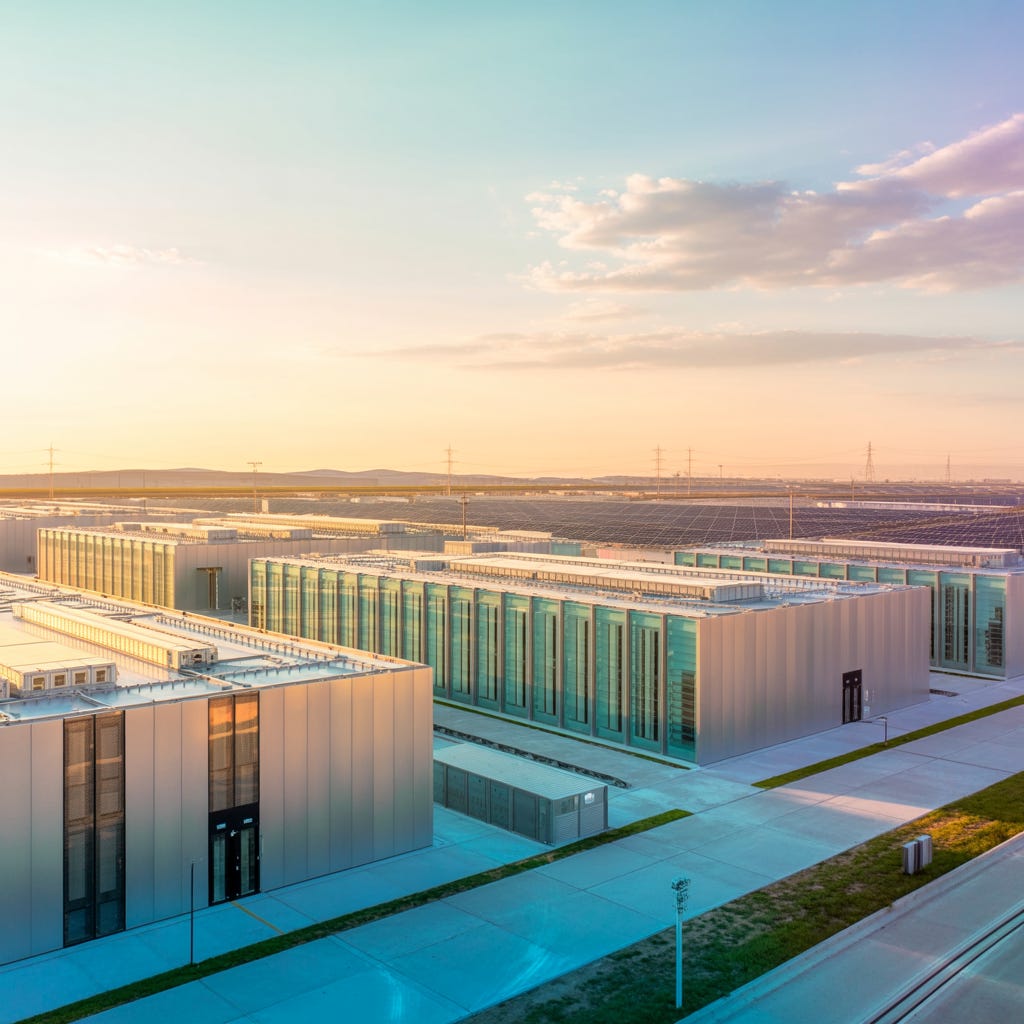
What Abilene, Texas traded for its giant AI campus
All four kinds of money eventually land in a real town.
In Abilene, Texas, a campus known as the Stargate site began as a $3.4 billion joint venture announced in October 2024, built around a 206-megawatt facility designed to run as many as 100,000 AI chips.
Public reporting now puts the campus at 1.2 gigawatts across eight buildings, close to the electricity draw of a million American homes, with OpenAI, the maker of ChatGPT, running its workloads there on hardware owned by Oracle.
Abilene’s side of the bargain has a documented cost. The city granted an 85 percent property tax break to land the project, and Business Insider reported in July 2025 that Oracle disputed the county’s valuation of the site to lower its bill further.
New York moved the other way: on July 14, 2026, the governor signed a one-year pause on new data centers of 50 megawatts or more, roughly the electricity draw of 40,000 homes, while the state studies their effect on electricity prices and the grid.
The same money that makes these projects possible is now meeting towns and states deciding what the projects are worth to them.
The foundation under the feed
None of this is visible from your phone. The answer arrives in a second, and the screen never shows the loading dock or the loan documents behind it.
These buildings are the physical foundation of the digital life you already live, and the four kinds of money are simply the world deciding, in four different ways, that the foundation is worth paying for.
The next time a headline announces a pension fund buying a data center company, or a state pausing construction, you’ll be reading the same story this piece just told: the financing of the physical world underneath your digital one.
A question for you: if part of your retirement savings is helping to build AI data centers, and it probably is, how do you feel about that?
Great map of the capital stack. Even with $3T in committed capital, the physical layer is gating deployment.
Morgan Stanley's $1.5T "gap for outside money" is assuming the projects can get built. But 30–50% of 2026 US datacenter capacity is already delayed or canceled. Its not because of funding, but because of transformer lead times (128 weeks, up from 12–18 months pre-2020) and grid interconnection queues (2,000+ GW waiting, 4–7 years in core markets).
The Blackstone/CPP AirTrunk deal and the Equinix/GIC joint ventures are bets that the power and equipment supply chains can scale faster than the capital.
The financing is there. The electrons are not. Which constraint breaks first between capital deployment or physical buildout?