

Welcome to Global Data Center Hub. Join investors, operators, and innovators reading to stay ahead of the latest trends in the data center sector in developed and emerging markets globally.
This article is the 18th article in the series: Ground to Grid: A Free 21-Lesson Guide to Mastering Data Center Development
Why Handover Is Where Development Becomes Operation
A commissioned facility earns nothing until a tenant is live inside it. Handover is the moment development ends and the operating business begins. A clean handover is what makes the asset start performing.
Handover sits at the end of the development lifecycle. Before it, a project team builds and tests the facility. After it, an operations team runs that facility for the life of the lease. Handover is the bridge between the two.
The bridge carries real money. At the end of 2025, Digital Realty reported $817 million of annualized GAAP base rent (yearly rent under standard accounting rules) from leases signed but not yet commenced, at its share.
So, onboarding a tenant is an operational discipline. The lease milestone is only one part of it.
The tenant has to install equipment safely, receive a working service, and start paying on a date both sides can prove.
The quality of that work also shapes the tenant relationship for the life of the lease.
The Steps of Onboarding and Handover
Handover runs in four steps. They overlap, but each has its own owner.
1. Tenant Fit-Out and Deployment
The tenant installs and commissions its own equipment. That means racks, network gear and, in AI halls, liquid cooling connections.
The operator and the tenant have to coordinate closely to bring that load online safely. Every person, vendor and shipment is approved before arrival.
NIST SP 800-53 Rev. 5 sets out the access controls: authorize access, issue and remove credentials, log entry, escort visitors.
All work inside a live facility runs under an approved method of procedure (a written, step-by-step work plan), a change ticket and a back-out plan.
Network service is often the critical path. A cross-connect is complete when optical levels, continuity and speed are recorded and the customer or carrier accepts it.
AI tenants raise the bar. Uptime Institute notes that direct liquid cooling physically links IT and facility systems. Coolant distribution units need factory witness tests and load simulation. Practice is still maturing, so the test scripts belong in the contract.
2. Service-Level Activation
At this step the SLA (service level agreement: the promised performance and the remedy for missing it) moves from a contract to a live operating commitment.
An SLA works only when someone can measure it at an agreed point.
Verizon’s public U.S. colocation SLA defines power unavailability at the customer cabinet. It ties verified downtime to service credits.
So monitoring, reporting and response processes go into effect here. Each SLA line needs a named object, a handoff point, a metric, a data source, start and stop rules, exclusions and a remedy.
3. Documentation and Turnover
The operating team needs a full record of what it is about to run. That includes as-built drawings, commissioning records, operating procedures, equipment manuals, warranties, maintenance plans and training records.
ASHRAE/IES Standard 202-2024, the current published minimum commissioning standard for new buildings and systems, sets a consistent approach to documentation and training. ASHRAE’s guideline written for data centers, Guideline 1.6, is still only a proposal.
The site operations leader should formally accept these materials. When operations inherits them by default, nobody has checked that they are complete.
4. Operational Handover
The last step moves accountability from the development and construction team to the operations team. From this point, long-term management owns the facility, the tenant and the SLA.
The cleanest way to mark that point is a signed commencement record. It states the effective date, the services, the committed capacity, any accepted open items, the SLA start, the billing start and the opening meter readings.
A short stabilization period follows, with closer monitoring and a final reconciliation of alarms, access lists, circuits, meters and invoices. Then the service moves to normal review.
Why Handover Quality Matters
A poorly documented handover leaves the operations team blind to the facility it runs.
The team cannot maintain equipment it does not know about or follow a control sequence nobody gave it.
The cost of that blindness shows up in outages. In Uptime Institute’s 2026 outage analysis, 57% of respondents to its 2025 survey said their most recent major outage cost more than $100,000. One in five said their most recent impactful outage cost more than $1 million.
Uptime counts human error as a contributing factor in nine out of ten outages.
Uptime also cautions that outage data has limits. Those figures cover all outages, but procedures, training and configuration are set up at handover.
A rushed tenant onboarding spoils the first impression, and that impression sets the relationship.
The SLA becomes real at handover. The operator has to meet it from day one, including on the days the team is still learning the site.
Gaps between development and operations then surface as early operating failures.
What Separates a Clean Handover
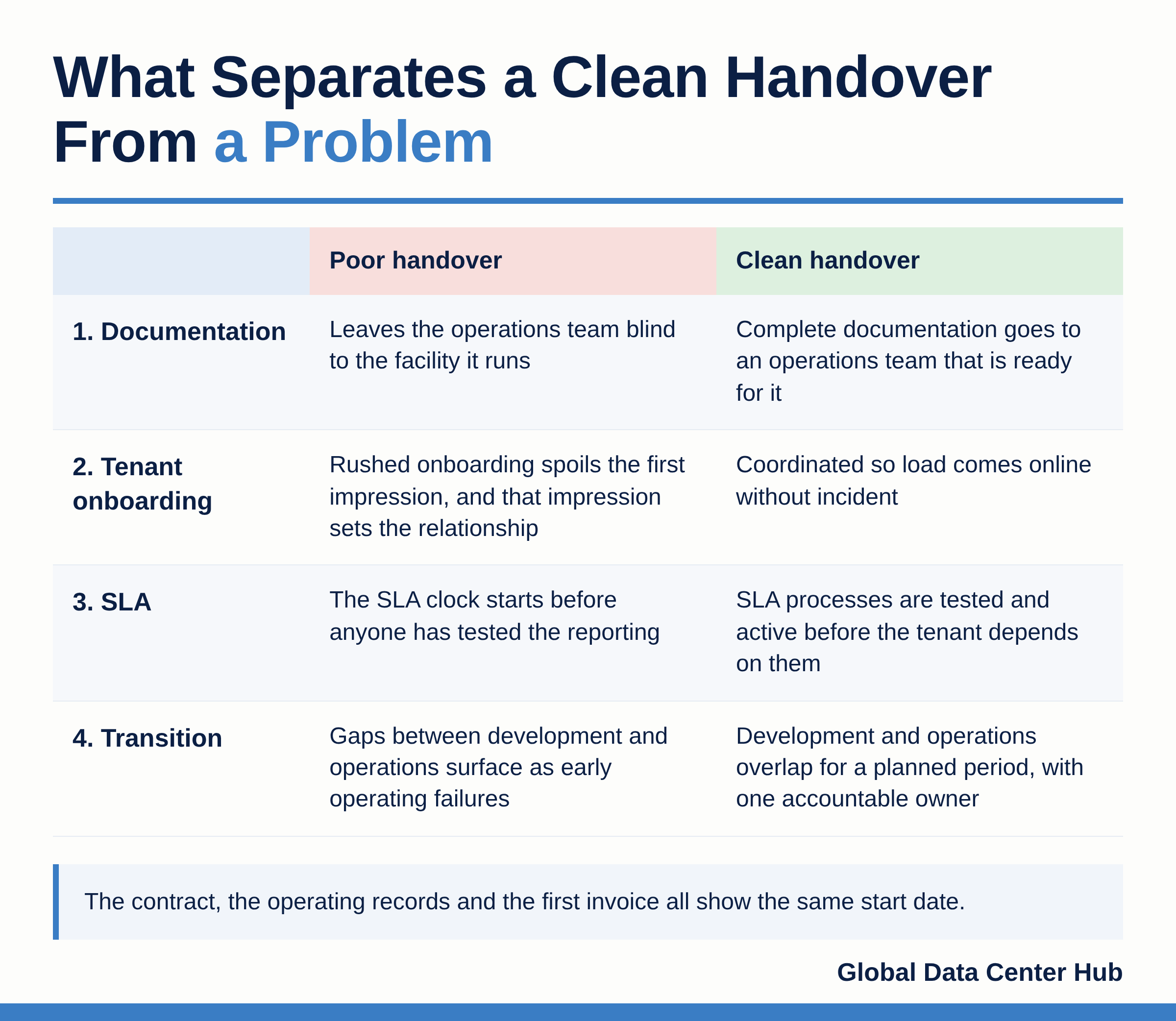
The strongest handovers share four features.
First, complete documentation goes to an operations team that is ready for it.
The team was staffed and trained before the tenant arrived, and it signed for what it received.
Second, tenant onboarding is coordinated so load comes online without incident.
Work runs under approved procedures, and capacity is reserved in the company’s systems of record before the tenant’s equipment ships.
Third, SLA processes are tested and active before the tenant depends on them.
Strong operators raise a test alarm, confirm the customer is notified, calculate a sample credit and produce a sample monthly report.
Fourth, the transition is deliberate. Development and operations overlap for a planned period, with one accountable owner from contract signature to stabilization.
The contract, the operating records and the first invoice all show the same start date.
A Real-World Example: How Digital Realty Reports the Wait
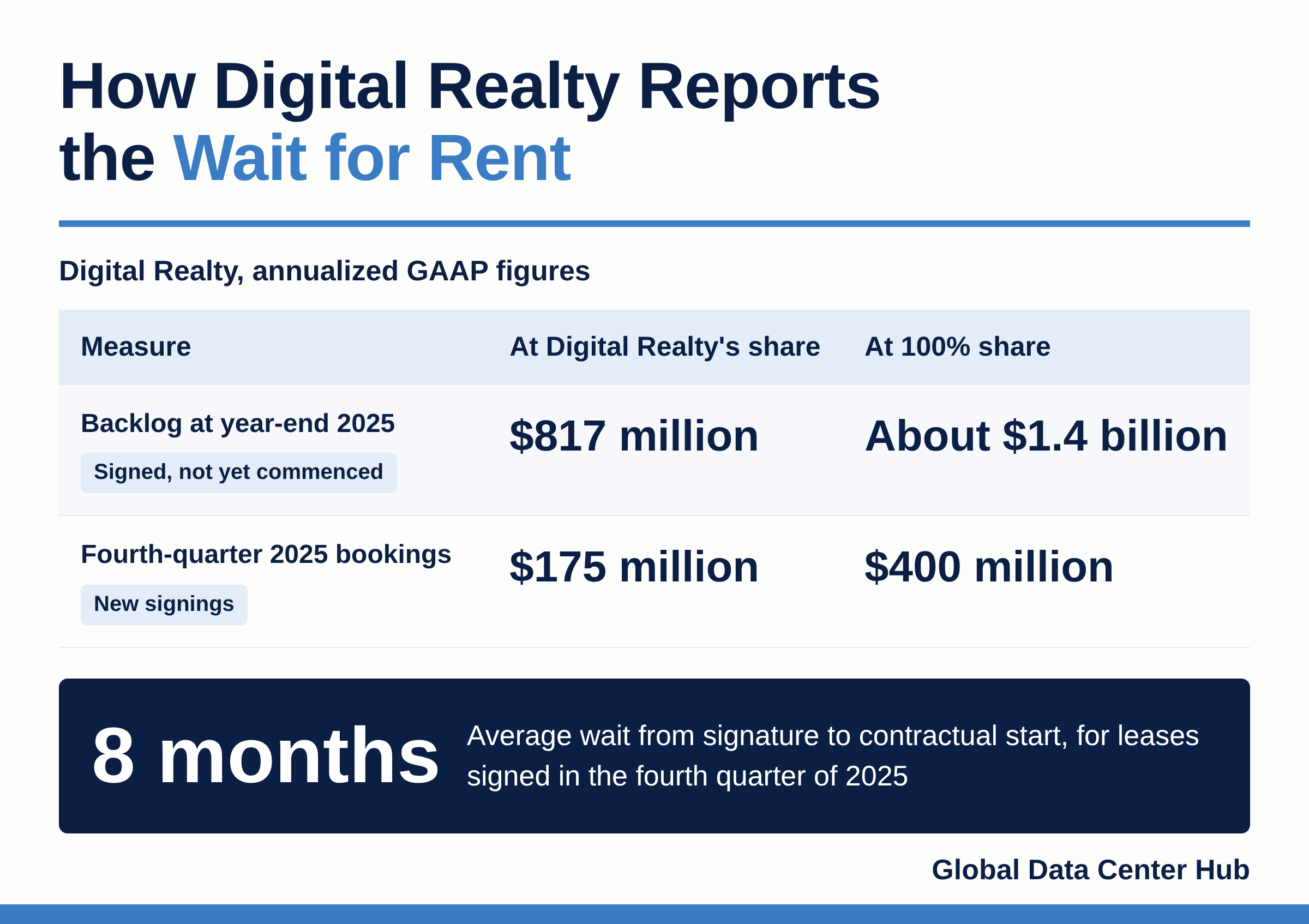
Digital Realty shows what this interval looks like in public numbers. It defines backlog as annualized GAAP base rent from signed leases not yet commenced.
At year-end 2025, backlog stood at $817 million at Digital Realty’s share. Its investor materials put total backlog at about $1.4 billion at 100% share.
In the fourth quarter of 2025, Digital Realty booked $400 million of annualized GAAP rental revenue at 100% share, or $175 million at its own share. For those fourth-quarter leases, the average wait from signature to contractual start was eight months.
That lag reflects normal delivery schedules in a growing business. Each of those leases still has to pass through the four steps above before its rent begins.

Strategic Implications
For developers: Your reputation is set at handover. A clean transition is what earns the next deployment from the same tenant.
Plan the documentation package and the operations team’s training from the first design review.
For investors: Handover quality predicts the early operating performance your returns depend on.
Ask what share of signed rent has not commenced, how the company defines “commenced,” and who signs for the handover on the operations side.
For operators: Everything you inherit at handover defines your starting position. That includes the documentation, the SLA commitments and the tenant relationship.
Refuse to start the SLA clock until you have tested the reporting.
For policymakers: Reliable operation from day one is what makes the sector a stable part of the digital economy you are trying to build.
EU Delegated Regulation 2024/1364 applies to data centers with at least 500 kW of installed IT power and lets colocation operators gather required data from customers.
Give operators time to write such duties into tenant contracts.
Key Takeaway
Development ends and the business begin at handover. Everything before that day is cost. From that day on, the asset has to earn.
The tenant does not experience the years of development. It experiences the day it goes live: whether its racks went in safely and whether the first alarm reached the right person. A clean handover makes that day the start of a working relationship.
That day also sets the numbers. Rent starts on the commencement date, and the SLA clock starts with it. Every week of slip moves both further out. Digital Realty’s eight-month lag shows how much rides on that interval.
So, treat handover as the first day of operation. Staff the operations team before the tenant arrives.
Test the SLA before anyone depends on it. If you leave handover to the end, the first months of the lease become a repair job.
In your experience, what is the handover detail most often overlooked, and how does that oversight show up in the first months of operation?