
Welcome to Global Data Center Hub. Join investors, operators, and innovators reading to stay ahead of the latest trends in the data center sector in developed and emerging markets globally.
SoftBank Group, Grab and PETROS want to build AI computing capacity on both sides of Malaysia.
On November 9, they announced joint development agreements tied to US$1.85 billions of proposed initial seed capital.
The combined release sets a long-term target of five gigawatts or more of AI compute capacity across Sarawak and Peninsular Malaysia.
The structure pairs three different strengths. SoftBank Group brings its technology and capital relationships. Grab brings regional customer reach and applied AI.
PETROS, Sarawak’s state-owned energy company, brings local energy and infrastructure development.
If the pieces fit, AI infrastructure in Malaysia could spread beyond its current hubs to a state that leads with energy.
The money is the part to read carefully. The $1.85 billion is seed capital, released in stages against milestones.
The public documents give no full-build budget, no debt package and no timeline to five gigawatts.
So, the useful question is what has to be signed before each stage of money moves.
What Was Signed, and What Still Needs Final Agreements
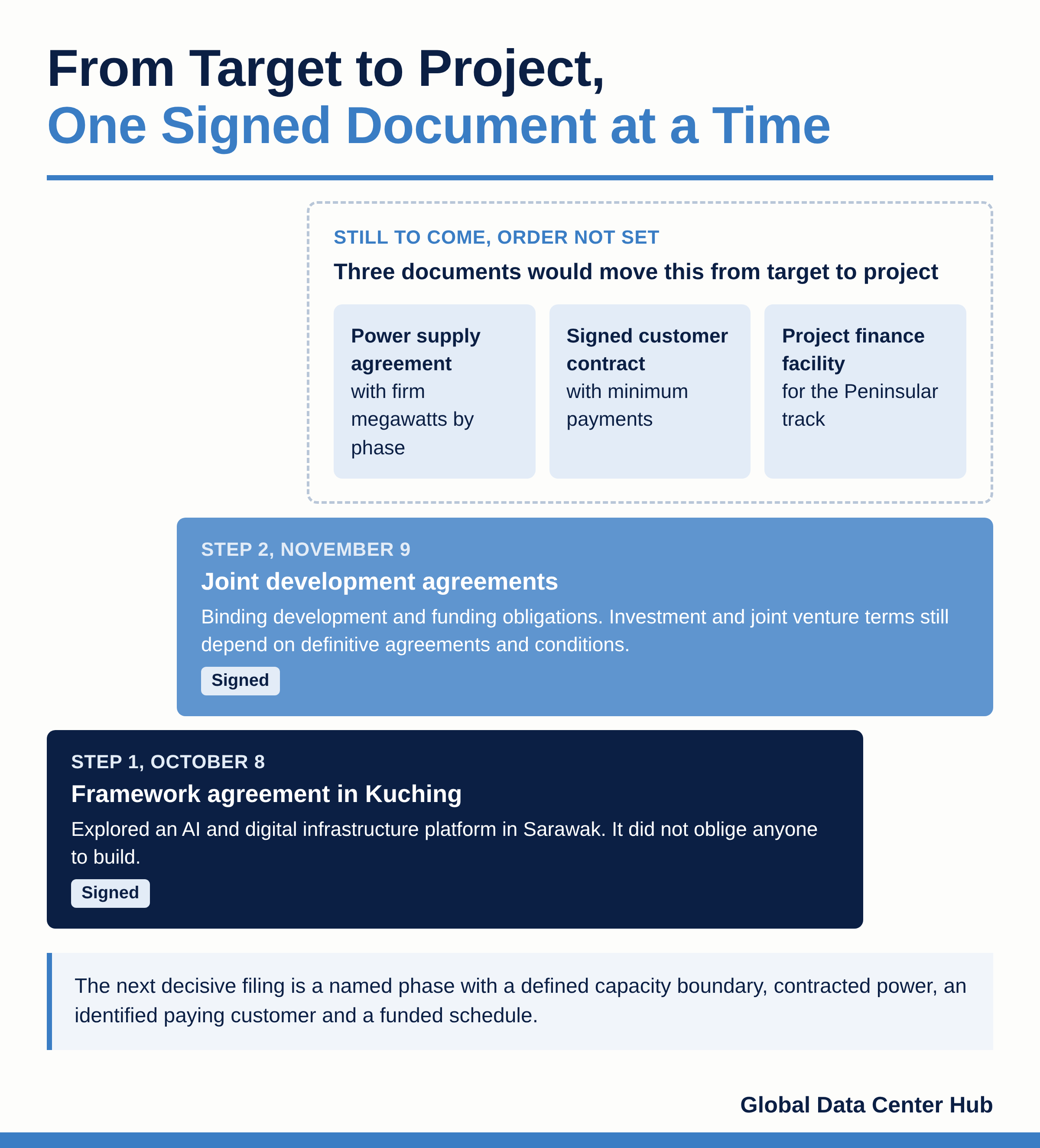
The partnership moved fast. On October 8, the three parties signed a framework agreement in Kuching to explore an AI and digital infrastructure platform in Sarawak.
That framework did not oblige anyone to build.
The November agreements go further. Grab’s Form 6-K says they contain binding development and funding obligations.
The same filing says investment and joint venture terms still depend on definitive agreements and conditions. Hughes Hubbard confirmed it advised Grab on the signing.
I would describe the stage as joint development with conditional investment. That is my reading, not a company term.
It is more than a memorandum. It is less than financial close or a final investment decision.
Two Projects, Two Leads
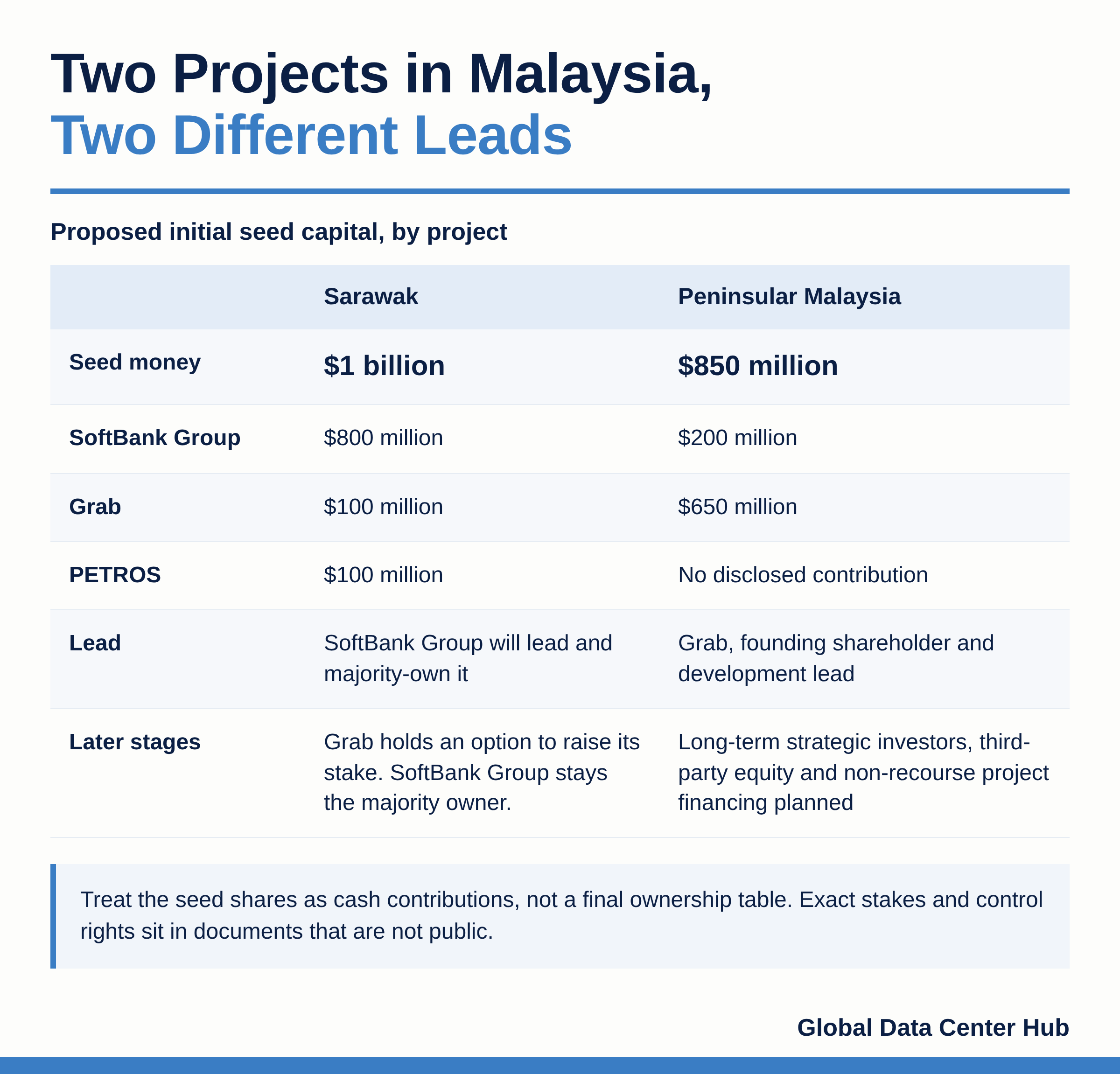
There are two projects here, each with its own lead.
The Sarawak project gets $1 billion. SoftBank Group puts in $800 million, Grab $100 million and PETROS $100 million, according to the Sarawak release. SoftBank Group will lead and majority-own it.
Grab holds an option to raise its stake, with SoftBank Group staying the majority owner. The option’s price, size and deadline are not disclosed.
The Peninsular Malaysia project gets $850 million. Grab puts in $650 million and SoftBank Group $200 million. PETROS has no disclosed contribution there. Grab is the founding shareholder and development lead.
The partners plan to bring in long-term strategic investors as the project grows, and to fund later stages with third-party equity and non-recourse project financing at project level. No loan facility has been announced.
Across both, SoftBank Group’s seed share is $1 billion, Grab’s is $750 million and PETROS’ is $100 million. Treat those as cash contributions, not a final ownership table. Exact stakes and control rights sit in documents that are not public.
The split tells you what each project is built around. Sarawak leads with energy. It has a state energy company at the table and a larger share of SoftBank Group capital.
The Peninsular project leads with commercial reach. Grab carries most of the seed money, and the plan points to project finance as it grows.
Two tracks give the programme two ways to find customers and two ways to raise money. That is my reading of the structure, not a stated strategy.
Grab chief executive Anthony Tan is expected to oversee both projects and appoint dedicated management teams, with approval from Grab’s board.
SoftBank Group also agreed in principle to a five-year lock-up on Grab shares held by an entity in its group, subject to agreed terms and customary exceptions.
Five Gigawatts Is a Target Without a Boundary Yet
The capacity figure needs care. The combined release says five gigawatts or more across Sarawak and Peninsular Malaysia.
The Sarawak release says five gigawatts in Sarawak. Read together, they describe overlapping ambitions. Do not add them into ten.
Neither release says whether the figure means server load or total facility power. Neither names a campus address, a land parcel, a first phase size, a construction start or a date to reach the target.
Kuching is where the framework was signed. It is not a disclosed site.
So, you should log five gigawatts as a development ambition. Keep it out of any tally of capacity under construction or contracted until a phase is named and sized.
Sarawak Brings Energy Plans. The Supply Contract Comes Next.
PETROS is Petroleum Sarawak Berhad. It is a different company from PETRONAS, the national oil company.
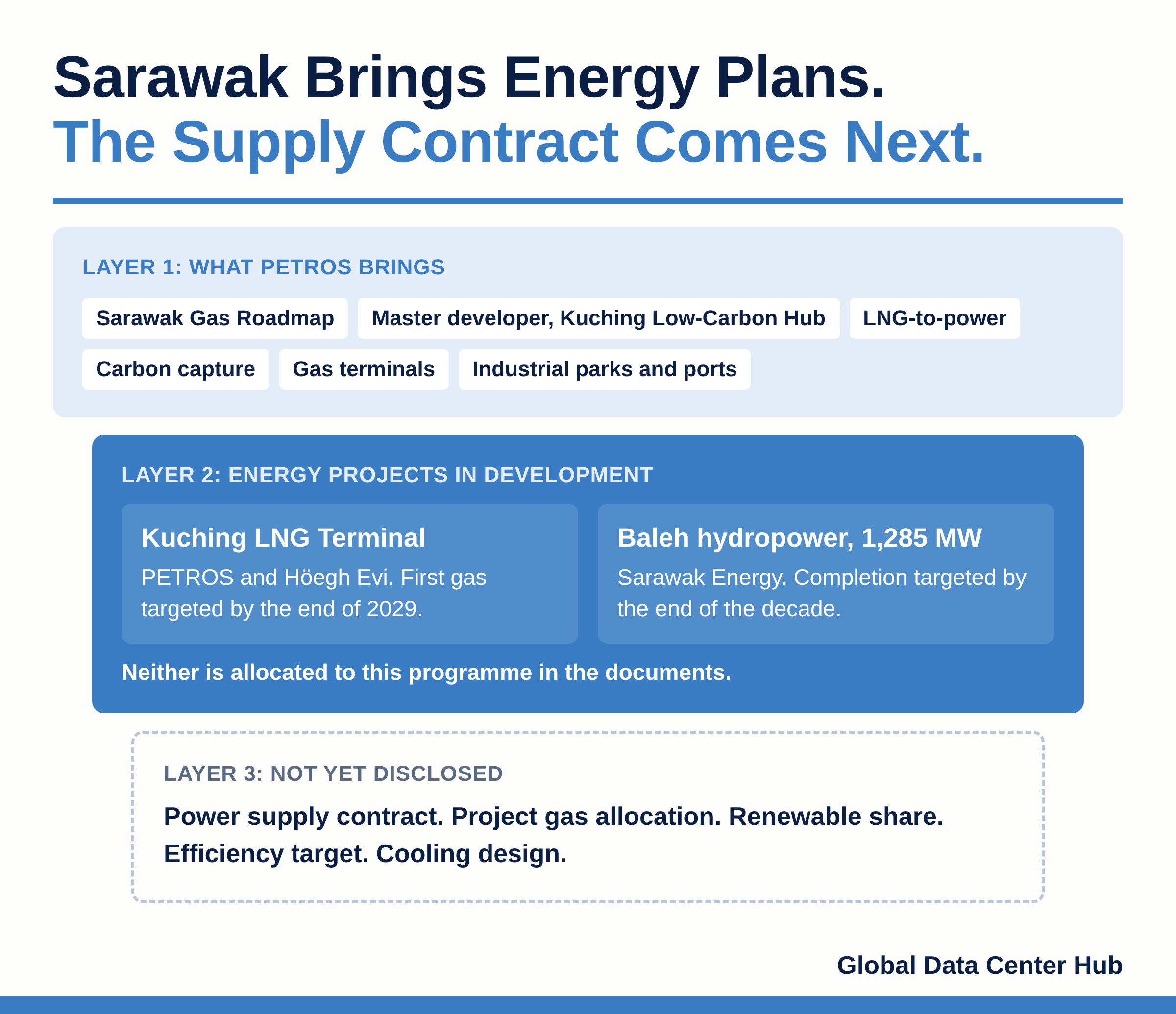
Its project announcement lists what it brings: the Sarawak Gas Roadmap, its role as master developer of the Kuching Low-Carbon Hub, and work spanning LNG-to-power, carbon capture, gas terminals, industrial parks and ports.
Two Sarawak energy projects show the direction. PETROS and Höegh Evi are developing the Kuching LNG Terminal, targeting first gas by the end of 2029.
Sarawak Energy describes the 1,285 MW Baleh hydropower project as serving rising industrial demand, with completion targeted by the end of the decade. Neither is allocated to this programme in the documents.
No power supply contract or project gas allocation has been disclosed. The combined release says the facilities will follow Malaysia’s renewable energy use guidelines and use designs that reduce water use and reliance on local grids. It gives no renewable share, efficiency target or cooling design.
Gas supply in Sarawak also carries a jurisdiction question. In January, PETRONAS said it had sought Federal Court clarity on the regulatory framework for its Sarawak operations, and that business would continue as usual.
In November, The Edge reported the Sarawak premier’s expectation of a settlement by year-end.
Malay Mail reported that litigation continues. Nothing here suggests the AI project is affected. It does mean any gas-linked power contract should state clearly who has authority to deliver.
The companies name these risks themselves. The filed announcement lists suitable connectivity, land, reliable and competitively priced power, and contracted demand.

Regional Demand Is Forecast in Tokens
The Malaysia release cites the e-Conomy SEA 2026 report for regional demand. The report’s forecast is in tokens, a measure of AI usage. Its base case is 10 to 15 times growth by 2030.
Its upside case is 50 to 60 times. Separately, it discusses roughly threefold growth in regional data center capacity over five years. All three are the report’s estimates.
That is a strong market backdrop. Contracts are the next test. Neither release names an anchor tenant or contracted megawatts. The partners say they will seek hyperscaler customers and more investors.
The revenue model is open too. Leasing space to a hyperscaler, renting GPUs by the hour and running AI services for enterprises put utilisation and hardware risk in different hands. The announcements do not say which model each project will use.
The Money Moves at the Pace of Contracts
This is where the deal’s design matters most. Grab’s filing says capital is deployed against development milestones, customer contract milestones and closing conditions. The thresholds are not public.
I read that design as a direct response to the Bankability Gap, the distance between announced capacity and capacity that has secured power, a site, permits, equipment, paying customers and financing. The partners do not fund five gigawatts up front.
They fund the steps that move capacity from announced to buildable, and more money follows each step.
Staging limits early spending, as long as the milestones are objective and backed by signed contracts.
For the Peninsular project, the next layer of money is planned as outside equity and non-recourse loans. Lenders on that basis are repaid from the project’s own contracts.
So, the customer and power agreements will decide how much debt each phase can carry.
What to Watch
If you invest, track this as a development programme with $1.85 billions of staged seed capital. The next decisive filing is a named phase with a defined capacity boundary, contracted power, an identified paying customer and a funded schedule.
The money at this stage is development capital. It pays for the work that turns a target into a project: land, design, permits, power talks and customer talks. Returns on it depend on how many of those steps convert.
The steady, contracted cash flows that infrastructure investors usually look for come later, once a phase is built, accepted by a customer and paid for.
If you operate or supply, watch for package awards. MIDA has named engineering, electrical systems, cooling and telecommunications as areas it wants local suppliers to grow into.
If you set policy, the useful question is how Sarawak allocates firm power and gas to new computing load, and on what terms.
Three documents would move this from target to project. A power supply agreement with firm megawatts by phase. A signed customer contract with minimum payments.
A project finance facility for the Peninsular track. Which one arrives first?
The milestone structure reads clearly. The open question is the power side in Sarawak: around 1 GW of new load is a big step on a system that peaks near 3 GW, so is the plan to draw on existing hydro from Bakun or to add gas capacity through PETROS? Whoever carries the transmission upgrade usually sets the real schedule.