
Welcome to Global Data Center Hub. Join investors, operators, and innovators reading to stay ahead of the latest trends in the data center sector in developed and emerging markets globally.
Edition No. 77
THE WEEK’S THESIS: THE CONTRACT COMES FIRST
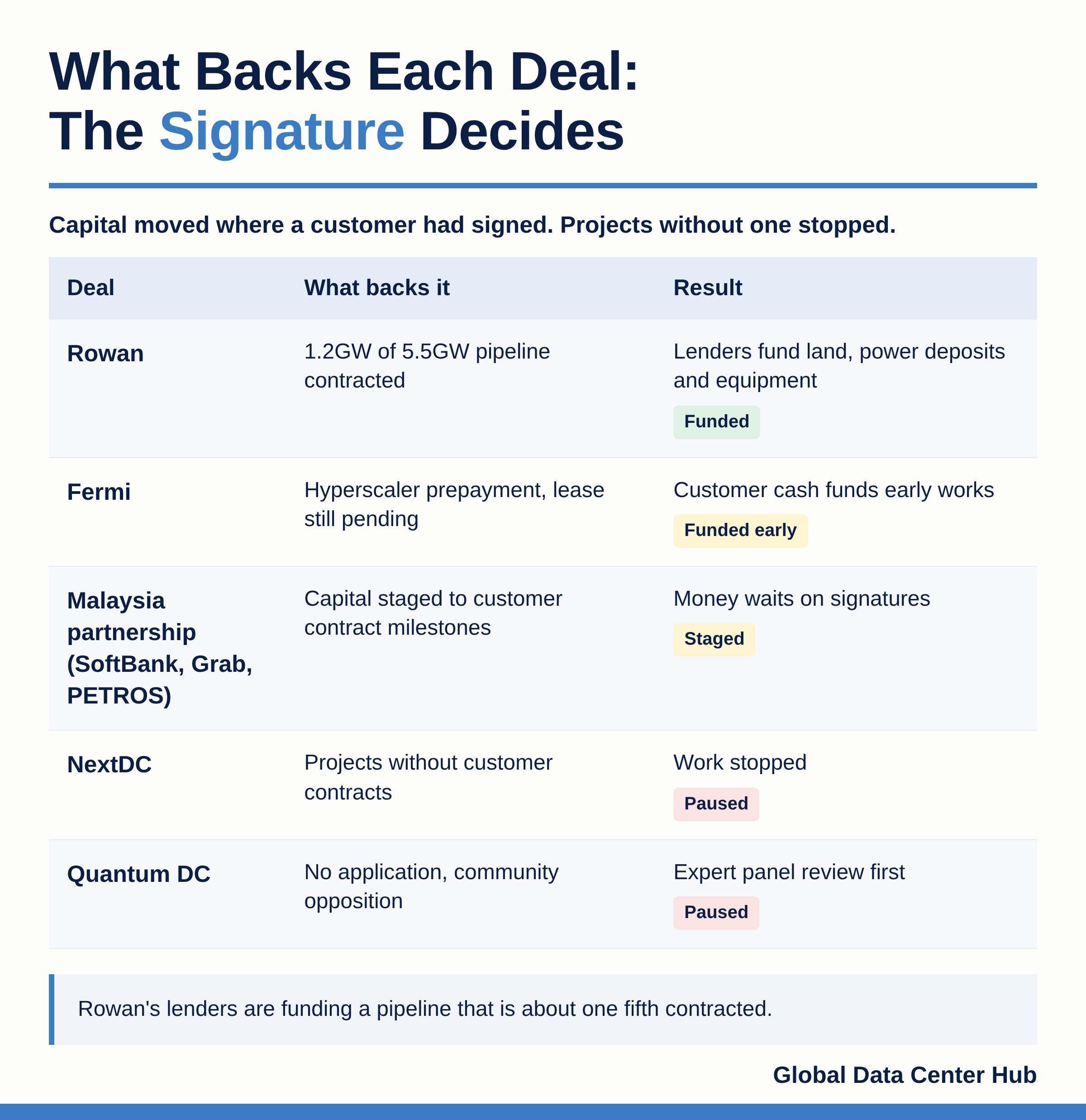
This week, money went only where a customer had already signed. Rowan, Fermi and a new Malaysian partnership all raised or committed capital, and each one tied it to a customer. Lenders and partners are paying for the land and the power queue once a buyer’s name is on paper.
The other side moved just as fast. NextDC shelved its unsold projects. Quantum DC paused a gigawatt campus after locals objected. Nebius slipped capacity into next year even with its contracts in place.
The projects still waiting are missing one of two things: a signature or a community. Norway’s grid operator added a third, a place in the queue.
The structure behind Rowan’s deal is in The Mechanism below.
MARKET SIGNALS
Norway freezes grid bookings for data centers. Statnett stopped reserving new grid capacity for data centers on November 9. The halt runs until August 1, 2027 at the latest, while the government drafts a licensing scheme. Norway has 800MW of data centers connected, 4,200MW reserved and 9,100MW queued, against peak demand just over 25,000MW. A place in that queue is now the scarce asset, and Oslo will soon choose which data centers it wants.
An Australian builder stops building on spec. Chief executive Craig Scroggie said NextDC will stop work on all projects without customer contracts. The pause follows power delays at its M3 campus in Melbourne. Those delays pushed back about A$140 million of contracted revenue this financial year. A builder once touted as Australia’s most prolific now builds only what it sells.
Nebius hits a delivery wall. Nebius now expects 2026 revenue at the low end of its $3.0 billion to $3.4 billion range. Some third-party capacity it expected this year has moved into the first half of 2027. The company says the contracts behind that capacity remain in place. A signed customer protects the revenue, but it can’t protect the calendar.
CAPITAL WATCH
Samsung and Modine. Samsung Electronics is in talks to acquire Modine, the Wisconsin maker of data center cooling systems, Bloomberg reported. Sources said a deal could come together within weeks, and neither company commented.
Seoul Economic Daily put the price at a reported ~$7.5 billion to ~$8 billion. That would rival the roughly $8 billion Samsung paid for Harman in 2017 and make cooling its biggest bet on AI data centers.
DAMAC and new land. Founder Hussain Sajwani said DAMAC is in “serious negotiations” for large land parcels in the UK and Australia. The group has 6GW today and targets 10GW by the end of 2027, he said at Bloomberg Invest Dubai. He also said build costs rose 30% in two years and could climb another 20% to 30%. That cost warning is the number the next buyer of these sites will price against.
GLOBAL LENS: THIS WEEK BY REGION
North America: buyers lock in supply and sites
Meta signed new multi-year agreements with lower-carbon cement and steel makers for its data center builds. Sublime Systems will produce at least 180,000 tons of lower-carbon cement, and Meta gets priority access. The deal backs Sublime’s first commercial-scale plant. Hyperscalers now sign offtake contracts with their own suppliers, the same tool developers use to finance campuses. That pulls Meta upstream into the materials that set construction timelines.
An Integra Mission Critical affiliate filed an $8 billion data center building with Texas regulators in Quanah, Hardeman County. The 288,355 sq ft building sits inside a planned 756MW campus. The filing runs construction from November 2026 to the end of 2028. Integra’s own project site reportedly puts the whole campus at $6.7 billion, and neither source explains the gap. A state filing isn’t financing, so the first construction loan is the real test.
Europe: state money and substations move first
Poste Italiane launched a €600 million fund to back data center investments, Reuters reported. Its asset manager, BancoPosta Fondi, runs the vehicle. The launch follows Poste's takeover of Telecom Italia. Italy’s state-controlled postal group now owns a telco, its data centers and a fund to grow them. The fund’s first assets will show whether it buys or builds.
Colt Data Center Services broke ground in Berlin, where contractor H&MV is delivering a 110kV substation. Berlin 1 and 2 will provide 54MW of IT capacity on a site 10km east of the capital. Berlin 1 is due to be live by the end of 2028. Colt says it has already secured renewable power contracts for the first phase. Building the substation first locks in the input German developers now queue for.
Asia-Pacific: India delivers, Central Asia signs up
STT GDC inaugurated NOI2, a 22MW facility on its Noida campus outside Delhi. It’s part of about 200MW planned across Delhi NCR. AI cloud provider Neysa has already picked NOI2 to host its compute expansion. An AI tenant on opening day means the building earns from the start.
Kazakhstan signed preliminary agreements with Gaw Capital, Boosteroid and Firebird for 480MW at Data Center Valley in Pavlodar region. The deals cover phase two and could grow to 620MW. They aren’t binding, and the government disclosed no terms. Phase one’s first 68MW building is due in the second quarter of 2027. Until those deals turn binding, the 480MW stays a reservation.
CONSTRAINT OF THE WEEK: LOCAL CONSENT
Local consent is now the gate that power and money can’t open. Quantum DC paused its 1,200MW Tungkillo campus east of Adelaide after residents objected. It won’t lodge a development application this year. The developer received a list of 432 community questions and will set up an independent expert panel. A gigawatt-scale site now waits on that panel before it files anything.
In Sutton, Massachusetts, residents packed a Select Board meeting over a proposed $16 billion, 900MW campus backed by the Kraft Group. The proposal is tentative, and no one has filed an application. The town projects about $27.8 million a year in tax once the campus is complete, close to its whole 2027 levy. Residents still want it scrapped, and a town meeting vote is expected in the spring.
SpaceX gave public notice of a $24 billion data center and gas-fired power plant near Brownsville, Texas. The land left Brownsville and joined the city of Starbase, which put it outside Brownsville’s new 90-day data center moratorium. The gas plant could run the site without a connection to the state grid. A tax abatement hearing is set for December. A developer that can move a city line can route around local consent.
The next bottleneck sits higher up. The Welsh government has taken control of the Cardiff East data center plan, the BBC reported. Campaigners say the plan drew more than 3,000 objections. When ministers make these calls, the delay moves from the town hall to the capital.
THE MECHANISM
Lenders now pay for the place in the power queue
Rowan Digital Infrastructure builds hyperscale data center campuses across the US. Quinbrook backs it, and Blackstone took a 49% stake in April, according to W.Media. This week Rowan said it has secured more than $1.5 billion in new financing capacity. The money funds the earliest work: land, power procurement, and long-lead equipment.
The package has three parts. Apterra expanded its term loan from $300 million to $900 million. Citi led a new $590 million revolving credit facility and a $355 million letter of credit facility. Mizuho, MUFG, Goldman Sachs, Societe Generale, SMBC and Huntington joined the bank group.
The letters of credit do the interesting work. They back utility interconnection deposits and equipment vendor obligations, cash a developer must post well before a tenant pays rent. So the banks are holding Rowan’s place in the power queue. The revolver can grow to $2 billion and the letter-of-credit line to $1 billion, subject to conditions.
The collateral is the pipeline. Rowan counts 5.5GW, and more than 1.2GW of it is contracted to technology companies. That’s about a fifth signed, and lenders are betting the rest converts.
The release names no customers, no pricing, and no maturities. The risk sits in the unsigned four-fifths of the pipeline.
I read this as banks moving one step earlier in a data center's life. They used to wait for a signed lease. Now they fund the deposit that keeps the grid slot alive. What I’m watching is Rowan’s next project-level construction loan, which should take out this development debt. That announcement will show how much of the 5.5GW has really converted.
NOTABLE TRANSACTIONS
Fermi: $200M hyperscaler prepayment for 600MW at Project Matador
Fermi America signed new agreements with an undisclosed investment-grade hyperscaler for an initial 600MW at Project Matador in Texas. They include a $200 million prepayment agreement and a $15 million early construction and site development agreement. The company announced them with third-quarter results on November 12.
Notably, the customer is paying before any lease is in place. The parties are still working toward a definitive long-term lease. The parties are still finalizing a $90 million steel and building materials agreement.
The same release ended the August lease with TensorWave, and AMD’s credit support for it. The developer closed the quarter with $315.5 million in cash and restricted cash. It posted a $141.6 million net loss and carries $958.4 million of net debt.
Watch the long-term lease. Until it’s signed, the 600MW rests on prepaid cash. A construction lender will want the lease first.
SoftBank, Grab and PETROS: $1.85B seed capital for Malaysian AI infrastructure
SoftBank Group and Grab signed joint development agreements on November 9 with PETROS, Sarawak’s state energy company. Initial seed capital totals $1.85 billion: $1 billion from SoftBank, $750 million from Grab, and $100 million from PETROS. The long-term target is five gigawatts or more of AI compute across Sarawak and Peninsular Malaysia.
Notably, the money is released against milestones. The partners say they deploy capital in stages as projects hit development and customer contract milestones. Closing conditions also apply.
The Sarawak project gets $1 billion and is led and majority-owned by the Japanese group. The Peninsular project gets $850 million, with Grab leading development. Both build on a framework agreement signed in Kuching on October 8.
Watch for the first customer contract. Under these terms, it unlocks the next tranche.
STAK Energy: 50-year Arctic land lease for a gas-powered data center campus
Alaska’s Department of Natural Resources approved a 50-year lease to STAK Energy, with the final decision signed November 10. The 715-acre site sits off the Dalton Highway, about 26 miles south of Deadhorse. Initial capital spending is about $500 million, over a buildout of about six years.
What makes it notable is how the state gets paid. Alaska plans a fee based on the electricity the campus produces and uses, plus land rent set after appraisal. State revenue rises and falls with the campus’s power output.
The campus will run off-grid on North Slope gas. STAK announced a 15-year gas supply agreement with ExxonMobil in early November, the Anchorage Press reported. The state received more than 1,200 public comments, most of them opposed. The draft lease lets payments be renegotiated if new state rules change the project’s economics.
Watch the 20-day reconsideration window and any court challenge. If none comes, the project moves to environmental permitting. Financing has not been disclosed.
THE FRAMEWORK: WHAT BACKS EACH DEAL
Every deal this week sorts by one question: who has signed? The chart lines up what backs each one.
THE QUESTION FOR NEXT WEEK
What will NextDC’s capital spending review cut when the board reports at its AGM on November 20? The company has said it is weighing sales of selected development sites. If it sells, buyers will set the first price for uncontracted Australian capacity.
If you are new to Global Data Center Hub, visit our Start Here page for more information about the newsletter.
If you found this newsletter useful, share it with a colleague.
Have a great week.
- Obinna