

Welcome to Global Data Center Hub. Join investors, operators, and innovators reading to stay ahead of the latest trends in the data center sector in developed and emerging markets globally.
A speculative data center in an emerging cluster breaks the quarter its hall is finished and the anchor hyperscaler’s next phase lands in the same market, because a handful of deployments now set both supply and absorption.
The old underwriting paradigm read low trailing vacancy in a young cluster as proof of deep, diversified demand.
Capital that still underwrites lease-up on that signal is funding a building whose occupancy date belongs to someone else.
The shift is scale. Single hyperscale and AI deployments are now larger than many of the markets they enter.
So, one tenant’s phasing decision can move a whole cluster’s vacancy in a year.
The question for every allocator is simple: in this market, who decides when space gets absorbed, and is the capital following that party or running ahead of it?
One Anchor Can Reset a Whole Cluster’s Vacancy
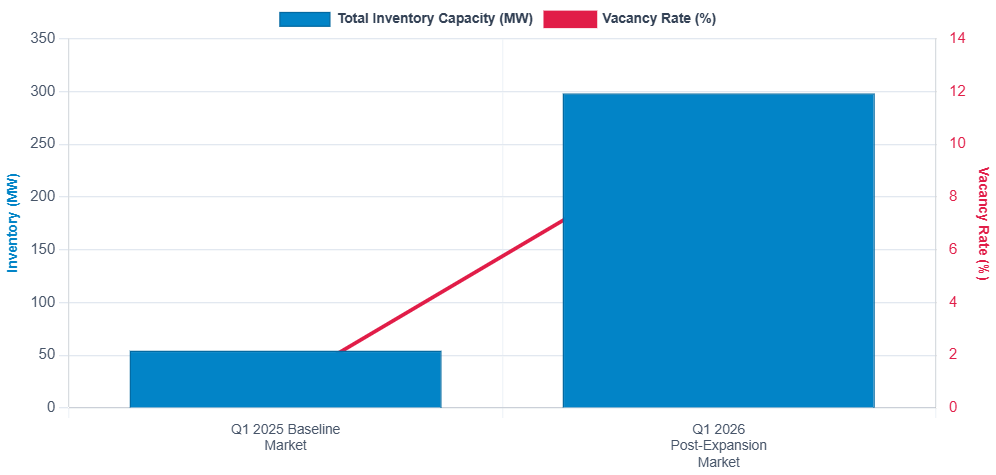
CBRE’s Global Data Center Trends 2026 reports Querétaro inventory up 450.2% year over year to 298.2 MW in Q1 2026.
That is about five and a half times the market’s size a year earlier.
CBRE says the growth was “driven by a small number of large-scale hyperscale and AI deployments.”
Vacancy moved with it. CBRE puts Querétaro vacancy at 10.6% in Q1 2026, up from 0.9% a year earlier, “as new hyperscale supply outpaced absorption.” Available supply reached 31.5 MW.
Demand in Querétaro did not disappear. Supply arrived in blocks, and each block was big enough to change the market on its own.
Then the grid adds friction. CBRE notes that grid capacity constraints continue to limit expansion in Querétaro, and that developers are increasingly required to self-generate or coordinate with local utilities.
So, a developer in Querétaro is exposed twice. The anchor controls when its capacity lands. The utility controls when anyone’s capacity turns on.
Trailing Vacancy Measures the Anchor’s Phasing Schedule
The industry has long assumed that a young cluster with low vacancy has deep demand waiting for new supply.
That assumption held when clusters grew through many enterprise, network, and cloud tenants, each small against the size of the market.
It does not hold now, because a single hyperscale or AI deployment can be larger than the market it enters.
When that happens, trailing vacancy stops measuring demand. It measures where the anchor sits in its build schedule.
Querétaro at 0.9% was a market between anchor phases. Querétaro at 10.6% is the same market after a phase landed.
The level of vacancy tells you less than its direction and its source. CBRE’s same report shows Hong Kong at 18% vacancy in Q1 2026, down from 28% a year earlier.
Bogotá sits at 18.7%, down from 21.2%, on unchanged inventory of 44.3 MW. Both headline numbers look like glut. Both markets are tightening.
The public data carries the facts. The consequence goes unstated: in a concentrated cluster, vacancy is a timing signal before it is a demand signal.
The Anchor Holds the Phasing Option and Spec Capital Pays
The cost of anchor concentration is time, and the anchor decides how much of it you carry.
Microsoft showed how that option works. In March 2025, TD Cowen reported that Microsoft had walked away from about 2 GW of data center capacity in the US and Europe through lease cancellations and deferrals.
TD Cowen read it as oversupply relative to Microsoft’s demand forecast. In Europe, DCD reported, Google absorbed some of the released leases and Meta took up additional freed capacity.
Days later, the pullback reached emerging markets. On April 3, 2025, Bloomberg reported that Microsoft had halted or delayed sites in Indonesia, the UK, Australia, Illinois, North Dakota, and Wisconsin, including parts of a campus outside Jakarta.
Microsoft said the changes reflected the flexibility of its strategy.
Then Microsoft opened Indonesia Central on May 27, 2025, with three availability zones, under a US$1.7 billion Indonesia investment plan for 2024 to 2028.
The anchor kept its market entry. It adjusted the pace of its phases. That flexibility is the anchor’s asset. Every third-party hall sized against the full announced plan carries the other side of it.
Whether anyone backfilled the paused Jakarta phases is not in the public record reviewed for this piece. That gap is the risk.
The announcement pipeline widens it. Knight Frank’s Data Centre Atlas 2026 shows Bangkok with 136 MW of live IT capacity, a 4,981 MW pipeline that includes early-stage projects, and 23.3% colocation vacancy as of Q2 2026.
Johor, in the same report, runs 1,110 MW live at 0.7% vacancy. Same region. One cluster is absorbing. The other is announcing.
Private Capital Carries the Lease-Up Gap in Emerging Clusters
This decision belongs to private capital: the infrastructure funds, private equity, real estate funds, and private credit that finance speculative phases in emerging clusters.
Your binding constraint is the lease-up schedule. In a core market, lease-up risk is a function of the market.
In a concentrated emerging cluster, it is a function of one or two tenants’ build calendars and one utility’s energization calendar. Neither sits in your model as a variable you control.
When you miss it, the cost lands as a finished, powered hall carrying debt service with no rent behind it. The IRR decays with every month the anchor waits.
So, underwrite the anchor. The cluster’s vacancy is an output of the anchor’s decisions. Price that before you fund the shell.
Map Every Anchor Phase Before You Fund the Shell
The first check is anchor mapping: assess how much of the past four quarters’ new supply came from the top two or three deployments and what phases they have announced. Use broker reports, hyperscaler announcements, and utility filings. This belongs in the market-entry screen, before site control.
The second check is phase collision. Model lease-up with the anchor’s next phase delivering into your first lease-up year. Querétaro went from 0.9% to 10.6% vacancy on that kind of collision. It belongs in the investment committee base case.
The third check is the pipeline ratio. Ask what multiple of live capacity sits in the pipeline, and how much is under construction versus early stage. Bangkok, at 4,981 MW against 136 MW live, is the benchmark for an announcing market. It belongs before you size phase one.
The fourth check is energization. Ask whether your delivery date is tied to an energization date the utility has confirmed in writing, or to a funded self-generation plan. It belongs before notice to proceed and the first construction draw.
The fifth is backfill: identify a second hyperscaler with a live region that could take the space if the anchor defers. In Europe, Google and Meta filled part of Microsoft’s released capacity in 2025. Use live regions and signed leases as evidence. This belongs in tenant diligence.
The sixth is the pre-lease gate: require a signed lease or binding letter of intent covering phase one before vertical construction. CBRE reported Dallas-Fort Worth at 716.7 MW under construction and 88% preleased in Q1 2026. Make this a covenant in the construction facility.
So before private capital funds a phase, it needs three answers. Which anchor stands behind the phase? What energization date has the utility confirmed? Who takes the space if the anchor defers?
The open question is who exercises the pipeline’s options first, and whose balance sheet carries the wait.