
Welcome to Global Data Center Hub. Join investors, operators, and innovators reading to stay ahead of the latest trends in the data center sector in developed and emerging markets globally.
Capacity Is Short, So the Real Question Is Who Pays for the Wait
For three years the AI infrastructure story was a spending race. Each quarter the question was how much the largest cloud companies would put into chips, data centers and networking, and each quarter the answer got bigger.
Demand is not the limit for either company this quarter. Supply is.
Alphabet is renting third-party compute to bridge what management called a “supply-constraint environment.”
Microsoft watched third-party GPUs it had contracted for slip out of its quarter.
When capacity is short, the cost of waiting has to land somewhere. Servers and accelerators wear out in roughly six years.
The contracts meant to pay for them run longer and convert slowly. Power decides how fast new sites come online, and energy is now showing up as a named cost line.
Between the purchase order and the paying customer sits a large block of money, and someone has to carry it.
Alphabet and Microsoft face the same gap and give opposite answers to who carries it. Alphabet is moving part of the risk outward, onto new shareholders, preferred holders and bondholders.
Microsoft is keeping it inside, on its own cash flow, its own working capital and its exposure to one customer it partly owns.
That split, not the size of either capex number, is the quarter’s signal.
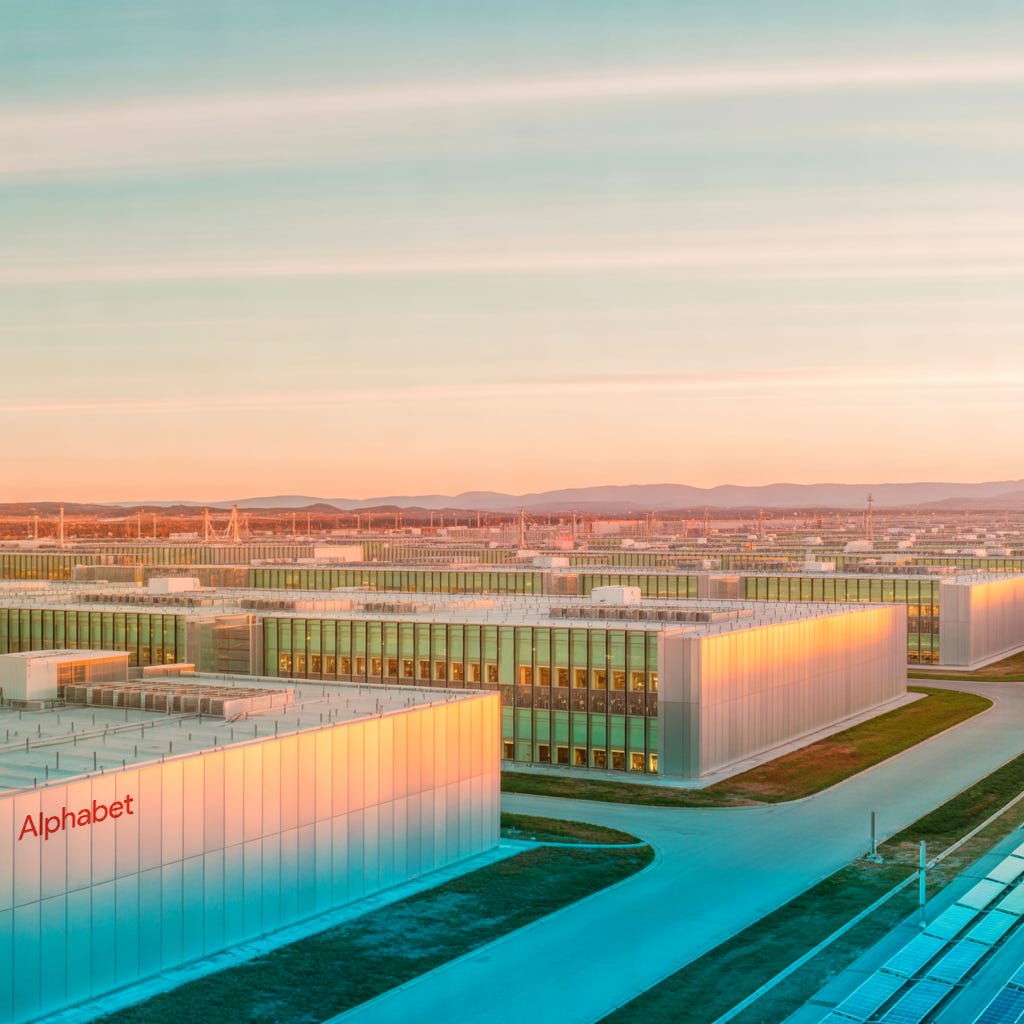
Alphabet Is Handing Part of the Bill to Outside Investors
Alphabet spent $51.4 billion on capex in the third quarter, up 114%, against $42.3 billion of operating cash flow. Free cash flow fell from $10.1 billion in Q1 to -$9.1 billion in Q3.
The gap was filled from outside. Alphabet bought back $39.8 billion of stock in the first nine months of 2025 and none in 2026.
Instead, it sold $42.9 billion of common stock and $19.1 billion of mandatory convertible preferred. Long-term debt rose from $46.5 billion to $125.1 billion.
The same outward move shows up in the hardware. Google Cloud revenue rose 103% to $30.7 billion, and Cloud product revenue now comes “primarily from the sale of TPU systems.”
Nearly 100 customers use TPUs, including Anthropic and Apple, and Google signed TPU partnerships with Oracle and Crux AI. A TPU system Alphabet sells is the buyers to house and power.
Alphabet held $265.1 billion of cash and marketable securities, $90.4 billion of it marketable equity, and the disclosures do not explain why it raised money instead.
About 65% of capex goes to servers and networking with six-year lives, and depreciation rose 49% to $8.4 billion. Alphabet is paying for six-year assets with permanent equity and multi-year debt.
Its 2026 guidance of $195 billion to $205 billion implies $63 billion to $73 billion in Q4 alone.
Selling the risk outward does not make it disappear. Cloud operating income rose from $3.6 billion to $11.1 billion at a 36.2% margin, which is the case for the build.
But Alphabet carries $924 billions of purchase commitments and $152 billions of leases not yet started, against $561 billions of Cloud backlog. Contract flexibility may lower actual spend.
TPU inventory rose from $2.4 billion to $13.3 billion. New investors share the risk. They do not take it off Alphabet’s books.
For the full Alphabet breakdown, read: Alphabet Doubled Cloud Revenue and Raised $62B Selling Its Own Stock
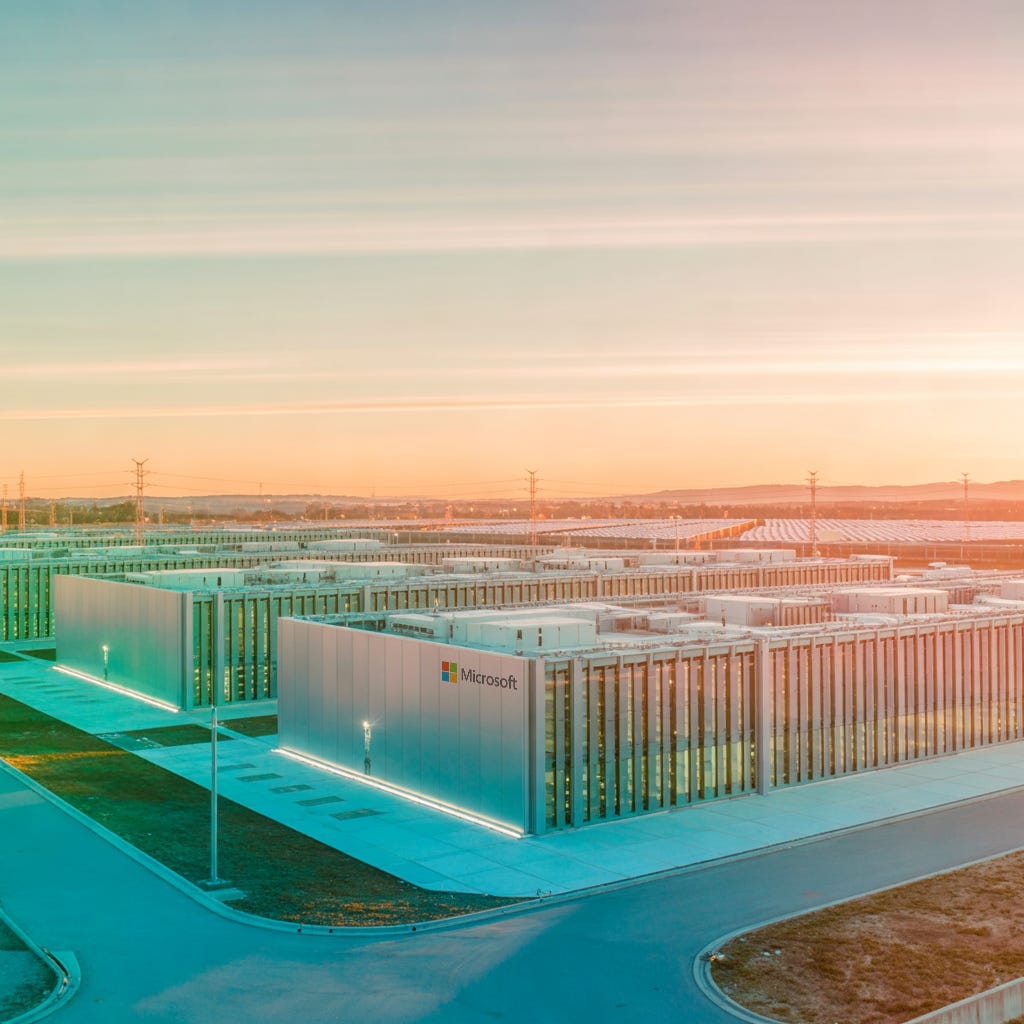
Microsoft Is Carrying the Risk on Its Own Books
Capex, including finance leases, came in at $45.2 billion against a $50.7 billion consensus, because third-party GPU deliveries slipped.
Azure still grew 48% to $33.165 billion, and management guided the December quarter to 49% to 50% growth against a 45.1% consensus, with more than $50 billion of capex and faster spending in the second half of fiscal 2027. The gap was scheduled, not saved.
Growth came from getting more out of the existing fleet: better GPU utilization, higher revenue per token, and CPU engineering that turned idle capacity into billable use.
Foundry revenue more than tripled. Microsoft also added 24 data centers and said its Maia 200 chip delivered up to 1.7 times more tokens per watt in Teams and Copilot, a management claim rather than a fleet-wide figure.
Microsoft paid for the quarter from its own cash. Operating cash flow rose 28.7% to $58.0 billion, and free cash flow fell 27.4% to $18.6 billion as cash capex absorbed about 67.9% of operating cash flow, up from 43.0%. There is no announced debt program.
The risk sits in lines the capex number does not show. Receivables tied to server-component purchases rose from $27.8 billion to $35.7 billion in one quarter, Microsoft’s own cash tied up keeping hardware moving.
Operating-lease assets rose to $30.2 billion, and about three-quarters of capex went to short-lived equipment.
OpenAI supplied $10.0 billion of revenue, about 10.8% of the total, and owed $7.2 billion, up 20% in a quarter.
Microsoft owns roughly 24% of OpenAI. Both exposures sit on Microsoft’s books. Commercial backlog rose 73% to $677 billion, but only about 30% is due within 12 months.
The strength is breadth: Microsoft earns at several layers, and operating margin reached 49.76%. The weakness is the flip side. Azure supplied about 74% of the quarter’s revenue growth.
For the full Microsoft breakdown, read: Microsoft Spent $5.5B Less Than Expected and Azure Grew 48% Anyway
The Same Constraint, Opposite Structures
Both are short on capacity and both lean on third parties, with Alphabet renting compute and Microsoft waiting for it.
Both hold stakes in AI labs they also sell to: Alphabet’s $90.4 billion of marketable equity swings with SpaceX and Anthropic valuations, and Microsoft holds about 24% of OpenAI. Both put most of their spending into equipment that ages fast.
The difference is who absorbs a shock. If AI returns disappoint at Alphabet, part of the loss falls on investors who bought $62 billion of new equity, and on bondholders whose $125.1 billion claim ranks ahead of them.
If they disappoint at Microsoft, the loss falls on Microsoft: on its cash flow, on the $35.7 billion it has put into its supply chain, and on a $7.2 billion receivable from a customer it partly owns.
Alphabet’s ties the pace of its build to bond and equity markets as well as to chips and power.
Microsoft keeps the market out of the decision but concentrates the exposure in one cash flow statement, one supply chain, and one large customer.
Neither moves the obligation itself. Alphabet’s $924 billion in commitments are still Alphabet’s, and Microsoft’s slipped GPUs are still due.
What Resolves Next
Three signals will show which structure holds. First, Alphabet’s 2027 capex figure and any free cash flow framework on the Q4 call. If spending rises “significantly” with no framework, more outside capital follows.
Second, Microsoft’s delayed third-party capacity in the second half of fiscal 2027, and whether Azure hits its 49% to 50% guide before that capacity lands.
Third, the quality of each company’s AI revenue: the split between recurring Google Cloud usage and one-time TPU hardware sales at Alphabet, and OpenAI receivables versus OpenAI revenue at Microsoft.
For investors, the read splits by market. Private credit and bond buyers should expect a steady supply of hyperscaler paper, since Alphabet has $27.6 billion of at-the-market capacity left and a build that still outruns its cash.
Public equity investors can no longer compare these companies on capex or free cash flow alone. Receivables, leases and equity issuance now matter too.
For operators, both companies point demand toward third-party halls, and Microsoft’s quarter shows that contracted capacity and switched-on capacity are different things. Returns should be tied to the second.