
Welcome to Global Data Center Hub. Join investors, operators, and innovators reading to stay ahead of the latest trends in the data center sector in developed and emerging markets globally.
In Q3 2026, AI labs signed some of the largest data center contracts of the year. The company signing for capacity was often not the one owning the campus, raising the debt or backing the payments. If you build, lend to or invest in this market, that changes the questions you need to ask.
New Buyers, More Backers
AI labs became direct buyers of data center capacity in Q3 2026. Anthropic agreed to about $45 billion of capacity over six years with Nscale.
OpenAI announced a $20 billion campus of its own in Georgia and is the named customer for 8 GW at SB Energy’s PORTS-Pike campus in Ohio.
The money around them came through more hands than before. Banks lined up $15 billion for an Anthropic campus in Texas, with Google’s credit rating standing behind Anthropic.
Nvidia gave credit support at PORTS-Pike and set a $500 billion financing target with six of the largest investment firms. In El Paso, BlackRock became majority owner of a Meta campus while Meta kept a guarantee on part of its value.
I read this as good news for capital formation. More partners make money easier to raise. The open task is to widen the base of demand behind that money, because many of these structures still lean on a small group of labs and suppliers.
Most of the capital in this quarter’s list is also attached to capacity that is still being built, powered or contracted. For you, the opportunity is real, and so is the work of checking what each commitment actually covers.
How to Read This Quarter

Five Structural Trends
1. AI Labs Became Direct Buyers
Anthropic with Nscale in West Virginia. OpenAI in Effingham County and at PORTS-Pike. OpenAI again through Firmus in Asia-Pacific. The labs signed for capacity directly, and one report in the dataset put Anthropic’s compute deals at $517 billion over 11 months.
They were not the only buyers: Google, Meta, ByteDance and SK Telecom all committed capital too.
The labs also want capacity sooner than gigawatt campuses can deliver it, and both OpenAI and Anthropic were reported to be seeking 20 to 30 MW sites in the meantime. If you own ready capacity at that size, you are in a good position this year.
2. More Partners Now Stand Between the Tenant and the Money
The company using a data center is often not the one owning it, borrowing for it or backing its payments, and those roles are not interchangeable. Nvidia’s $500 billion platforms are a fundraising target.
At PORTS-Pike, Nvidia gave formal credit support on land, power and shell. On the Nexus loan, Google backstopped Anthropic with its credit rating. In El Paso, BlackRock became the majority owner while Meta kept a residual value guarantee.
Each of these moves a different piece of risk. If you lend into this market, “who is the tenant?” is no longer enough. Your question is which payments are supported, by whom, on what conditions, and which risks stay with the project.
3. Bitcoin Miners Became AI Landlords
Hut 8, Bitdeer and CleanSpark signed long-term AI leases. Riot reached a deal with Anthropic, IREN added $2.8 billion in contracts, and Core Scientific agreed to give AMD access to more than 500 MW.
The miners spent years assembling power and land, and in Q3 several turned those sites into AI leases running 16 to 20 years.
The value depends on conversion: cooling, network links, reliability, and the cost of meeting AI customers’ specifications. Where those line up, this is one of the quickest routes to powered capacity.
4. Local Policy Moved Into the Financing
States are setting clearer rules for large data centers, and the approaches differ. New York paused new state permits for hyperscale projects of 50 MW or more for one year.
Texas paused grid-connection approvals for new data centers while regulators review a queue of about 474 GW of proposed demand, roughly 90% of it from data centers.
Pennsylvania made its development standards mandatory and tied state permits to local approval, without a moratorium. These rules give developers a clearer path, and they also feed into financing.
Some lenders are already factoring permitting timelines into how they price construction debt. If you are planning a campus, your permitting plan is now part of your financing case.
5. Resilience Became Part of Site Planning
The Gulf remains one of the fastest-growing data center regions, and this year it also showed why resilience planning matters. Regional security events affected some facilities, and AWS advised some customers in Abu Dhabi and Bahrain to consider alternatives while repairs continue.
Investment kept coming. Microsoft framed its $10 billion Gulf strategy around resilience, Microsoft confirmed its Saudi Arabia East region for November 2026, AWS and Humain committed to 50 MW in a Saudi AI zone by 2028, and Humain is seeking $2.5 billion for new capacity.
If you are building or financing in the region, redundancy and physical security now sit next to power and land in your plan.
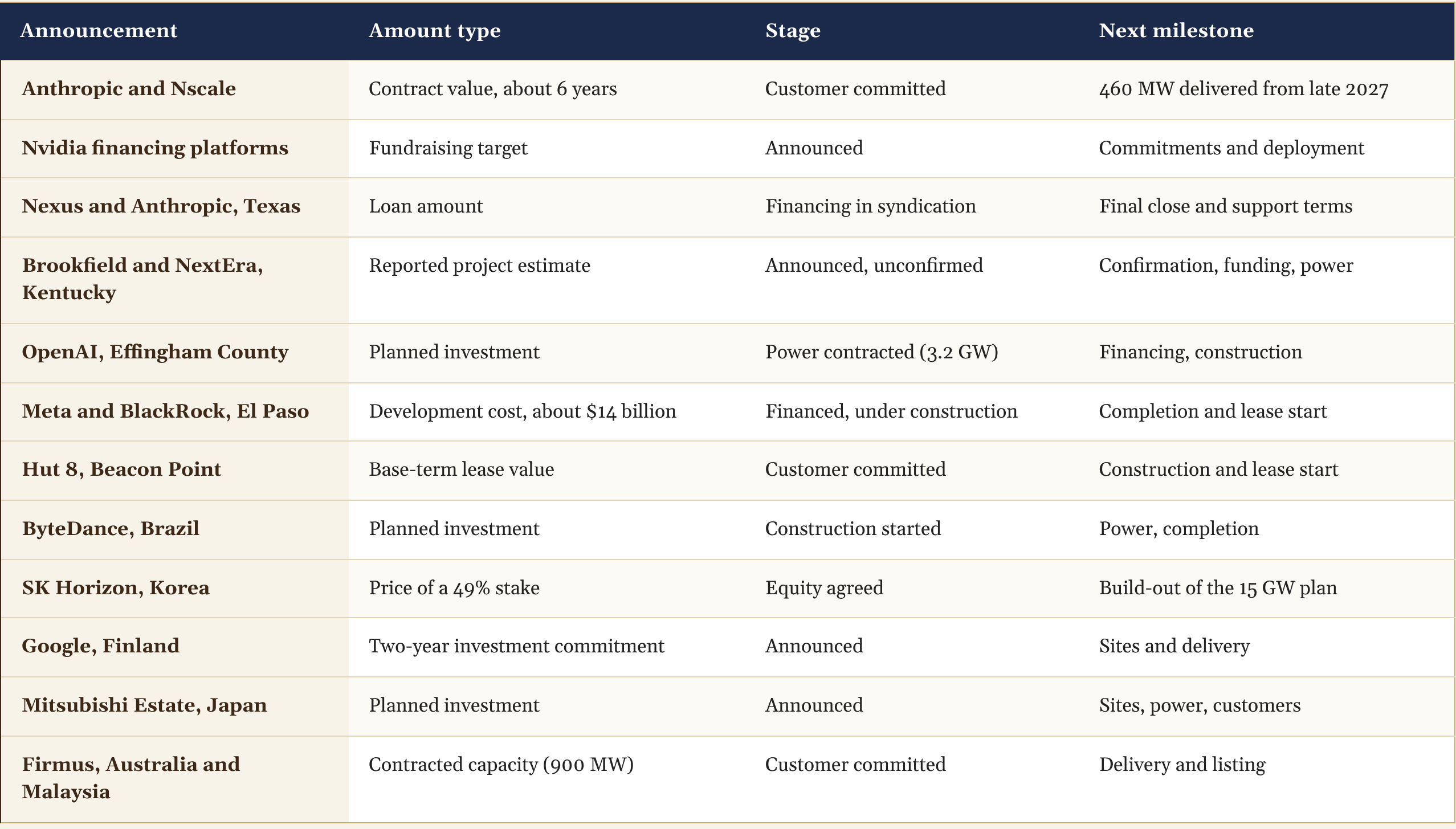
Where the 12 Announcements Stand
Capacity moves through stages: announced, site controlled, customer committed, power contracted, financed and under construction, energized, and finally accepted and earning revenue. The dollar figures in this list sit at very different points on that path, and knowing which point helps you compare them.
Where the Openings Are
1. Lending Where a Strong Backer Supports Specific Payments
The Google-backstopped Nexus loan moved toward bank sell-down within weeks, and an Anthropic-linked data center raised $1.3 billion in private credit. The opening is for lenders who read the support documents, not only the press release: what is backed, by whom, for how long, and what stays with the project.
2. Mining Sites That Can Be Converted at the Right Cost
Hut 8, Bitdeer, CleanSpark, Riot, IREN and Core Scientific all signed AI deals in the quarter. Your opportunity is in the sites that can meet AI customers’ needs at a conversion cost and on a timetable the lease supports.
3. Public Listings for Builders
Nscale filed for a US IPO. Switch lined up a $10 billion listing at a potential $80 billion valuation, SB Energy filed publicly, Firmus courted investors for an ASX listing, and Blue Owl planned a listed data center REIT. These are filings and plans, not completed raises. As they price, early backers gain a route to liquidity and builders a new source of equity.
4. Emerging Markets With New Rules and Funded Projects
Brazil signed its Redata tax regime into law. Indonesia drew a $3.1 billion loan for Zankore’s 1 GW project, plus CoreWeave’s first APAC entry. Johor kept raising multi-billion-dollar financing, and Egypt signed a $1 billion data center and sovereign AI deal. In each case, policy arrived with money attached.
5. Mid-Size Capacity That Can Deliver Soon
OpenAI and Anthropic were reported to be seeking 20 to 30 MW facilities while larger campuses are built. If you own ready capacity at that size, you may have pricing power, provided your site meets the labs’ needs on power density, cooling, connectivity and location.
What to Plan For
1. Widening the Base of Demand
Different developers, lenders and financing structures can still depend on the same few labs and suppliers. More partners make capital easier to raise. Spreading the demand behind it is the next step, and it is worth tracking in your own portfolio.
2. Power Costs Became a Policy Question
California signed seven bills requiring data centers to disclose power and water use and to keep the cost of new power off other customers’ bills. The US House passed the Ratepayer Protection Act 417-3. It asks states to consider a standard that makes large users pay the full cost of new generation and transmission, and it now goes to the Senate.
Virginia ordered a review of backup generators and named Eastern Virginia a cooling-water-scarcity area. Thailand asked operators to pause 49 buildouts while it completes a legal framework.
Clear cost rules help you plan. They also mean your project should budget for its own power and grid costs from the start.
3. Credit Terms Tied to Ratings and Permits
Some utilities now ask large data center customers below a set credit rating to post collateral sized to the power plants and lines built for them, which can run into the billions for the largest projects.
The El Paso debt priced at about 7.5%, and some lenders are factoring permitting timelines into construction loans. If you are raising money, your credit rating and your permits now shape your terms as much as your tenant does.
4. Resilience in Fast-Growing Regions
Recovery timelines for some affected Gulf facilities are still being set, and the UAE has revised its AI data center plans. Redundancy and site choice in the region now carry a planning cost that earlier budgets did not include.
5. Gigawatt Campuses Need Time
Large campuses in several markets have taken longer than planned, and grid connection timing has shaped schedules in parts of the UK, where Ofgem has proposed reforms to prioritize ready projects.
The labs are signing faster than big campuses can be energized, which is why smaller, ready sites are in demand.
What Would Change My View Next Quarter
Delivery dates. Whether Nscale’s West Virginia campus, Meta’s El Paso campus and OpenAI’s Effingham site hold their schedules.
The terms behind the backing. Whether the Nexus loan closes, and what Google’s support covers once the terms are public.
The state rules. What the Texas grid review concludes, whether the Ratepayer Protection Act passes the Senate, and how New York’s one-year permit pause ends.
Demand breadth. Whether new lab and enterprise customers join the contracts, widening the base behind the money.
Gulf recovery. Whether recovery dates are set and how new capacity in the region is designed for resilience.
The Full Ranked List: Top 12 Global Announcements (Q3 2026)
The 12 announcements below are ranked by capital scale, strategic signal and structural impact. The dollar figures measure different things, from contract value to financing targets, so each entry says which one it is.
1. Anthropic Agrees $45 Billion AI Data Center Deal With Nscale
Anthropic agreed to rent capacity from Nscale, a UK start-up, in a deal worth about $45 billion over six years. That is contract value, not money invested. It covers 460 MW at Nscale’s flagship campus in Mason County, West Virginia, with Anthropic’s access starting when the chips come online in late 2027. About a month later, Nscale filed for a US IPO, which gives public investors a view of the contract and the delivery plan behind it. Nscale’s next chapter centers on delivering this campus on time. [Read here]
2. Nvidia Builds $500 Billion AI Compute Financing Platforms With Six Major Investors
Nvidia partnered with Apollo, BlackRock, Blackstone, Brookfield, Goldman Sachs and KKR on financing platforms that aim to mobilize more than $500 billions of third-party capital. That figure is a target, not committed money. The firmer step came the same month at SB Energy’s PORTS-Pike campus in Ohio.
There, Nvidia agreed to give credit support on the land, power and shell buildout for an initial 4.25 GW of IT capacity, with an option on the rest, and to be the site’s AI compute supplier. OpenAI is the named customer for 8 GW. The chip supplier is now helping fund the buildings its chips go into. [Read here]
3. Banks Line Up $15 Billion for Google-Backed Anthropic Data Center
In late July, Morgan Stanley was leading advanced talks to lend $15 billion to Nexus Data Centers for an Anthropic campus in Hubbard, Texas. Google agreed to backstop Anthropic with its investment-grade credit rating. By early August, the banks were reported to be preparing to sell the debt on to other investors. If you are a lender, the key is the exact scope of Google’s support, meaning which obligations it covers and on what conditions. [Read here]
4. Brookfield and NextEra Plan $100 Billion Campus in Paducah, Kentucky
Brookfield Asset Management and NextEra Energy are reported to be developing a $100 billion data center campus in Paducah, Kentucky. That is a project estimate from an unnamed source, and neither company has confirmed it in the dataset, so I treat it as pipeline. The firmer Brookfield move came earlier: it expanded its Bloom Energy partnership fivefold, to $25 billion, to build and finance fast on-site power. [Read here]
5. OpenAI Announces $20 Billion Campus in Effingham County, Georgia
OpenAI announced a $20 billion data center development in Effingham County, Georgia. That is planned investment. About a month later, a 3.2 GW power deal for the site was approved. Acting as its own developer gives OpenAI more control over timing and design, along with responsibility for site, power and community relations. [Read here]
6. Meta and BlackRock Form El Paso Data Center Venture
Meta and BlackRock formed a venture to own a 1 GW campus under construction in El Paso, with about $14 billion in total development costs. Funds managed by BlackRock own 80% and put in about $4.9 billion of cash, partly funded by a $12.5 billion debt raise priced at yields of about 7.5%. Meta keeps 20%, leases the whole campus for an initial four years with options out to 20, and manages construction.
Meta also gives residual value guarantees with a threshold of about $13 billion: under certain conditions in the first 16 years, it covers any shortfall between the campus’s value and that level. It is a useful model for you to study: ownership moves to institutional capital, while the user keeps a share of the value risk. [Read here]
7. Hut 8 Fully Leases 1 GW Beacon Point Campus at $19.6 Billion
Hut 8 signed a second 352 MW IT lease, which fully leased its 1 GW Beacon Point campus and lifted campus-level base-term contract value to $19.6 billion. That is lease value over the base term. The source headline does not name the tenant. Bitdeer signed a $4.7 billion, 16-year lease in Norway, and CleanSpark a 20-year lease in Georgia. Mining sites bring power and land, and the payoff comes from converting them to what AI customers need, at a cost and on a timetable the lease supports. [Read here]
8. ByteDance Begins $38.44 Billion Data Center in Brazil
ByteDance began building a $38.44 billion data center in Brazil, the largest single Latin American commitment in the dataset. That is planned investment. Two more signals followed. Brazil signed its Redata tax regime into law, and Alibaba Cloud opened its first South American region there. Brazil is drawing global platforms at a scale that gives it a real say in how the next wave of capacity is built. [Read here]
9. SK Telecom Sells 49% of SK Horizon to KKR and IMM for $2.2 Billion
SK Telecom launched SK Horizon, its AI data center company, and agreed to sell 49% to KKR and a Korean private equity consortium including IMM for 2. 2billion.That is the price of the stake. Earlier in the quarter, SKToutlinedUS91.5 billion of new Korean data center investment and a plan for 15 GW of AI capacity. Bringing in a large minority partner before construction puts outside equity in at the start of the program. [Read here]
10. Google Commits €13 Billion to AI Infrastructure in Finland
Google committed €13 billion over two years to AI infrastructure in Finland. It had company. Cerebras and Compute Nordic announced a 165 MW site in Mikkeli, TikTok expanded its Finnish capacity, and Microsoft started pre-construction in Vaasa. Finland’s power and climate are drawing a cluster of global builders at once.[Read here]
11. Mitsubishi Estate Enters Data Centers With 2.5 GW and $9.3 Billion
Mitsubishi Estate is entering the data center market with 2,500 MW of planned capacity and a $9.3 billion planned investment. That is a first move at gigawatt scale. Goodman also signed the first hyperscale lease at its 1 GW Tokyo campus, and Keppel DC REIT agreed to buy stakes in two Tokyo data centers for $1.05 billion. Japan’s big property owners are moving into data centers as a business line. [Read here]
12. Firmus Passes 900 MW Contracted and Adds OpenAI as Anchor Customer
Firmus passed 900 MW of contracted capacity, signed OpenAI as an anchor customer and expanded into Malaysia. A month earlier it had closed a fully subscribed $2 billion strategic equity raise. By mid-September it was courting investors for an ASX listing. Contracts, equity and a listing process, all inside one quarter. [Read here]