

Welcome to Global Data Center Hub. Join investors, operators, and innovators reading to stay ahead of the latest trends in the data center sector in developed and emerging markets globally.
This article is the 14th article in the series: Ground to Grid: A Free 21-Lesson Guide to Mastering Data Center Development
Why the Capital Structure Determines Who Builds
A data center is funded in layers. Each layer has its own cost. Each layer also has its own claim on the asset, and that claim decides who gets paid first when something goes wrong.
Once you understand the stack, you can see who is able to build and what return they need to do it.
This stage comes after demand is contracted. The tenant has signed. Now the developer assembles the money to build against that contract.
Large builds are usually financed as projects. The facility is placed inside a Special Purpose Vehicle, a separate legal company that owns one asset.
Lenders are repaid from that asset’s contracted cash flow. It is the same method used to fund toll roads and gas-fired power stations.
The split between equity and debt shapes the outcome for everyone.
More debt means less equity is needed, so each equity dollar earns more if the project performs. More debt also means a thinner cushion for lenders if it does not.
The Layers of the Capital Stack
1. Equity
Equity is first-loss capital. It goes in earliest and is repaid last. It funds the stage with the most uncertainty: land, permits, design, and early construction.
Equity usually comes from the developer and from infrastructure funds that partner with them.
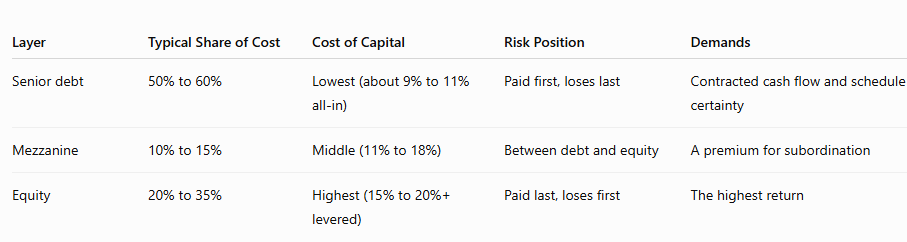
On a greenfield hyperscale build with a creditworthy tenant, sponsors typically contribute 20% to 35% of total cost. Because equity absorbs losses first, it expects the highest return, often 15% to 20% or more on a levered basis.
2. Debt
Senior debt is the lowest-cost capital in the stack. It typically covers 50% to 60% of total project cost. Pricing runs around SOFR plus 350 to 550 basis points, roughly 9% to 11% all-in.
Senior lenders hold the first claim on the project’s assets and cash. They lend once a signed lease or offtake has reduced the project’s revenue risk.
3. Project Finance Structure
Project finance is the legal frame that holds the layers together.
Debt is made to the SPV on non-recourse or limited-recourse terms. Non-recourse means lenders can look only to the project if it fails.
Limited recourse adds specific sponsor support, usually during construction, that falls away once the facility is complete.
The effect is isolation. A failed project does not pull down the developer’s other assets. A troubled developer does not freeze the project’s cash flow.
4. Mezzanine and Hybrid Layers
Mezzanine debt and preferred equity sit between senior debt and common equity.
Mezzanine typically fills 10% to 15% of the stack.
Mezzanine is subordinated debt, often provided by infrastructure credit funds and private credit platforms.
It commonly pays 11% to 18%, sometimes with interest that accrues into the loan balance.
Preferred equity comes from pensions, insurers, and sovereign wealth funds. It carries a preferred return of 12% to 18% plus a share of the upside.
Both layers exist for the same reason. Senior lenders stop at a set leverage level, and developers want to commit less common equity than the remaining gap requires.
How the Stack Gets Built
The stack is assembled in sequence.
Equity moves first. It funds pre-development and early construction, when no lender will take the risk. Development-stage projects carrying entitlement and construction risk can require 50% to 70% equity.
Contracted demand then unlocks senior debt. A signed lease with a creditworthy tenant gives lenders a cash flow to lend against. Operating facilities with established tenants can support 65% to 75% debt.
Construction usually runs 18 to 36 months with no revenue. Interest on drawn debt is added to the loan balance.
At the commercial operations date, the construction loan converts to a term loan.
Repayment begins from lease cash flow. Once stable, the facility is often refinanced into cheaper long-term debt.
The debt-to-equity ratio sets the economics for both sides. Senior lenders size the loan so that project cash flow covers debt service by roughly 1.25x to 1.35x.
That coverage ratio sets the maximum debt. Whatever the debt cannot fund, equity must.
What Each Capital Layer Demands
Equity demands the highest return.
It is paid last, after operating costs, lenders, and reserves. It also loses first.
Senior debt demands certainty. Lenders want contracted cash flow and a construction schedule they can rely on.
They also require a full contract package.
That package includes the lease, an EPC contract with performance guarantees, a power agreement, a ground lease, and insurance.
In return, they take a first lien on the assets and the right to step in if the sponsor defaults.
Mezzanine demands a premium for its position. It is repaid after senior debt and before equity, and it prices that middle position into its return.
Every layer depends on the anchor tenant. Without a signed lease from a creditworthy tenant, the cash flow each layer is priced against remains a forecast.
Comparison: Capital Layers by Cost and Risk
Real-World Example
The flagship Stargate campus in Abilene, Texas, shows the structure at work.
The site was financed through a $3.4 billion joint venture between Crusoe, Blue Owl, and Primary Digital Infrastructure. Alongside it sits a $2.3 billion JPMorgan construction loan.
The loan is secured by the project’s assets and by Oracle’s lease. It pays interest only during construction.
Principal is repaid from Oracle’s lease payments once the campus operates.
A toll road is financed the same way. The toll road has a concession. The data center has a lease.
In both cases, lenders are repaid from a long-duration contracted cash flow, and their claim is limited to the asset.
That is why institutional capital now treats data centers as core infrastructure.
The structure makes the cash flow predictable, and predictable long-term cash flow is what pensions and insurers buy.

Strategic Implications
For developers: The stack shapes your return and control. More debt can raise equity returns but increases risk when schedules slip.
Construction may take 18 to 36 months with no revenue, while interest adds to the debt. Limited-recourse deals also carry completion and cost-overrun guarantees.
Institutional partners often seek voting rights over major decisions.
For investors: Your position in the stack defines your risk and return. First-loss equity may earn 15% to 20% or more by absorbing losses.
Senior debt earns less but benefits from liens, reserves, and priority in repayment.
Before comparing returns, confirm where your dollar sits in the payment order.
For operators: The financing structure sets the pressure on performance. If coverage falls below agreed levels, cash is held back and distributions stop.
On a highly levered project, a small outage or a power cost increase can trigger that test.
The more debt in the stack, the less room you have for operating mistakes.
For policymakers: Long-duration debt follows certainty. Lenders view reliable, priced power as essential to 15- to 20-year data center financing.
Clear permitting and predictable grid connections reduce the equity needed before debt arrives, lowering the cost of each megawatt built.
Key Takeaway
A data center is funded by a stack of capital, with each layer priced to the risk it carries.
Equity takes the early risk and asks for the highest return. Senior debt provides most of the money at the lowest cost.
The tenant’s contract holds the stack together. It turns a building into a cash flow that lenders can size a loan against. Without it, the cheapest layer stays closed, and equity has to carry the build.
The order matters as much as the mix. Developers who secure tenants before raising capital access cheaper funding. Building first means paying equity returns on capital they could have borrowed.
When you look at a data center deal, do you focus first on the equity return or the debt terms, and what does that tell you about how you see the risk?