
Welcome to Global Data Center Hub. Join investors, operators, and innovators reading to stay ahead of the latest trends in the data center sector in developed and emerging markets globally.
This article is the 7th article in the series: Ground to Grid: A Free 21-Lesson Guide to Mastering Data Center Development
Permitting is the longest phase in data center development, and it is the one most newcomer’s underestimate.
Land, power, and cost get the early attention.
The approvals that turn a viable site into a buildable one take longer than any of them, and they run on their own logic.
This piece walks through that process in the order a developer actually encounters it.
Start with scale. Data center development typically takes 3–6 years, with permitting and approvals alone often requiring 6–18 months.
Between May 2024 and March 2025, at least $64 billion in U.S. projects were delayed or blocked by regulatory hurdles and local opposition.
Understanding the permitting process is essential for setting realistic timelines.
The Process Is Not One Approval. It Is Eight Running in Parallel.
The first thing to understand is structure.
Permitting is not a single approval a developer waits on.
It is roughly eight distinct workstreams zoning, environmental review, building permits, fire and life safety, grid interconnection, water, air, and utility coordination.
They do not happen one after another. They run at the same time, each handled by a different agency, each on its own timeline.
A delay in one can force changes in another.
Learning the process means learning how these workstreams interact, not just what each one requires.
Zoning and Land Use Come First
Zoning is where most projects begin, because it determines whether a data center is even an allowed use on a given parcel.
Historically, data centers occupied an ambiguous position in municipal codes, and many jurisdictions permitted them “by-right” meaning the use was allowed without discretionary review or public hearings.
That is changing. In 2000, Loudoun County, Virginia the world's largest data center market classified data centers as office parks, allowing by-right development in key industrial zones.
In March 2025, the Board of Supervisors replaced that with a Special Exception requirement, adding public hearings and a Board vote to every new application.
Fairfax County followed with equipment enclosure rules, a one-mile Metrorail buffer, and 200-foot residential setbacks.
The educational point is that zoning posture is jurisdiction-specific and changes over time.
A market that was straightforward to build in five years ago may require a full discretionary process today.
Reading the current zoning treatment of a specific county is the starting point of the entire timeline.
Environmental Review Runs in Two Layers
Environmental review is the workstream with the longest potential tail, and it operates at two levels.
At the federal level, the National Environmental Policy Act (NEPA) applies when a project involves federal land, permits, funding, or federally regulated resources.
Reviews range from Categorical Exclusions requiring little analysis to full Environmental Impact Statements (EIS), which assess alternatives, cumulative impacts, and public input and can take two years or more.
A 2025 executive order expanded fast-track eligibility for qualifying large projects, though implementation still depends on agency rulemaking and legal challenges.
State environmental reviews typically run separately from federal reviews, creating multiple approval layers.
In Pennsylvania, a single project may require permits for earth disturbance, stream crossings, sewage planning, and water withdrawals each with its own agency, timeline, and documentation.
Coordinating these parallel approvals is a core responsibility of the developer.
Air Permitting Depends on How the Permit Is Classified
Air permitting has become more complex because large data center campuses can house dozens or even hundreds of diesel backup generators.
Facilities with a Potential to Emit above 100 tons per year are classified as major sources and face stricter permitting. Most data centers avoid this by operating as synthetic minor sources with binding operational limits.
These limits cap how many hours generators can run for non-emergency purposes, typically between 50 and 100 hours per year depending on the permit.
Emergency use during grid outages is not federally limited, provided all operating hours are properly logged.
Standards are tightening in major data center markets. In Virginia, air permit applications for diesel generators submitted on or after July 1, 2026 must meet Tier 4-equivalent controls, increasing costs and raising the bar for future projects.
On-site primary generation is also evolving. In the Vantage VA2 case in Loudoun, a data center received a minor air permit for natural gas turbines because emissions stayed below major-source thresholds.
Virginia has since updated its rules, requiring a Special Exception for associated power generation facilities and closing regulatory gaps exposed by gigawatt-scale projects.
Water Permitting Is Becoming More Significant
Water is a tightening part of the process as cooling demand draws regulatory attention.
Any discharge from cooling operations into US waters requires an NPDES permit.
Ohio EPA has proposed a draft general NPDES permit for data center discharges, which streamlines the approval while codifying discharge limits.
Construction that disturbs one or more acres requires Construction General Permit coverage and a Stormwater Pollution Prevention Plan before ground-breaking.
In water-stressed regions, withdrawal permits have moved from routine to project-defining.
Grid Interconnection Is Usually the Longest Single Item
The workstream that most often sets the true timeline is grid interconnection.
Virginia’s DEQ permitting queue now estimates wait times of up to seven years for data center grid connections in Northern Virginia.
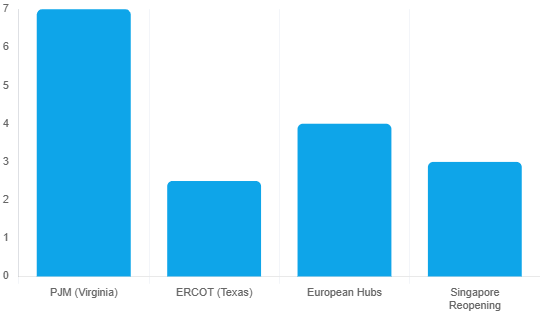
Interconnection studies alone can run longer than all other development phases combined.
Dominion Energy signaled as early as 2022 that it could not supply new Loudoun data centers until at least 2025 to 2026.
For anyone learning the process, this is the item to map first, because it frequently determines when a project can actually energize.
How Different Players Experience the Same Process
The same process looks different depending on who is moving through it.
For independent operators, the work centers on the completeness of the application. Incomplete or placeholder submissions restart review timelines, and a single resubmission cycle can add three to nine months.
Smaller entrants without established agency relationships tend to absorb those delays more heavily, while experienced developers move the same review faster on the strength of their track record.
For private equity and infrastructure investors, the central concern is carry cost. A 12 to 18 month permitting delay on a one-billion-dollar project, at a 7 percent cost of capital, represents 70 to 105 million dollars before any revenue.
For this group, understanding the process means underwriting permitting timelines as a real financial variable jurisdictional history, local posture, developer track record rather than treating them as a fixed assumption.
For public equity investors, the relevant dynamic is how policy shifts move across markets at once. New York’s legislature passed a one-year moratorium on data centers of 20 MW or more on June 4, 2026, pending the Governor’s signature. At least 14 states have proposed or enacted similar measures.
For investors holding operators concentrated in tightening markets, the effect is felt across a whole footprint, not one project.
The Process Is Easier in Some Jurisdictions Than Others
The final thing to understand is that the process is not uniform. As several mature US markets add steps, other jurisdictions are streamlining.
Singapore reopened a multi-year moratorium in April 2026, approving four facilities under defined efficiency conditions PUE at or below 1.3, fully renewable energy certificates, and liquid cooling for at least 60 percent of IT load.
Gulf states can issue approvals in 48 hours for credentialed operators. Texas processes interconnection faster than PJM and imposes no Tier 4 mandate.
The practical lesson for anyone learning this process is that jurisdiction selection shapes the timeline as much as any single permit.
The markets that move quickly today may tighten as they mature, just as Loudoun did.
Understanding where a given jurisdiction sits on that path is the foundation of a realistic development plan.
Part 8 examines where the money is locked, not spent: Design Is Where the Money Is Locked, Not Spent
A fascinating overview.
Reading this, I found myself thinking about a question that sits slightly outside the permitting process itself.
Permitting determines whether infrastructure can be built.
Communities often end up asking something different:
What does it mean to host it?
Places like Horndal or Gävle, become important to global systems because they have land, power, permits, and patience.
The technical process is complex, but the democratic question is surprisingly simple:
If a place helps host the infrastructure of the future, what should it receive in return?
That question led me down a rabbit hole recently while writing about what I ended up calling an infrastructure ledger.
https://saraeson.substack.com/p/who-is-still-there-when-the-bill?r=1t83gn&utm_medium=ios
They will be orbital! And that is happening now!
Some that are planned on earth will be cancelled
Reality is a view of the present. The past shows trends. Futurism is based on trends & knowing the present. Here is a glimpse.
We are all connected. I create and promote peace with my creations.
https://substack.com/@johncharlesharman/note/c-282568315