
Welcome to Global Data Center Hub. Join investors, operators, and innovators reading to stay ahead of the latest trends in the data center sector in developed and emerging markets globally.
The fiber deal breaks when the second customer the model counted on signs for a satellite terminal or a 5G receiver and never orders the lateral.
Fiber underwriting has long assumed the anchor pays for the route and the fill arrives later, because nothing else could carry the traffic.
Underwrite that fill at the old odds today and you pay infrastructure prices for a return that only the anchor contract secures.
The pressure is building because the buyers of fill changed their test.
Public money now goes to the cheapest qualifying technology, and national networks now buy satellite capacity from third parties.
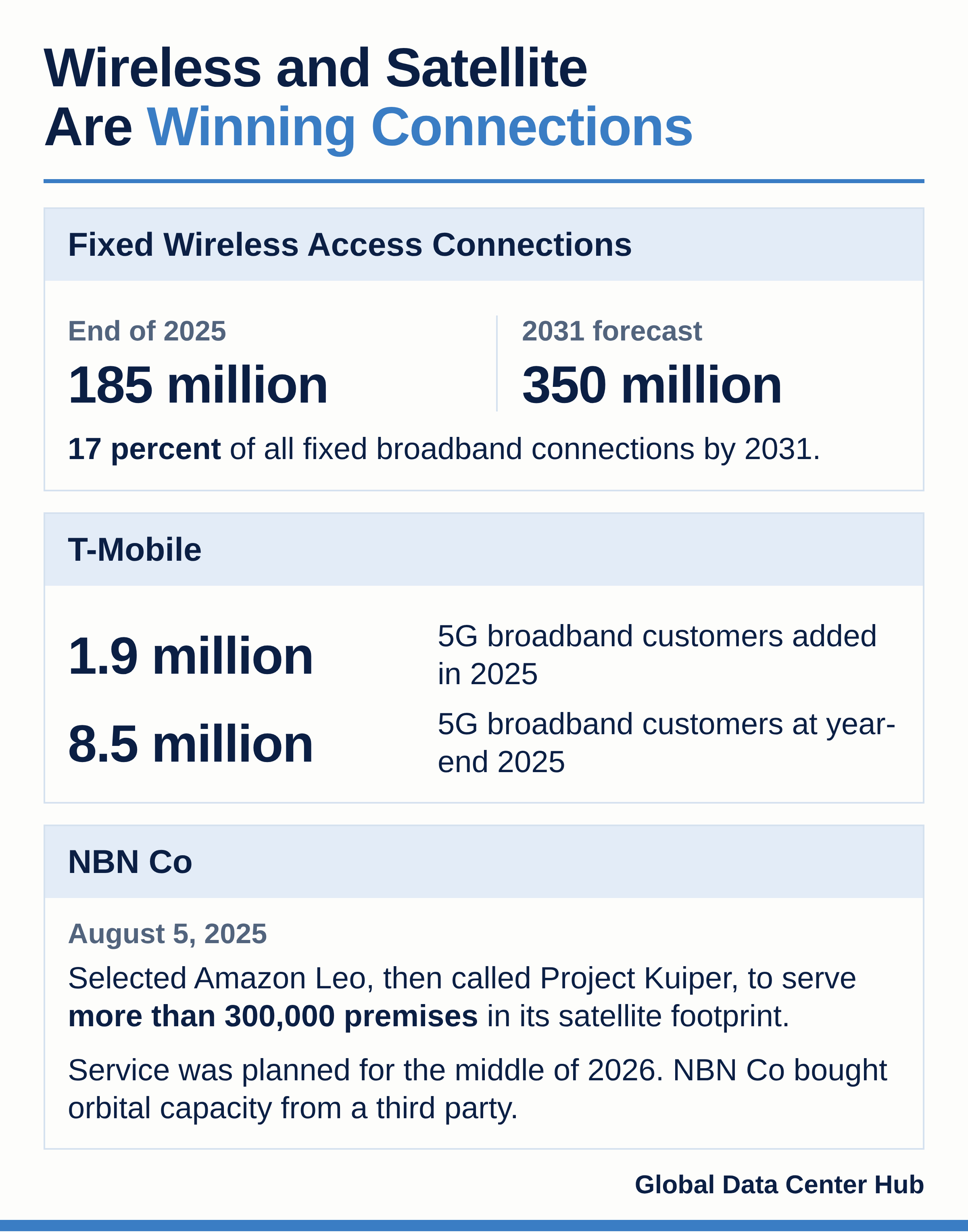
Ericsson’s June 2026 Mobility Report counts 185 million fixed wireless access connections at the end of 2025 and forecasts 350 million by 2031, equal to 17 percent of all fixed broadband connections.
The capital question is simple. Where does the fill go now, and who gets paid for it?
Wireless Competes Where Fiber Earns Its Lease-Up
Every fiber network has two revenue layers.
The first is the core: data center to data center routes, plus the dark fiber and wavelengths that serve cloud campuses.
Satellite and radio cannot carry that volume at that consistency. The core stays fiber.
The second is the tail: laterals to enterprise branches, small cells, backup circuits, and subsidized last-mile builds.
The tail is what turns an anchor-backed route into a growth case.
It is also the layer where fixed wireless and low-Earth-orbit satellite now win on cost and speed.
The Broadband Equity, Access, and Deployment program (BEAD) illustrates the mechanism publicly.
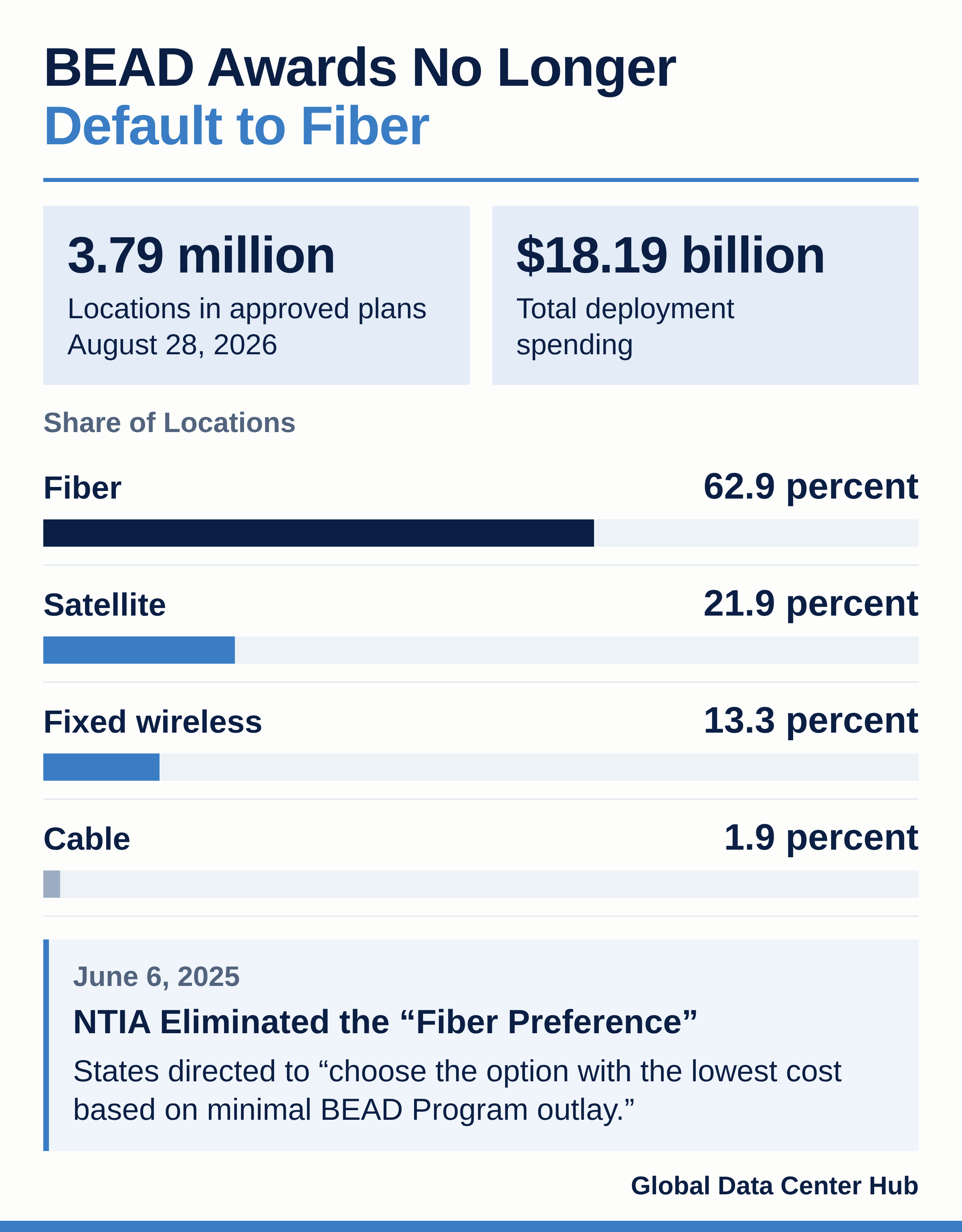
On June 6, 2025, NTIA’s BEAD Restructuring Policy Notice directed states to “choose the option with the lowest cost based on minimal BEAD Program outlay.”
Then the results came in. Broadband Breakfast’s August 28, 2026, tally of the approved plans covers 3.79 million locations.
Fiber takes 62.9 percent. Satellite takes 21.9 percent. Fixed wireless takes 13.3 percent. Cable takes 1.9 percent.
Broadband Breakfast’s analysis of draft spending plans found SpaceX and Amazon in line for a combined $1 billion while serving 22 percent of the program’s locations.
Total deployment spending is $18.19 billion. Satellite serves more than a fifth of the locations for a small fraction of the money.
That is the price a fiber lateral now competes against.
BEAD Removed Fiber’s Default Claim on Public Money
The industry has long assumed that public broadband money defaults to fiber.
That assumption held when the original BEAD rules carried a Fiber Preference section.
It does not hold now, because the June 2025 notice states that NTIA “hereby eliminates the ‘Fiber Preference’ section” and lets states select from all qualifying technologies.
The coverage treats the outcome as a broadband milestone. NTIA announced on August 25, 2026, that all 56 final proposals were approved.
The last one, Illinois, covers nearly 143,000 locations for $831 million. Fiber gets 68.1 percent of them.
Fixed wireless gets 23.6 percent. Satellite gets 8.1 percent. More than $169 million went unused.
Read that as an underwriter. Fixed wireless and satellite together take 31.7 percent of the Illinois locations. Each one is a lateral no fiber owner will be paid to build.
Fiber Loses the Lease-Up Race on Time
Fiber pays for rights-of-way, permits, crews, and trenching before it earns a dollar.
Wireless and satellite put that spend into radios and orbit that many customers share. The difference shows up in the calendar.
On August 5, 2025, NBN Co selected Amazon Leo, then called Project Kuiper, to serve more than 300,000 premises in its satellite footprint.
Service was planned for the middle of 2026. NBN Co had launched its own Sky Muster satellites for that footprint.
This time it bought orbital capacity from a third party.
T-Mobile added 1.9 million 5G broadband customers in 2025 and ended the year with 8.5 million, according to its February 11, 2026, earnings release. None of those customers waited for a new lateral.
So, the fill does not wait for fiber. A customer who can turn up service in days will take it and negotiate the fiber later, or never.
Infrastructure Funds Now Carry the Uncontracted Fill Risk
This lands on private capital. Infrastructure funds, private equity, private credit, and family offices own the gap between what a fiber route earns under contract and what the model says it will earn once the fill arrives.
The binding variable is the share of value that rests on uncontracted fill. When that share is high, the return depends on customers who now have a cheaper option. The anchor contract protects the debt. It does not protect the growth case.
The market has already shown what a fiber book built for small cells and enterprise customers can be worth against its carrying value.
Crown Castle recorded a goodwill impairment of about $5.0 billion on its Fiber reporting unit for 2024.
The charge left no goodwill in that unit. Crown Castle then sold the fiber solutions business to Zayo and the small cell business to EQT for $8.5 billion, closing on May 1, 2026, at $8.4 billion net of preliminary adjustments.
Crown Castle did not attribute the charge to wireless substitution.
The lesson is narrower. Fill-dependent fiber gets marked on what buyers will pay, and buyers price the tail hard.
You own the anchor. You do not own the fill. Price them as two different assets, because the market already does.
Split the Anchor From the Fill Before Pricing
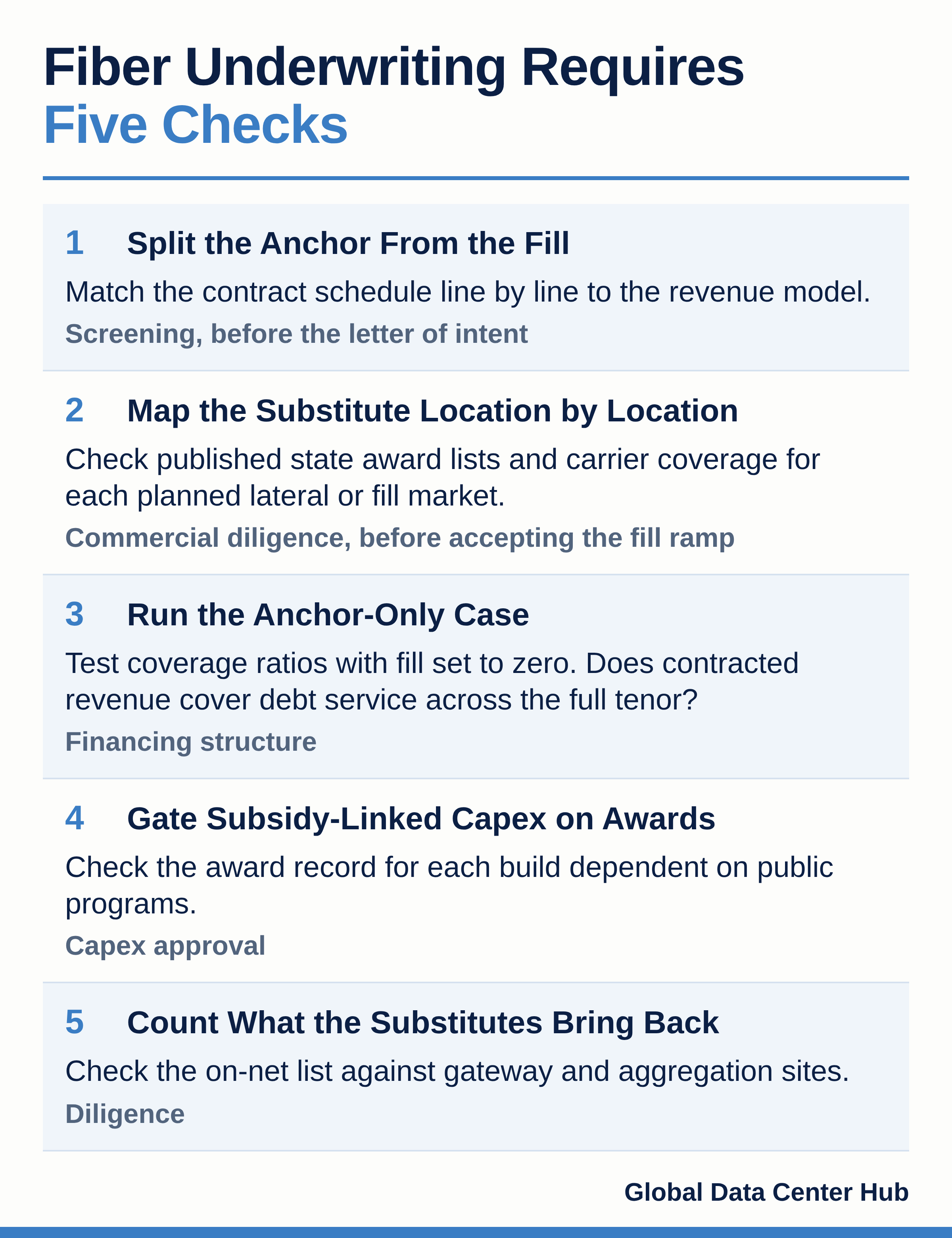
Start at the screen. Ask what share of projected revenue sits under contract (take-or-pay terms, indefeasible rights of use, minimum commitments, anchor leases) and what share is forecast fill.
The evidence is the contract schedule matched line by line to the revenue model. Do this before the letter of intent, because the split sets what the route is worth.
Map the substitute location by location. For each planned lateral or fill market, ask whether a state BEAD plan has already awarded the location to fixed wireless or satellite, and whether 5G home broadband is sold there today.
The evidence is the published state award lists and carrier coverage. This belongs in commercial diligence, before the fill ramp is accepted.
Run the anchor-only case. Ask whether contracted revenue alone covers debt service across the full tenor.
The evidence is coverage ratios with fill set to zero. This belongs in financing structure, and it decides how much debt the route can carry.
Gate subsidy-linked capex on awards. Ask which builds depend on public programs, and whether each one has a confirmed award.
The evidence is the award record itself. This belongs in capex approval.
Count what the substitutes bring back. Satellite and fixed wireless traffic still reaches the internet through ground stations and towers that feed data centers. Ask whether the network is on net at those points.
The evidence is the on-net list against gateway and aggregation sites. This belongs in diligence, because it is where the tail turns back into demand.
Enterprise Fill Is the Next Contested Layer
BEAD settled the subsidized last mile.
The open question is how far the same economics reach into enterprise branches and backup circuits, the fill that data center fiber platforms still count on.
Ericsson expects fixed wireless to reach 350 million connections by 2031. Watch whether those connections start to show up in business accounts.
When they do, the anchor-only case stops being a stress test and becomes the base case.