

Welcome to Global Data Center Hub. Join investors, operators, and innovators reading to stay ahead of the latest trends in the data center sector in developed and emerging markets globally.
Edition No. 74
THE WEEK’S THESIS: THE POWER DATE DECIDES
The power date decided what a data center contract was worth this week. The deals that came with their own power moved. The deals waiting on someone else’s grid got cut.
Microsoft will fund new generation for its Indiana campus through NiSource. Google is paying homes and businesses across the PJM grid to free up capacity through Voltus. In Norway, Crusoe keeps adding halls on Polar’s hydro power.
The ones that stalled were waiting on a power line. Nscale’s Loughton site lost its anchor customer when the grid date moved out by years. NEXTDC cut its outlook after work stopped on the line feeding its Melbourne campus. A contract with no power date is a promise with no start date.
The structure behind Nebius’s deal is in The Mechanism below.
MARKET SIGNALS
Amazon commits to Germany. Amazon plans to invest more than €16 billion (~$18 billion) in Germany in 2027. AWS takes €4.8 billion of that to expand its Frankfurt region. The release doesn’t separate new money from projects already announced. Either way, Frankfurt’s grid now has to carry a bigger cloud on a 2027 timetable.
Nvidia stands behind its customers’ buildings. Forbes tallied ~$164.5 billion of data center commitments Nvidia has reportedly guaranteed or taken on, based on The Information’s reporting. The largest piece is reportedly a ~$105 billion lease guarantee for an OpenAI campus in Ohio. The chipmaker’s own quarterly filing confirms a much smaller slice: $3.53 billion of land, power and shell guarantees. Most of the headline number sits outside the filing, so the full size of the backstop is still a reported figure.
OVHcloud has room to sell. OVHcloud has 250MW connected and 140MW in use, CEO Octave Klaba told Reuters. That leaves 110MW, about half, ready for new customers. Its first AI model launches in early 2027. Powered, empty halls are the scarcest thing in Europe right now, and the French provider has them.
Thailand writes the rules first. Thailand is finalizing data center rules while projects worth more than 1 trillion baht (~$30 billion) wait on them, Bangkokbiznews reported. Proposed setbacks run 100 to 200 meters from homes, schools, hospitals and temples, scaled to how much fuel a site keeps. A draft framework is due in the first quarter of 2027. Until then, the pipeline has a price and no permit.
CAPITAL WATCH
Blackstone and its energy fund. Blackstone closed its fifth energy transition fund at $8.7 billion, its hard cap and more than 50% larger than the last one. The fund has already backed three power generation and transmission platforms. It also bought Flow Control Holdings, which makes parts for data center liquid cooling. Private equity is paying for the plant behind the building, the part that sets the power date.
Elice and the Kosdaq. Elice, a Korean GPU cloud provider, fell 32% on its Kosdaq debut on Oct. 20. It raised 201.1 billion won (~$151 million) at 90,500 won a share, the top of its range, then closed at 61,500 won. The retail tranche was reportedly ~400 times oversubscribed. Every GPU cloud heading to market now gets priced against that first day.
DayOne and its bankers. DayOne is weighing whether to delay its US listing or shrink it to $2.5 billion to $3 billion, Bloomberg reported. The original plan reportedly targeted as much as $5 billion at a $20 billion valuation. No decision has been made. A smaller deal keeps the listing alive but lets this month’s market set the price.
Nvidia and Firmus. Nvidia is in talks to invest hundreds of millions of dollars in Firmus, The Information reported. The GPU cloud provider had shelved its ~$5 billion IPO. Bloomberg reported earlier this month that Firmus was exploring a $2 billion to $3 billion private round. The private round’s price will show whether that check sets the value or props it up.
GLOBAL LENS: THIS WEEK BY REGION
Europe: hydro and cooling get booked first
VINCI’s Cobra IS won a €165 million contract for the cooling plant at a large data center campus in the Iberian Peninsula. The job covers 126 dry coolers sized for about 200MW, plus mechanical and electrical work. The client and the country aren’t named. Cobra is bidding for later phases it puts at several billion euros. Cooling now gets bought as a plant of its own, and the phase-one contractor stands first in line for the rest.
Polar plans a second building at its Tørdal site in Norway, with 40MW of liquid-cooled IT for Crusoe. The first building, at 12MW, is already live on hydro power. Crusoe plans to deploy Vera Rubin NVL72 systems in the new hall, due to go live in late 2027. The release doesn’t say that capacity is under contract yet. Norway gives the tenant a power date it can count on, so the open item is the lease.
North America: capacity found outside the queue
Google expanded its Voltus deal to a 1GW virtual power plant across PJM, up from 100MW signed in June. Voltus pays homes and businesses to cut their use at peak times through thermostats, batteries and industrial equipment. Google funds it, and the agreement runs about three years. That’s headroom on the grid that already exists, with no new plant to build. The test is whether PJM keeps counting that flexibility as capacity.
Applied Digital and Soluna signed a definitive agreement for a joint venture to build a 50MW data center in Briscoe County, Texas. Applied takes 51% and brings the capital. Soluna takes 49% and brings land and power assets next to the 150MW Briscoe wind farm. ChronoScale, majority-owned by Applied, signed only a non-binding letter of intent to lease it. Closing waits on a county tax abatement, and the tenant is still a sister company.
Asia-Pacific: old buildings get the GPUs
GreenSquare brought SYD1 online in Western Sydney, a 1995 data center rebuilt for AI in eight months. Sharon AI is the tenant and is deploying ~8,200 Blackwell Ultra GPUs. IT capacity rose 275% inside the original footprint. Programs managed by Partners Group back the developer. The proposed 80MW second stage will show whether reuse works at scale.
Aolani says it signed non-binding letters of intent for up to ~500MW across Tier III sites in Malaysia. It names neither the sites nor the counterparties, and the letters still need definitive agreements. The startup expects up to 580MW committed by 2027, up from ~80MW this year, with capacity arriving from the second half of 2027. It also plans 22,000 Blackwell Ultra GPUs across Malaysia and the Philippines. The letters hold the megawatts, but a signed lease and the GPU financing decide whether anything gets built.
CONSTRAINT OF THE WEEK: THE GRID DATE
The grid date decided more contracts this week than price did. Microsoft confirmed on Oct. 19 that it pulled out of Nscale’s Loughton site in Essex. Power was due around the end of 2026, and the grid now points to the 2030s. Darren Hardman, who runs the company in the UK and Ireland, told ITV its £22 billion UK plan won’t change. So the money stays in Britain and moves to sites that can switch on sooner.
NEXTDC cut its FY27 guidance on Oct. 21 after Jemena suspended parts of a power line upgrade feeding its M3 campus in Melbourne. Net revenue guidance fell to A475–500millionfromA615–640 million. Work won’t restart before February 2027, so the next power increase at M3 slips to FY28. The shares fell about 40% that day, Rask Media reported. One suspended line repriced a listed operator’s whole year.
Developer Curtis Hall wants a gas plant of up to 49.9MW to start its Cardiff data center, the BBC reported. The plant would run from July 2028 to July 2033, when the full 150MW grid connection is expected. Critics say the size sits just under the 50MW line that sends a project to the Welsh government. Cardiff councillors have objected. Bridge power buys five years, and it moves the fight to the planning committee.
The next bottleneck is the courtroom. Two Lowndes County, Alabama residents sued the county commission over its approval of Project Red Clay under the state’s Open Meetings Act. The project carries a $1.15 billion tax break and has asked Alabama Power for 1,500MW. The judge has recused, and the case is pending. A campus can have its power lined up and still sit idle while a court reviews the vote.
THE MECHANISM
One-year money for a multi-year build
Nebius is an AI cloud company listed on Nasdaq and based in Amsterdam. It builds data centers, fills them with GPUs and rents the computing power to developers and companies. On Oct. 22 it signed a $3.5 billion senior secured facility with Citi. The money goes to data center development, GPU purchases and general corporate purposes.
The facility matures in 364 days. It charges Term SOFR, a benchmark rate, plus 2.75% at first, and that margin can rise to 3.50%. It’s secured, and Citi is lead arranger, agent and security agent. Customer prepayments and operating cash flow make up the rest of the funding base, the company says.
So this is bridge money. Nebius says longer-term asset-backed debt can follow, based on more than $40 billion of long-term contracts with investment-grade customers. That debt rests on the contracts. The contracts rest on halls that are powered and running. Citi gets repaid from that next financing, which puts every power date in the build inside a one-year clock.
The release doesn’t say what secures the loan or what moves the margin up. It doesn’t name the customers behind the $40 billion or say when their capacity goes live. The risk sits in the gap between a 364-day maturity and a build that runs longer.
I’m watching whether the longer-term debt closes well before the 364 days run out. I’d press on what happens to the margin if a site slips. The document to watch is Nebius’s third-quarter results filing, where the security package and the step-up terms should appear.
NOTABLE TRANSACTIONS
NiSource: 20-year Microsoft power agreement for ~1,100MW of new generation
NiSource signed a long-term energy agreement with Microsoft on Oct. 16 for its planned campus in northwest Indiana. Service starts in 2028 and runs for 20 years. Its generation arm will add about 1,100MW to its pool. No contract value was disclosed.
What makes it notable is that the customer pays for the power plant before it draws a megawatt. The tech company fully funds the generation and transmission needed to serve its load. The utility says that keeps the cost off its existing NIPSCO customers.
The utility now expects about $1.75 billion of savings for those customers over the contracts’ lives, up from $1.4 billion. That works out to as much as $140 per customer a year. The generation arm also contracted 600MW of battery storage under a long-term tolling agreement. An affiliate of AGP Group will build it.
What to watch is the regulatory approval. The agreement still needs it, and the conditions attached will show how much risk stays with ratepayers. A clean approval gives other utilities a template to copy.
Alcoa: Massena East smelter site sale for up to $315 million
Alcoa signed definitive agreements on Oct. 15 to sell parts of its idle Massena East smelter site in New York to a data center developer. Total proceeds could reach $315 million. The company doesn’t name the buyer. Datacenter Dynamics reported it is North Country Colocation Services, an NYDIG affiliate.
What makes it notable is that most of the price depends on megawatts that don’t exist yet. The seller gets about $50 million to $65 million at closing, set by how much data center capacity is approved.
Another $60 million to $250 million comes over seven years after closing, tied to approved expansions and commissioned capacity. Most of it is expected in the first five years. Alcoa’s CFO said on the earnings call that 180MW is initially permitted, expandable to 635MW, DCD reported. So the seller shares the permitting risk and gets paid as the buyer’s power comes through.
What to watch is the permitting. Closing needs regulatory approvals and the conditions to start construction, and it’s expected within six months. The approved megawatts decide how much of the $315 million Alcoa actually sees.
CBRE: Onnec acquisition for £460 million plus up to £300 million earnout
CBRE signed a definitive agreement on Oct. 20 to buy Onnec Group, a London-based data center infrastructure services firm. The initial price is £460 million (~$610 million) in cash. Closing is expected around the end of the year, subject to regulatory approvals.
What makes it notable is that a real estate services firm is paying a buildout price for cabling and fiber crews. Onnec designs, deploys and maintains network, fiber and data center infrastructure for hyperscalers in the UK, Europe and Asia-Pacific.
Onnec is expected to bring in about £370 million of revenue and more than £50 million of core EBITDA in 2027. That puts the upfront price at no more than about nine times 2027 core EBITDA. The earnout adds up to £300 million if Onnec hits growth thresholds. CBRE expects its critical infrastructure services line to bring in nearly $4.5 billion of revenue in 2027.
What to watch is the earnout. Its terms haven’t been published. They’ll show how much of the price rides on hyperscaler build spending staying high for several more years.
THE FRAMEWORK: WHEN THE POWER ARRIVES
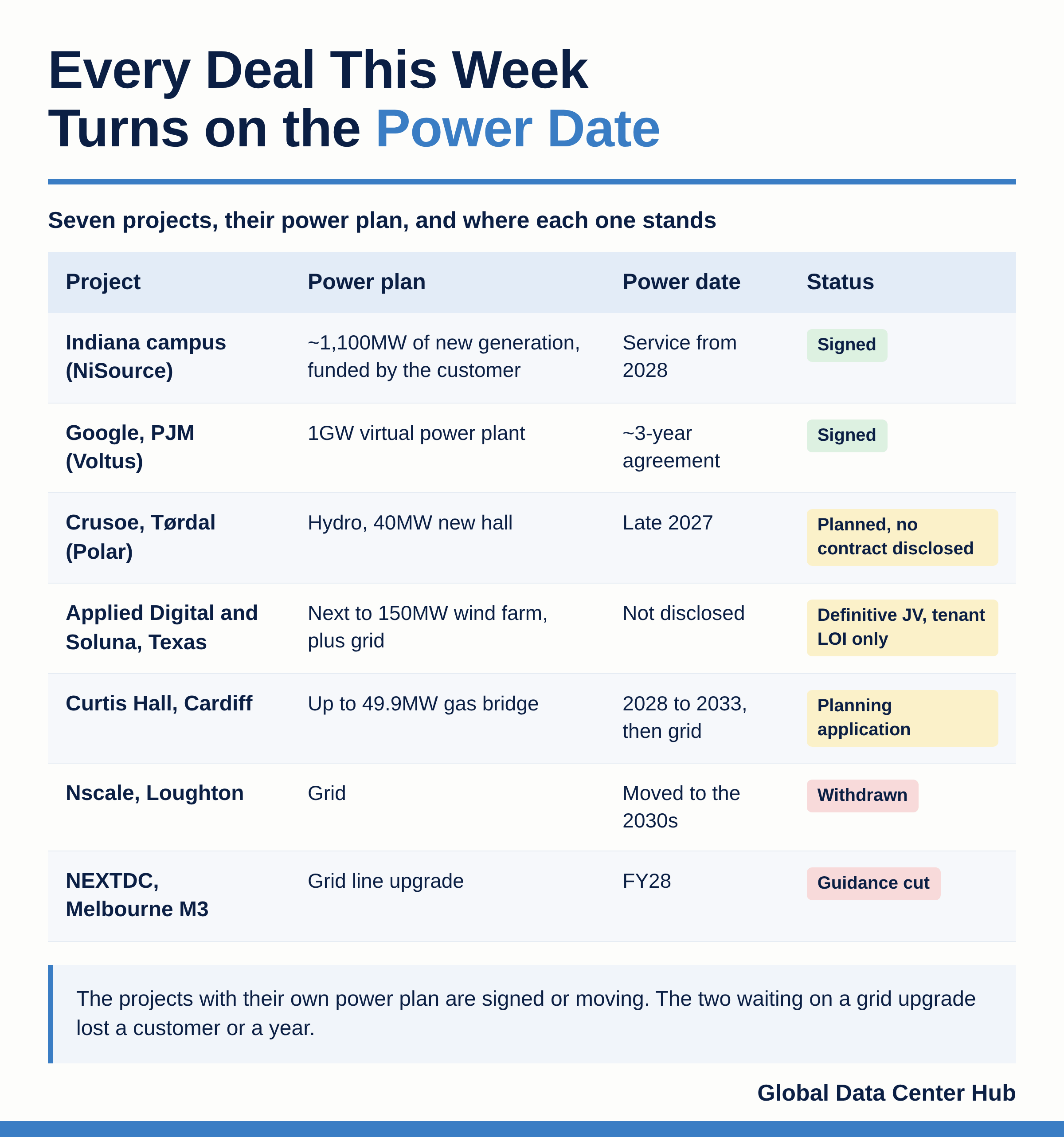
Every deal in this edition turns on the date its power shows up. The table sets each one against its power plan and where it stands.
THE QUESTION FOR NEXT WEEK
What does NiSource disclose on Oct. 28? The utility promised more operational and financial detail on the deal at that day’s third-quarter call. If it puts a cost on the new generation, every utility courting a hyperscaler gets a price to copy.
If you are new to Global Data Center Hub, visit our Start Here page for more information about the newsletter.
If you found this newsletter useful, share it with a colleague.
Have a great week.
- Obinna