
Welcome to Global Data Center Hub. Join investors, operators, and innovators reading to stay ahead of the latest trends in the data center sector in developed and emerging markets globally.
Edition No. 76
THE WEEK’S THESIS: FUNDING CLOSES, DELIVERY SLIPS
This week the money showed up on time and the megawatts didn’t. Financing for AI capacity closed in Korea, Saudi Arabia, Malaysia, Thailand and the Nordics. Grids and customers set the dates that matter.
Naver’s deal is the clearest case. The capital is committed and Nvidia has paid in. The first compute still won't arrive until 2027. HUMAIN, PDG and Polar also banked money this week. Their calendars now sit with utilities and construction crews.
The slips came from the delivery side. IREN pushed back work for Microsoft after the customer changed the design. NextDC’s Melbourne power slipped, and two rivals bought into the stock. In the US, the midterms put local opposition on the ballot.
The structure behind Naver’s deal is in The Mechanism below.
MARKET SIGNALS
Voters turned on data centers. Democratic governors won on promises to stop data center building, the Financial Times reported. Ballotpedia counted 41 data center ballot measures in the same vote, and all but one went against data centers, Silicon UK reported. Meta president Dina Powell McCormick told the Wall Street Journal that new US campuses will be harder to build but existing ones easier to expand. So a site that already holds its permits is now worth more than land still waiting on a vote.
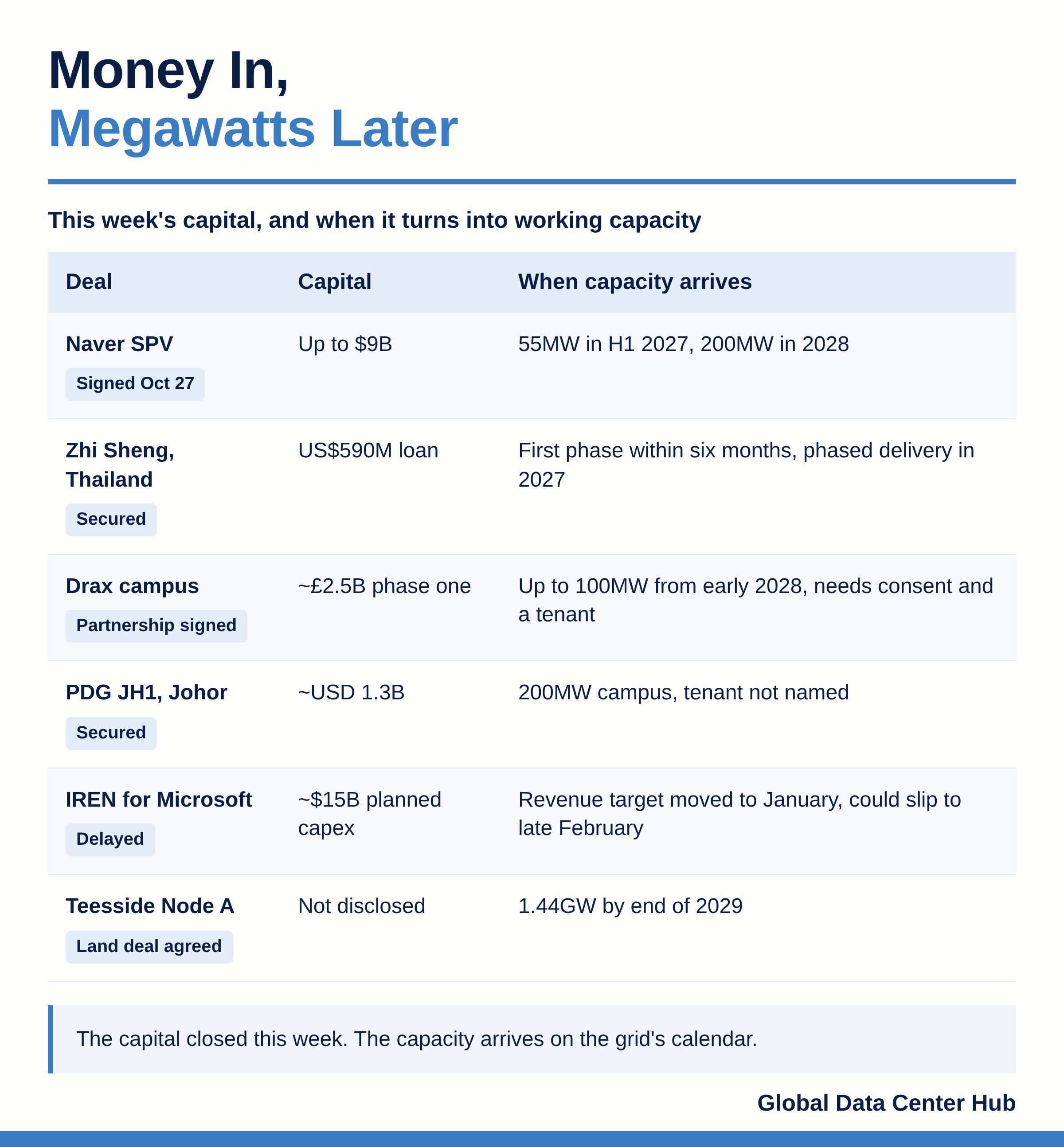
A neocloud schedule slipped. IREN delayed part of its 200MW of Texas capacity for Microsoft, Reuters reported. The customer asked for the design changes, so no penalties apply. The target for more than $4 billion of annualized revenue moved from year-end to January, and could slip to late February. Bloomberg reported the customer is tightening oversight of neocloud projects, while IREN plans roughly $15 billion of capex.
Johor gets a second Microsoft region. Microsoft Malaysia said Southeast Asia 3, a new cloud region in Johor Bahru, will join Malaysia West, which opened in May 2025. The company expects SEA3 to become its largest region in Southeast Asia. No figure or opening date came with it, so it’s a claim on Johor power that still has to be priced.
CAPITAL WATCH
Pure DC and Citi, FAB and Infranity. Pure DC put in place a $780 million Platform Growth Facility with a $1.1 billion accordion. Together, they let it raise about $1.9 billion for its pipeline and new sites across Europe and the Middle East. Citigroup, First Abu Dhabi Bank and Infranity join existing lenders ABN AMRO, Allianz Global Investors and SMBC. The money sits at platform level, so lenders are now funding sites before anyone names them.
ING and the bid list. ING is selling about $500 million of data center loans in a single auction, Bloomberg reported, citing people familiar with the matter. The dozen loans include a $25 million debt piece on a Stargate campus in New Mexico. The rest is tied to Vantage Data Centers and CyrusOne. Bids must be at least $10 million, so buyers will be funds big enough to take on construction risk the bank no longer wants.
GLOBAL LENS: THIS WEEK BY REGION
Asia-Pacific: banks fund Johor, the next wave is pledged
PDG secured ~USD 1.3 billion of green financing for its JH1 campus in Johor’s Sedenak Tech Park. Six banks lent, including HSBC, Maybank, OCBC and Standard Chartered. The 200MW campus is built for AI and cloud loads, and the tenant isn’t named. The money counts toward PDG’s plan to raise up to USD 5 billion of debt. Six banks on one Johor campus says lenders still treat the corridor’s land and power as bankable.
Google will invest $15 billion in Malaysian data center campuses over 2027 and 2028, AFP reported. That builds on the $2 billion it announced in 2024. It also pledged more than one gigawatt of new clean energy for the national grid. The plan carries no capacity figure and isn’t a signed deal. How fast that grid pledge lands will decide how fast the campuses can draw power.
North America: builders share the risk, then move in
Fluor signed a definitive EPC contract with TeraWulf for three buildings at the Justified Data Campus in Hawesville, Kentucky. Fluor carries cost overruns up to a share of its profit. Neither side gave a value or a megawatt figure. Fluor books the award in the fourth quarter, once pricing for the first two buildings is final. With the contractor sharing overrun risk, TeraWulf’s lenders get a firmer ceiling on the bill.
SpaceXAI is opening two more Colossus 2 campuses in Southaven, Mississippi, Elon Musk said. Gun Range, a former police and fire training site, should run by the end of November. Spam, a former Hormel Foods warehouse, follows in December. Musk put about 420,000 Nvidia GB300 GPUs across the two. Reusing old industrial buildings shortens the build, so power permits become the pacing item.
Europe: Nordic money and an English power station
Polar has passed €1 billion of funding commitments in 2026. That includes an €800 million Nordic bond from June and new equity from H.I.G. Capital and LIAN Group. Palistar Capital added an initial €75 million development facility for early work such as land and grid connections. The bond and equity fund two contracted Norwegian projects, DRA02 and HER01. The Palistar line pays for grid connections in Finland and Germany before any tenant signs.
Drax signed an agreement with Brookfield and its UK platform Radiant to develop an AI campus at Drax Power Station. The target is more than 1GW, with up to 100MW in phase one from early 2028. The investor puts phase one at about £2.5 billion, and total potential spend, chips included, above £20 billion. Phase one still waits on planning consent and an anchor tenant. The site already has about 4GW of grid access, so the tenant search starts with power in hand.
CONSTRAINT OF THE WEEK: POWER COMES WITH THE SITE
Power decided which projects moved this week, and the builders who brought their own moved first. Google said it will spend $17 billion on a campus in Laramie County, Wyoming, Silicon UK reported. Part of the power comes from a planned 702MW fuel cell plant using Bloom Energy cells. Google said it will pay for all the power the campus uses. Covering the full bill answers the ratepayer objection before a regulator raises it.
Partners Group completed its majority investment in AVK, an initial commitment of over $1 billion. AVK builds, owns and runs on-site power for data center developers. Customers pay through power purchase agreements, with no upfront capex. AVK reports an Energy-as-a-Service pipeline above 2GW. That moves on-site generation off the developer’s balance sheet and onto a fund’s.
Teesworks agreed to sell 73.3 acres at Dorman Point to National Grid for a new substation, Teesworks said. Teesside Node A should deliver 1.44GW by the end of 2029. Teesworks will clean up the site over six months before the land transfers. Steel River Power has 1,440MVA of that capacity contracted for its private network. Substations are the next bottleneck, and that's three years away.
THE MECHANISM
The investor owns the GPUs, Naver carries the bill
Naver runs a South Korean internet portal and sells computing through Naver Cloud. On October 27, it signed an infrastructure agreement worth up to $9 billion with Brookfield. The deal funds an AI factory centered on Naver’s GAK Sejong data center. Capacity starts at 55MW in the first half of 2027 and reaches 200MW in 2028. It also cleared the way for Nvidia, which paid $1 billion for 4.13% of Naver on November 6.
The investor sets up a special purpose vehicle, tentatively called Asset Co. It puts all of the SPV’s capital into buying GPUs and data centers. Asset Co. sells that compute to Naver Cloud, which runs the factory. Usage fees track business revenue, so payments stay light while the factory ramps. Naver guarantees Naver Cloud’s fee obligations for up to eight years.
That splits ownership from risk. The SPV owns the chips and the buildings. Naver holds control and expects to consolidate Asset Co. as a subsidiary under Korean accounting rules. Naver says the guarantee creates no cash outflow. Its credit still stands behind every fee.
The release gives no fee level and no contract term past the guarantee. It also says nothing about what the GPUs are worth when the guarantee ends. That residual value decides who eats the loss if the chips age faster than the fees pay them down.
I’d watch the guarantee more than the headline number. If Naver consolidates Asset Co., the outside money behaves like Naver’s own debt. I want to see the fee schedule in Naver’s next quarterly filing. The real test is the first 55MW, due in the first half of 2027.
NOTABLE TRANSACTIONS
Aramco: 49% of HUMAIN for ~$2.6 billion in cash plus AI assets
PIF and Aramco closed their HUMAIN transaction on November 1. The oil company now holds 49% of the Saudi AI firm through a wholly owned subsidiary. PIF keeps 51%. The buyer will transfer key AI assets and add about SAR 9.9 billion ($2.6 billion) in cash during 2026.
What makes it notable is that the buyer pays mostly in kind. The cash comes on top of AI, compute and digital assets. Both shareholders also contribute capabilities and talent. So the firm’s value now rests on what those contributed assets earn.
The firm launched in May 2025. It builds data centers, cloud platforms and AI models, including the Arabic language model ALLaM. The deal supports its plan for 3GW of AI data center capacity by 2030. Aramco expects revenue growth from running its industrial operations on that infrastructure.
Watch for the first named outside customer. A third-party contract would show the build plan can sell beyond its own owners.
Zhi Sheng Group: US$590 million seven-year loan for a Thai AI campus
Hong Kong-listed Zhi Sheng Group secured a seven-year, US$590 million loan from a Thai bank, the company said on November 6. The borrower is Haoyang Data Center 1 (Thailand), part of a group Zhi Sheng is buying. The loan funds a hyperscale AI data center in Thailand’s Eastern Economic Corridor. First-phase completion is targeted within six months, with phased delivery in 2027.
What makes it notable is that a signed lease backs the loan before the building exists. An unnamed leading internet company signed a 10-year colocation agreement in July 2026. The contract is valued at about US$1.6 billion, excluding electricity.
That contract covers about one-third of expected rental revenue at full build. So the bank lends against a minority of the site’s future income. The borrower’s chairman, Chatchaval Jiaravanon, belongs to the family that controls CP Group.
Watch for an exchange filing that names the bank and the tenant. Then watch who leases the other two-thirds.
Goodman and Digital Realty: up to 9.9% of NextDC at AU$9.50 a share
Goodman and Digital Realty ran an after-market book build for up to 9.9% of NextDC on November 4. They bid AU$9.50 a share through Ackland Investments No.1 Trust, a vehicle they own jointly. The final stake was still unconfirmed when the target responded on November 5. Both buyers said they have no current plans for a takeover bid. They kept the right to make one later.
What makes it notable is the timing. The buyers moved about two weeks after the operator disclosed a power delay at its M3 Melbourne campus. Suspended parts of Jemena’s 66kV network works pushed M3’s next power step into fiscal 2028.
The operator cut fiscal 2027 net revenue guidance to AU$475 to 500 million, from AU$615 to 640 million. Underlying EBITDA guidance fell to AU$245 to 265 million. It paused projects and land purchases without customer contracts. NextDC called the stake purchase opportunistic.
Watch the substantial holder notices for the final stake size. A stake near 9.9% puts two rivals on the register of a power-starved competitor.
THE FRAMEWORK: MONEY IN, MEGAWATTS LATER
The money in this week’s deals is in place. The table shows when each one turns into working capacity, and what still stands in the way.
THE QUESTION FOR NEXT WEEK
Who bids on ING’s data center loans before the November 19 deadline? The clearing price will be the first market mark on construction-era AI debt since the midterms. A deep discount would raise borrowing costs for every developer still financing a build.
If you are new to Global Data Center Hub, visit our Start Here page for more information about the newsletter.
If you found this newsletter useful, share it with a colleague.
Have a great week.
- Obinna