
Welcome to Global Data Center Hub. Join investors, operators, and innovators reading to stay ahead of the latest trends in the data center sector in developed and emerging markets globally.
TL;DR
Meta expanded its Richland Parish campus in Louisiana to 5GW of compute capacity, the largest capacity figure among July’s five regional anchor deals. Meta is recorded as its own anchor customer, and the campus is under construction rather than proposed. Committed investment exceeds $50 billion, with a further sum for roads, water and wastewater held outside that figure.
SK Telecom committed $91.5 billion, the equivalent of KRW140 trillion, to more than 2GW of AI data center capacity across Yeongnam in South Korea. SK Telecom describes the programme as the first major stage of a national platform targeting 15GW by 2035. No anchor customer is disclosed, and investment size, timing and financing structure remain subject to refinement.
Nscale and Nordkraft formed Nordscale Operations AS to run the 230MW Narvik campus, the only one of July’s five regional anchor deals that names a generation source. Nscale Norway holds 51 percent of the operating company and Nordkraft holds 49 percent. The underlying Kvandal facility is designed on hydropower, with OpenAI recorded as the initial offtaker.
Top 5 Deals — Deep Dives
Five transactions anchor the month, with Entergy’s power arrangement among the most significant. Its supply portfolio combines new natural gas generation, nuclear uprates, batteries and purchased electricity to serve large, steady loads without relying on a single technology. The nuclear up rates are particularly important, adding firm capacity without new plant siting. Taken together they describe five different answers to the same question, which is how you get compute built where the power actually is.
Meta Richland Parish 5GW Expansion (North America)
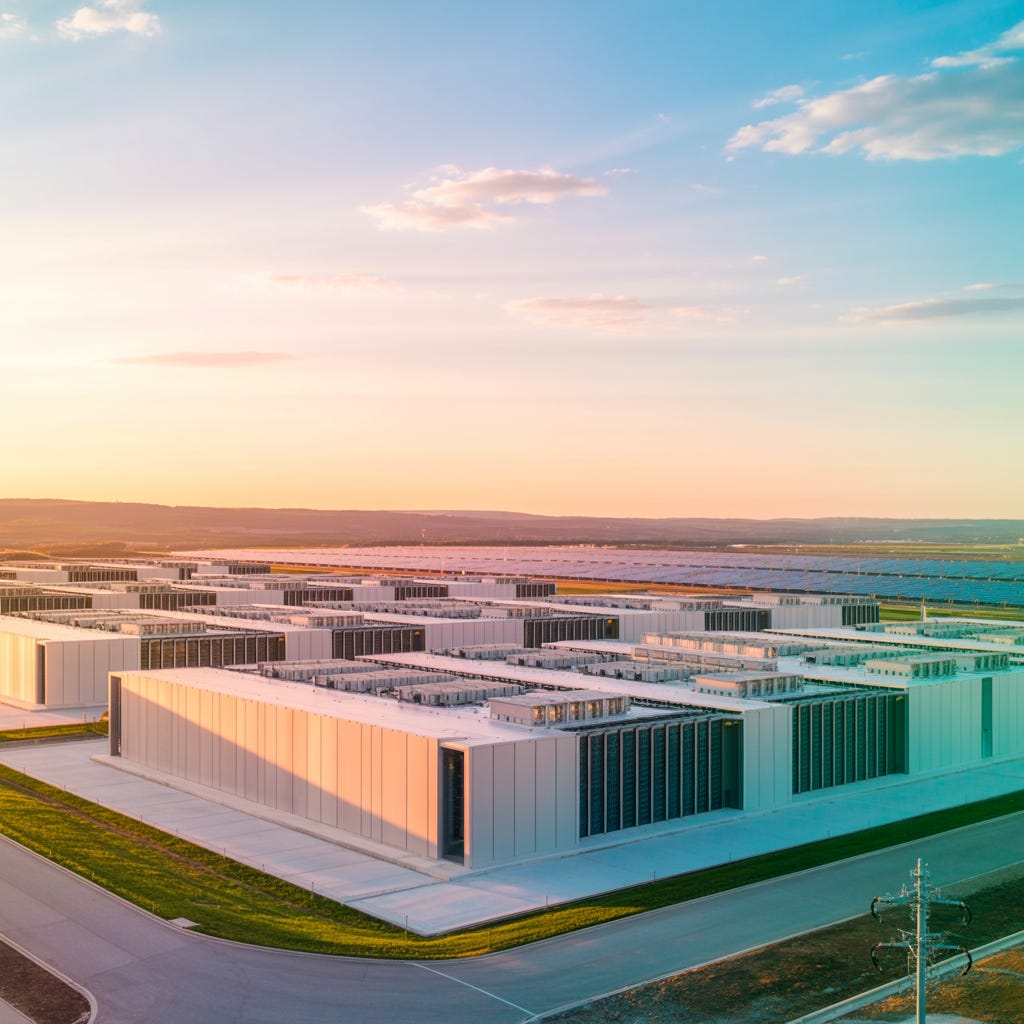
Meta expanded the scale and the investment commitment of its Louisiana campus this month, taking Richland Parish to 5GW of compute capacity with more than $50 billion committed.
The status matters as much as the number. This is recorded as under construction, not proposed, which separates it from most of what sits above 1GW in the July log.
The power arrangement is the key feature.
Entergy’s supply portfolio combines new natural gas generation, nuclear uprates, batteries and purchased electricity to serve a large, steady load without relying on a single technology.
That is why the tracker records the source as grid rather than a specific fuel.
The nuclear uprates are particularly important because they add firm capacity without requiring new plant siting, a meaningful advantage for a 5GW load.
On capital structure, Meta is its own anchor customer.
There is no third-party tenant, no lease, no offtake contract to underwrite.
The company is funding the campus against its own demand, and the more than $1 billion of roads, water and wastewater work sits outside the headline figure.
That combination, self-anchored demand and a regulated utility building the supply portfolio around it, is available to a very short list of companies.
What Richland Parish reveals about North America is that the region’s largest credible capacity now moves through utility planning rather than through developer speculation.
The campus is not competing for grid headroom that already exists. Entergy is building the headroom to fit it.
Nscale–Nordkraft Nordscale Operations, Narvik (Europe)
The Narvik transaction is the smallest of the five and the most instructive.
Nscale and Nordkraft created Nordscale Operations AS, a jointly owned company that will manage Nscale’s AI data center facilities in the Narvik region, with Nscale Norway holding 51 percent and Nordkraft 49 percent.
The company was announced in early July and is expected to begin operations during 2026. No deal value was disclosed.
The underlying asset is a 230MW hydropower-backed campus at Kvandal, with OpenAI as the initial offtaker. A further 290MW of potential expansion is excluded.
The key feature is the structure: Nscale gave regional utility Nordkraft 49 percent of the operating company, aligning the power provider directly with the facility’s performance.
In a European market where interconnection queues and local opposition decide which projects survive, that is a structural move rather than an administrative one.
Nscale did not buy power. It bought alignment with the entity that supplies it, and it paid in ownership.
What Narvik reveals about Europe is that the projects clearing the bar are the ones that solved power before they solved anything else.
It is also the only anchor deal this month that names its fuel, which says something uncomfortable about the disclosure standard everywhere else.
SK Telecom $91.5 Billion Yeongnam Buildout (APAC)
SK Telecom outlined a plan to build more than 2GW of AI data center capacity across Yeongnam, with $91.5 billion attached, the equivalent of KRW140 trillion.
The programme starts with a 100MW facility in Ulsan, adds a 900MW expansion and then a further 1GW elsewhere in the region.
SK Telecom frames it as the first major stage of a national platform targeting 15GW by 2035.
The $91.5 billion capital figure requires context. Against 2GW of disclosed capacity, it implies roughly $45.75 million per MW, well above typical hyperscale construction costs.
The gap reflects both understated capacity and substantial spending on GPUs, high-bandwidth memory and other AI infrastructure beyond the facility shell.
The 5GW and 15GW targets are longer-term portfolio goals and are not directly tied to this capital figure.
No anchor customer is disclosed, and no power source is disclosed. For a programme of this size in a grid-constrained country, the second omission is the more significant one.
What Yeongnam reveals about APAC is that the region’s largest commitments are now national in framing and corporate in execution.
A telecoms operator is carrying a state-scale compute target on its own capital plan, and the announcement arrived before the power arrangement did.
Trinidad and Tobago–EY 300MW Development MOU (Latin America)
Trinidad and Tobago signed a development memorandum with EY and third-party developers for a 300MW data center project as part of a broader digital infrastructure push.
The 300MW represents peak power capacity rather than critical IT load.
A reported investment of more than $5 billion spans three national initiatives and cannot be attributed to this project, while its power source remains undisclosed.
The government also signed a separate memorandum with Hummingbird AI Holdings LLC on the same date for an initial 150MW with potential expansion to 500MW.
Two agreements, same week, same counterparty on the state side, different partners and different capacities.
An MOU with an advisory firm and unnamed developers is an early instrument. It commits nobody to spend anything.
What it does is signal that the state intends to package land, gas and policy for this use, and in a country with a long-established gas industry that is not an idle signal.
What Trinidad and Tobago reveals about Latin America is how thin the region’s disclosed pipeline is.
Three transactions across the entire month, and the region’s strongest entry carries no capital figure and no power source.
Any read on Latin America from this dataset is a read on three rows, and the report treats it at that weight rather than inflating it to match the other regions.
Crusoe $10 Billion Israel Lease Expansion to 150MW (Middle East & Africa)
Crusoe was reported to be expanding its leased footprint in Israel to approximately 150MW, with $10 billions of investment over roughly ten to fifteen years.
The expansion combines an additional 40MW on an existing Anan Group lease with a new 67.6MW agreement with MegaDC, across Afula, the Idan HaNegev Industrial Park and Haifa.
The status is Reported rather than announced, and the reason is specific.
Globes identified Crusoe as the customer, but neither MegaDC nor Crusoe had publicly confirmed the full programme, underscoring the distinction between reported and formally disclosed leased capacity.
The capital structure is unusual for a data center entry of this size, because Crusoe is not building.
It is leasing from third-party operators, and a substantial portion of the $10 billion is expected to fund GPU procurement rather than physical facilities.
That makes the figure incomparable with single-site construction capex and it makes the commitment far more reversible than an owned campus would be.
Power source is not disclosed for any of the sites.
What Israel reveals about the Middle East and Africa is that capacity in this region can now be assembled by contract rather than by construction.
Crusoe is acquiring one of its largest international positions without pouring concrete, which compresses the timeline and leaves the power question with the landlords.
Regional Scorecards
North America
Sixty-one transactions made this the deepest pipeline, led by long-term AI leases and power-backed projects.
TeraWulf, CleanSpark and Hut 8 secured 928MW of commitments, while major projects in Texas and Georgia paired data centers with dedicated power strategies.
Many Virginia and Pennsylvania proposals, however, lacked capacity, capital or power details.
The month was defined by hyperscalers and AI labs converting demand into firm commitments.
Europe
Fifty transactions showed a market dividing between projects with secured power and those still waiting for it.
Pure DC, Pantheon AI and Apto advanced large campuses through power and grid agreements, while others pursued alternatives such as offshore gas and wind.
Prologis’ $18.8 billion SEGRO proposal added a major consolidation signal. Europe’s defining constraint remains power access.
APAC
Thirty-three transactions showed the strongest concentration of state-adjacent ambition, led by major AI infrastructure programs in South Korea.
Australia delivered the region’s most complete power arrangement, while Southeast Asia advanced through large campus partnerships and financing.
India remained sovereign-led but modest in disclosed scale, while China surfaced mainly through early-stage initiatives.
Latin America
Just three transactions made July too thin for a confident regional read.
Trinidad and Tobago produced two government-backed memoranda totaling 450MW, while a nuclear-powered initiative emerged in Argentina and Brazil.
None disclosed capital commitments, and established markets such as Brazil, Chile and Mexico were largely absent. The month was defined by intent rather than execution.
Middle East & Africa
Seven transactions showed a region dominated by sovereign-led development.
The UAE, Saudi Arabia and Côte d’Ivoire advanced national AI and data center initiatives, while Jordan added a gas-backed campus proposal.
Commercial activity was limited, led by Crusoe’s reported Israel expansion and projects in Egypt and South Africa. Capital and power disclosures remained scarce.
Forward Indicators
The next 500MW to 1GW increments will land where secured land, power and demand converge. Few markets currently clear all three.
Texas is the strongest signal, with six independent developers assembling power-first positions, including MARA, Liberty Energy and PowerBridge, QTS, Crusoe, Nexus and Hut 8.
In Europe, Finland, Croatia and Poland stand out.
Seinäjoki has the full stack of permits, power, leasing and financing; Topusko has secured technical approval for 800MW; and Poland’s Gryfin Project offers a credible phased path toward 790MW.
Spain is also building a corridor of pre-secured power positions.
Australia leads APAC because large-scale power is already contracted, while South Korea’s major projects still lack disclosed power arrangements.
The UAE and Saudi Arabia are building sovereign delivery platforms ahead of capacity.
Latin America remains speculative, with Trinidad and Tobago’s memoranda still requiring developers and power contracts to convert.
Investor Takeaways
For institutional investors, July reinforced the separation of ownership from operations.
Meta, Nscale, Orange, TeraWulf and others brought outside capital into infrastructure while retaining operating or customer relationships.
These structures create new entry points, but should be priced on contracted demand, not announced capacity.
For sovereign investors, national ambition is not enough. The strongest projects pair policy support with a named utility or power counterparty from the outset.
For operators, contracted demand is now the entry ticket.
CleanSpark, TeraWulf and Hut 8 converted secured demand into long-term leases and financing, while speculative filings without tenants or power increasingly register as noise.
For utilities and policymakers, Richland Parish offers the clearest model: build new generation around future load rather than ration existing capacity.
Where utilities cannot do this, developers are increasingly pursuing off-grid and behind-the-meter alternatives.
My take…
https://danielsethroberts.substack.com/p/data-centers-are-not-ai-factories?utm_source=share&utm_medium=android&r=8cnl84