
Welcome to Global Data Center Hub. Join investors, operators, and innovators reading to stay ahead of the latest trends in the data center sector in developed and emerging markets globally.
The Funding Question Is Back, and the Answer Changed
In Q1, this series argued that capital structure was the first deciding variable in AI infrastructure and cost structure the second.
Meta’s Q3 shows what happens when the second variable can’t carry the load. The problem goes back to the first, and this time the answer is equity.
Demand is not the constraint. Meta says it is building four superclusters of more than one gigawatt each and expects its infrastructure capacity to nearly double in 2026.
What binds is the physical delivery of that capacity: power, sites, equipment, and the cash to pay for all of it before it earns anything.
Meta’s net property and equipment rose 43.5% in nine months, to $253.2B.
That asset base now starts to depreciate, and the depreciation lands on income statements long before the new products built on it report revenue.
The Ad Engine Is Not the Problem
The stock sale is not the rescue of a weak business. Advertising revenue rose 25.9% to $63.1B, 97.6% of the total.
Ad impressions grew 10% and the average price per ad grew 14%, so Meta sold more ads and got paid more for each one.
Revenue beat the $63.34B consensus and cleared the top of Meta’s own $61B to $64B guidance.
AI is paying off inside ads, measurably. Meta reports a 9.6% lift in app-ad conversions from expanding its GEM ranking model, and partnership ads now run above a $15B annual rate after growing more than 97%.
These gains show the infrastructure already earns a return where Meta has a business to put it in.
They don’t show a return on the whole program, because Meta doesn’t disclose one.
The Payroll Swap Did Not Close the Gap
In Q1, Meta framed compute and people as its two main cost centers and cut 8,000 roles to shift spending from one to the other.
The cut happened. Headcount ended Q3 at 66,775, down 15% from a year ago.
Costs grew anyway. Excluding a $9.89B legal charge tied to an agreement with 52 state attorneys general, expenses rose 35.9% to $41.7B, well ahead of 26.1% revenue growth. Cost of revenue rose 45.2%, depreciation 44.1%, and research and development 32.4%.
Operating margin, again excluding the charge, fell to 35.4% from 40.1%.
The mechanism matters for anyone building or financing capacity.
Meta named third-party cloud spending and third-party AI token costs as expense drivers alongside its own depreciation and data center costs.
Owning more capacity hasn’t ended Meta’s need to rent it while new workloads scale.
The labor swap is real, but it is small next to the infrastructure bill.
Capex Crossed Operating Cash
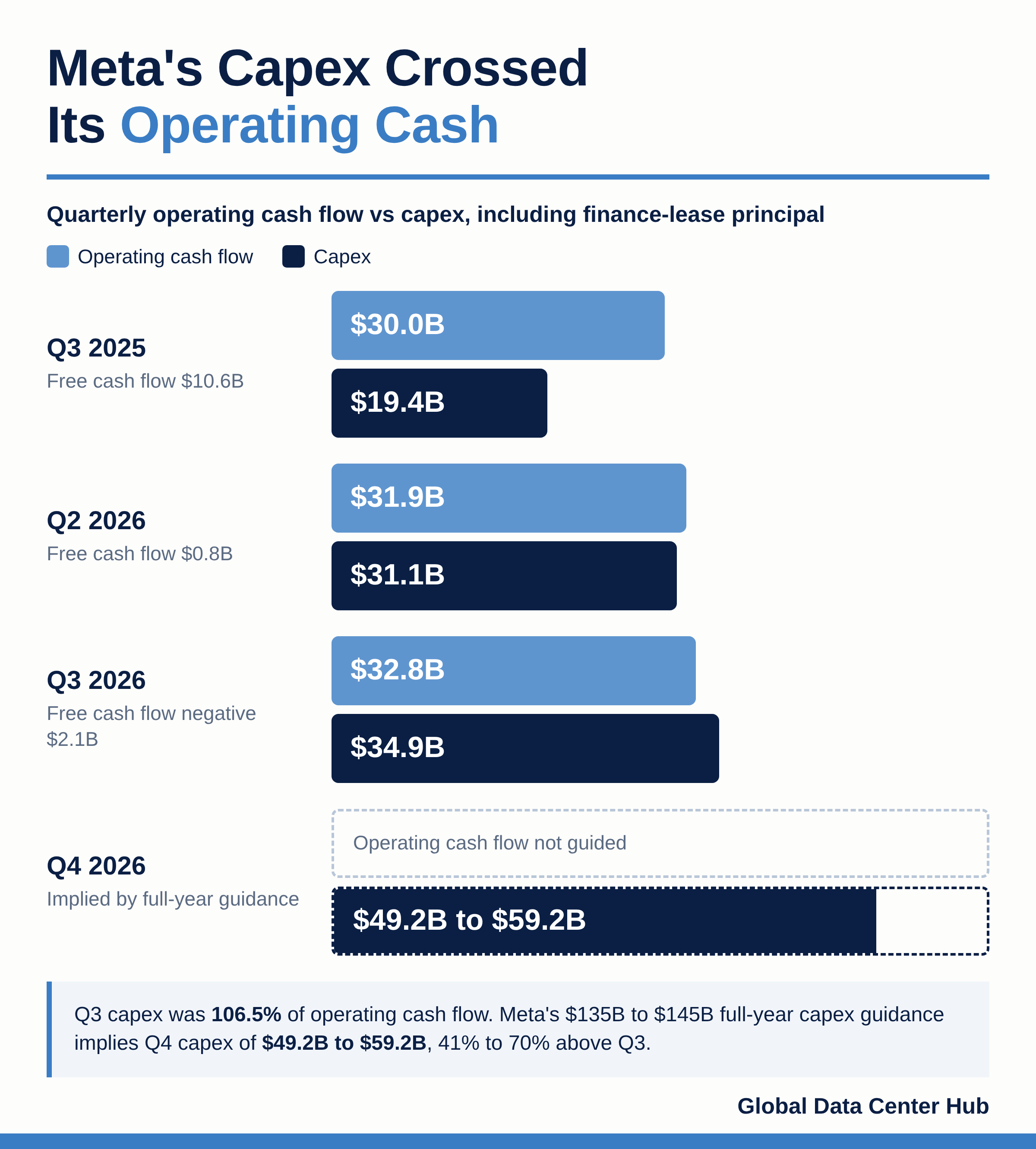
Q3 capex, including finance-lease principal, reached $34.9B against $32.8B of operating cash flow. That is 106.5% of the cash the business produced, and 54% of revenue. Free cash flow came in at negative $2.1B.
The year is not yet negative. Free cash flow through nine months was $11.0B, but that is down 62.6% from $29.5B in the same period of 2025. The bigger pressure is ahead.
Meta’s capex floor has risen in every quarter of 2026, from $115B to $125B, then $130B, now $135B, while the $145B ceiling has held since Q1. Hitting the new range means Q4 capex of $49.2B to $59.2B, which is 41% to 70% above Q3.
Free cash flow also overstates what is left. Meta paid $4.1B in dividends through September and $12.8B in taxes on employee share settlements, and both sit outside its free cash flow measure.
On the balance sheet, cash and securities of $82.4B now exceed long-term debt by only about $1.5B, after debt rose $22.2B since December.
Meta had already borrowed heavily this year. The equity raise is what came next.
Why Equity, and What It Costs
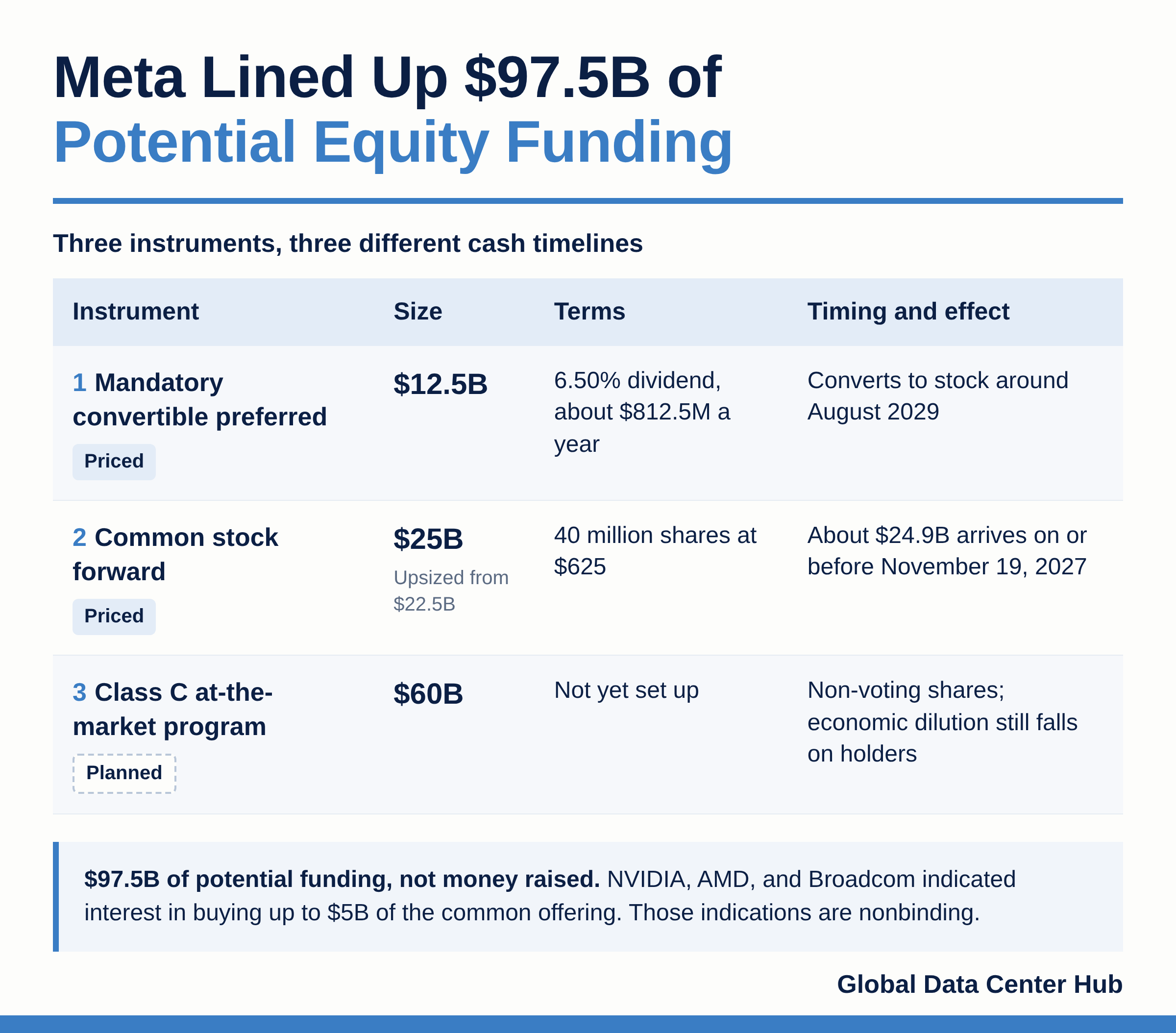
The financing has three parts. A $12.5B mandatory convertible preferred pays a 6.50% dividend, about $812.5M a year, and converts around August 2029.
A $25B common stock offering, upsized from $22.5B, sold 40 million shares at $625 through forward contracts.
Meta expects about $24.9B when those forwards settle, on or before November 19, 2027, so the cash is not on hand today. A further $60B Class C at-the-market program is planned but not yet set up.
Together that is $97.5B of potential funding, not money raised.
Class C stock is the structural piece. Meta plans a one-for-one Class C dividend to existing holders around January 19, 2027, which leaves voting power unchanged.
After that, Meta can issue non-voting shares to raise money, pay employees, or buy companies without diluting founder control.
The economic dilution still falls on holders. Equity avoids more leverage on a balance sheet where debt now nearly matches cash, but it shifts the cost onto per-share returns.
One detail shows how tight the loop has become. NVIDIA, AMD, and Broadcom indicated interest in buying up to $5B of the common offering.
Those indications are nonbinding. Even so, the companies Meta pays for chips and networking offered to help fund the purchases.
Meta Funds AI From a Single Business
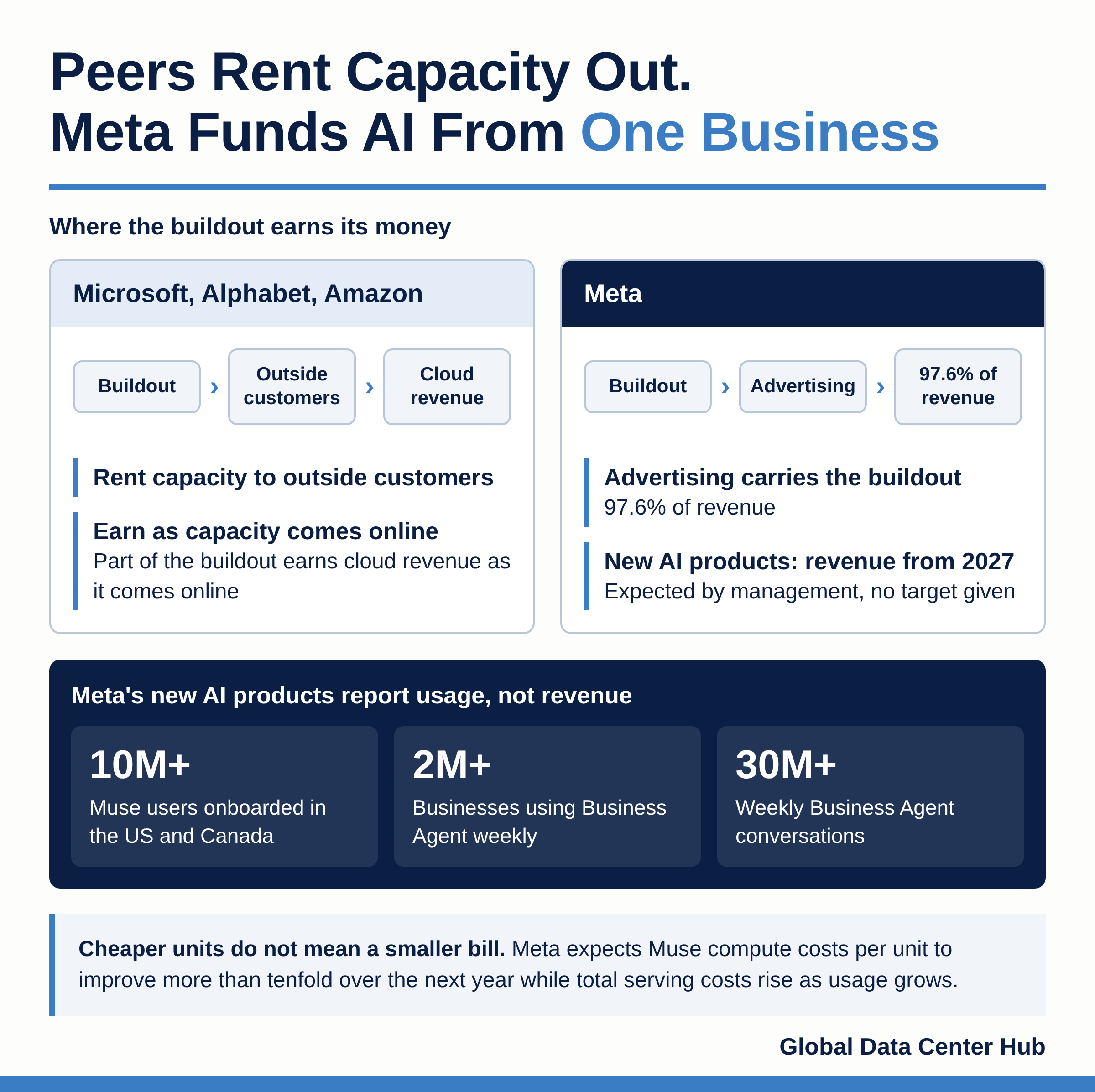
This is where Meta’s position differs from its peers. Microsoft, Alphabet, and Amazon each rent capacity to outside customers, so part of their buildout earns cloud revenue as it comes online.
Meta’s buildout earns through advertising, which is 97.6% of revenue, and through new products that do not yet report revenue.
Those products are growing in usage. Muse onboarded more than 10 million users in the US and Canada, more than two million businesses use Business Agent weekly, and Business Agents handle over 30 million weekly conversations.
Management expects incremental revenue to begin in 2027 but gave no target. It also expects Muse compute costs per unit to improve more than tenfold over the next year while total serving costs rise as usage grows. Cheaper units don’t mean a smaller bill.
The obligations stretch far past one year’s capex. Reuters reported about $825B in future spending commitments, largely data centers, AI infrastructure, and cloud capacity.
That figure comes from secondary filing analyses rather than a reconciled filing schedule, and it spans many years.
The same analyses show about $121.4B in contractual payments due in 2027.
What the Buildout Means Outside Meta’s Stock
Demand visibility and shareholder visibility are now separate questions.
Developers, equipment makers, and power providers can benefit from committed construction even while Meta’s equity holders face dilution and uncertain monetization.
For suppliers, the question is contract quality and payment timing, not Meta’s share price.
The location data Meta disclosed is US-only: owned data centers in 23 states and the supercluster program. Emerging markets show up on the other side of the ledger.
Meta’s ad pricing growth was partly offset by impression growth in lower-monetizing regions and surfaces, and management named compute intensity and localization as limits on rolling out agents internationally.
Emerging markets supply users and impressions. They are not where Meta disclosed capacity, and global reach is not a global deployment map.
What Resolves Next
Three signals will show whether the equity raise is a bridge or a permanent cost.
First, Q4 capex against the implied $49.2B to $59.2B, and Q4 cash conversion.
A quarter at the top of that range with flat operating cash flow would make the $60B Class C program look necessary rather than optional.
Second, the first revenue line for Muse or Business Agent in 2027. Management has said incremental contributions begin then.
A disclosed revenue figure confirms the thesis. Usage metrics alone, through another year of rising capex, would not.
Third, the pace of issuance. Watch when Meta settles the common forwards and whether it establishes the Class C program and draws on it.
The speed of that drawdown is the clearest read on how far operating cash falls short of the buildout.
The Bottom Line
The ad engine is strong, and AI is visibly improving it. That wasn’t enough.
Meta cut 15% of its workforce, and costs still grew faster than revenue. Capex passed operating cash, and Meta turned to equity five days after the print.
The cycle has now moved from capital structure to cost structure and back again, this time with shareholders carrying the bridge.
If Meta’s new AI businesses do not show revenue in 2027, that bridge becomes a lasting cost to shareholders.
Debt and stock investors both have a vote now, and Meta has lined up $37.5 billion of stock sales while its buybacks sit at zero. If investors keep trusting management to spend it well, this will keep going, so which company do you think loses that trust first?