
Welcome to Global Data Center Hub. Join investors, operators, and innovators reading to stay ahead of the latest trends in the data center sector in developed and emerging markets globally.
A fiber platform breaks the quarter its upgrade bill swallows its operating cash, and that can happen while traffic and EBITDA both grow.
The old assumption was that fiber is a build-once asset: lay the glass, then collect rent for decades.
Investors who still price fiber that way will pay a growth multiple for a business that spends almost everything it earns to stay current.
Lumen shows the gap in a single quarter. In Q2 2026, Lumen reported $971 million in operating cash flow and $902 million in capital expenditures, according to its earnings release filed with the SEC on 4 August 2026.
Free cash flow was $69 million. Those are company-wide numbers. They do not benchmark data center fiber on their own. But the point stands.
A large fiber network can generate nearly a billion dollars in operating cash in a quarter and keep very little of it.
The pressure is building because compute is moving.
TeleGeography’s 16 June 2026 analysis found that power and compute availability now shape where long-haul networks need capacity.
The same analysis says AI traffic cannot be separated from the rest of the traffic mix. So, the demand is real, but nobody can measure it cleanly.
Capital is moving toward platforms that can add capacity fast, and away from routes that don't end at the new campuses.
Every Fiber Upgrade Restarts the Capex Clock
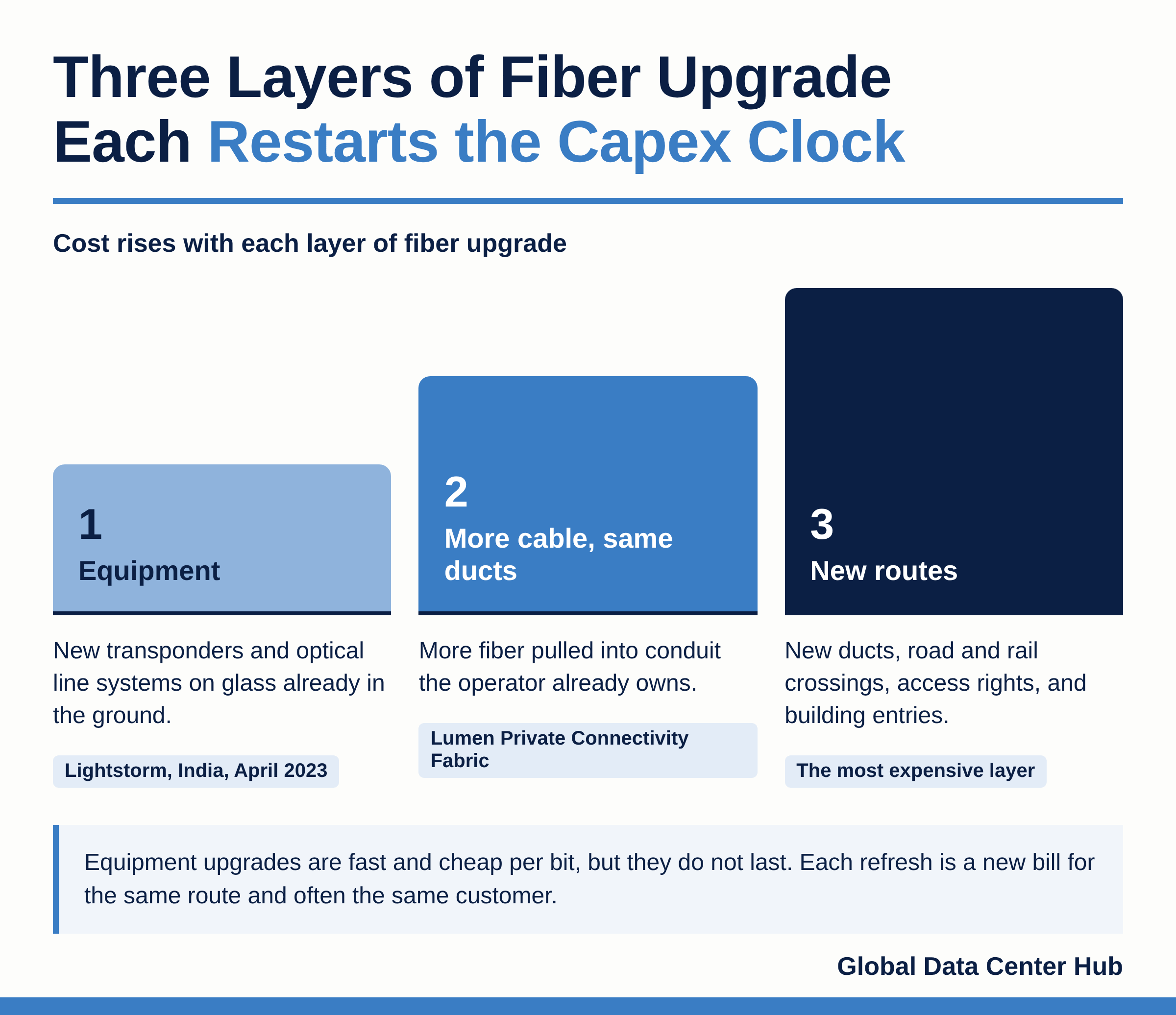
Fiber modernization is rarely a rip-and-replace job. It is a stack of separate spending decisions, and each one has its own test.
The cheapest layer is equipment. New transponders and optical line systems push more capacity through glass already in the ground.
Nokia’s 19 April 2023 announcement described C+L-band optical systems for Lightstorm in India, which widen the band of light a single fiber can carry.
The next layer is more cable in ducts the operator already owns.
Lumen’s Private Connectivity Fabric material describes a cable design that fits more fiber into existing conduit. The most expensive layer is new routes: new ducts, road and rail crossings, access rights, and building entries.
Here is the catch. Equipment upgrades are fast and cheap per bit, but they do not last.
Optics get refreshed. Line systems age. Each refresh creates a new bill for the same route, often for the same customer. So, a better cost per bit can sit right next to a higher total capital requirement.
The capacity gain makes the headline. The refresh schedule sets the cost.
Procurement adds a second clock. Zayo’s 20 August 2026 announcement expanded a long-term Corning agreement to secure a substantial share of the cable for its planned build.
The disclosed benefit is supply assurance. A locked supply contract protects a schedule. If the campus or the permit slips, that same contract becomes a commitment with nothing to install.
Capacity Gains Arrive Before Fiber Platform Returns
The industry has long assumed that traffic growth pays for capacity. That assumption held when a route, once lit, carried growing volumes at steady prices for years.
It no longer holds because prices on some products keep falling while the network must refresh to keep its customers.
TeleGeography’s 16 September 2026 pricing analysis documents continuing IP transit price declines, at different levels and speeds by market.
Read the scope closely. It covers IP transit only. It excludes dark fiber, dedicated wavelengths, local access, and installation fees.
So, the lesson is narrow, and it is sharp. Volume and price move separately, and each product carries its own price risk.
A fixed-price dark fiber contract and a usage-based transit service do not share one price curve. A renewing wavelength deal sits somewhere between them.
The facts here are public. What gets lost is the consequence. Growth in bits and growth in cash are two different lines. A model that blends them will overpay.
Financing Headlines Overstate the Capital Left for Upgrades
The second cost is time, and financing pays for it. Zayo’s own announcement names planning, permitting, materials, and execution as parts of long-haul delivery. Its build targets are company forecasts.
A delayed project does not take one hit. It takes several at once. Customer payments arrive late. Old and new systems run side by side for longer. Interest keeps accruing, and contract remedies may apply. Run those as one linked downside case, because they arrive together.
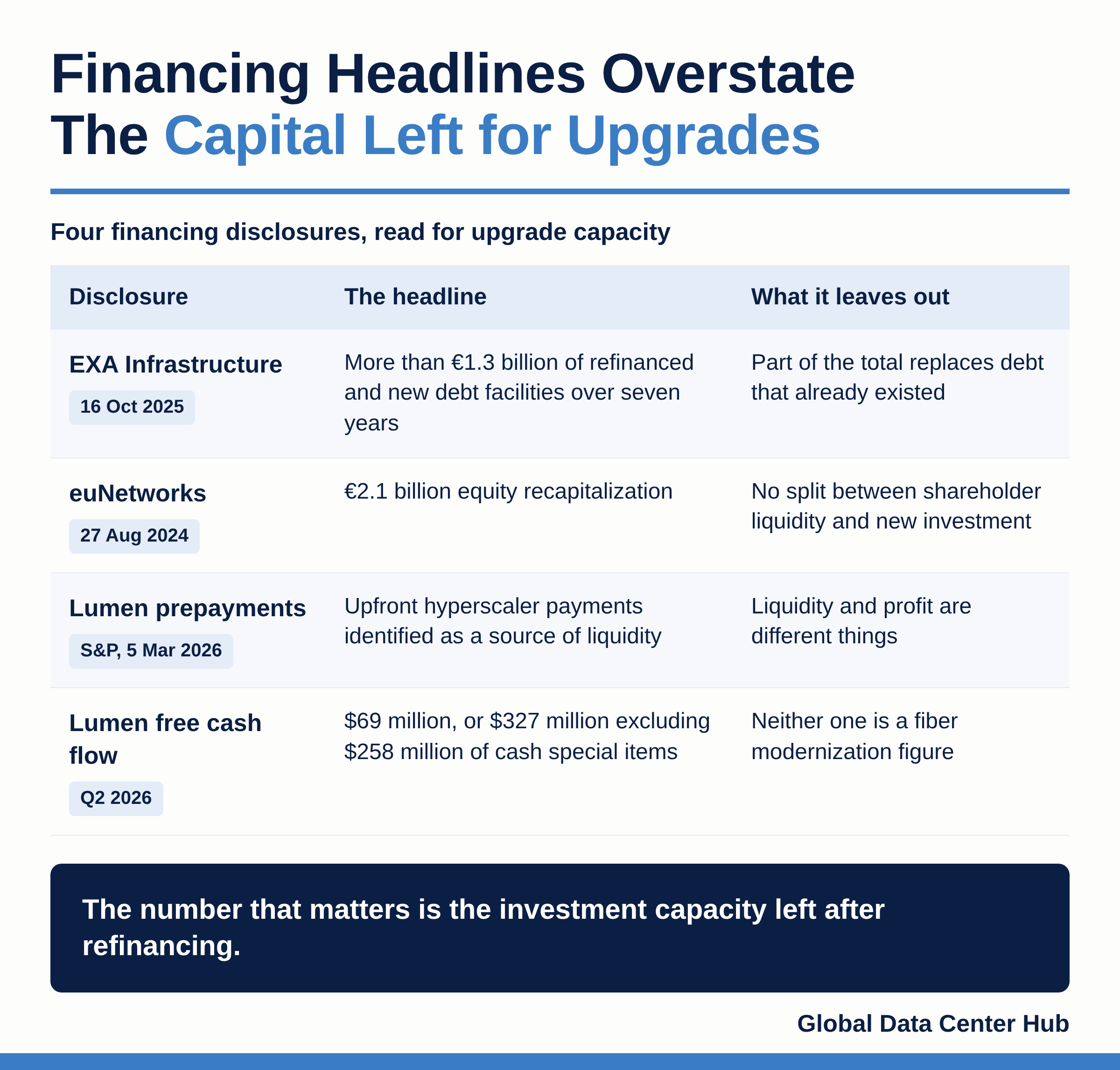
That is why financing totals mislead. On 16 October 2025, EXA Infrastructure announced more than €1.3 billion of refinanced and new debt facilities over seven years, to support expansion and acquisitions. Part of that total replaces debt that already existed.
On 27 August 2024, euNetworks closed a €2.1 billion equity recapitalization. It involved a Stonepeak-managed vehicle anchored by Mercer and Aware Super, with IMCO and APG investing alongside.
The announcement does not split that total between shareholder liquidity and new investment.
Neither headline is a modernization budget. The key number is the investment capacity left after refinancing.
Customer prepayments carry the same trap. S&P Global Ratings, in a 5 March 2026 analysis, identified upfront hyperscaler payments to Lumen as a source of liquidity.
Liquidity and profit are different things. The same dollar cannot fund construction and also count as distributable earnings.
Lumen’s own release shows why the definitions matter. Free cash flow excluding special items was $327 million, with $258 million in cash special items removed.
That is a different measure from the $69 million, and neither one is a fiber modernization figure.
Private Capital Owns the Upgrade Bill at Exit
This problem lands hardest on private capital: infrastructure funds, private equity, and private credit that buy or lend against fiber platforms.
The binding variable is cash flow after upgrades. Fiber platforms are often valued on EBITDA multiples, and EBITDA does not see capex.
If the refresh cycle is real and recurring, a low normalized capex number in your model inflates the price you pay and the debt you size. You find out at exit, when the buyer rebuilds the capex schedule from scratch.
Scale makes the stakes larger. DigitalBridge put an approximate $4.25 billion value on Zayo’s acquisition of Crown Castle Fiber Solutions in its 13 March 2025 announcement, and Zayo completed the deal on 1 May 2026.
Deals of that size buy metro density and route reach. Any acquired network also brings its own overlap with the buyer’s routes and its own future upgrade needs.
So, start every fiber deal with the bottleneck. Find the constraint that limits the route and then find out who pays to remove it and what contracted cash follows.

Ask Which Bottleneck the Upgrade Capex Removes
Five checks would catch the failure before the money goes out.
First, name the bottleneck. Ask the engineers and the sales team to point at the same constraint on each route: tired optics, a full duct, an expiring access right, or a campus with no connection. Each is a different investment case. Run this at screening, before valuation work starts.
Second, survey the ducts. An asset register doesn't prove you can pull a cable through every segment. Require surveys of occupancy, condition, and continuity before the model counts spare conduit as cheap expansion. This belongs in confirmatory diligence.
Third, match the rights to the model. Record access rights segment by segment, with renewal and expansion terms. Do not value a route past the shortest enforceable right beneath it, a problem GDCH covered in its analysis of dark fiber residual value at IRU expiry. Do this in legal diligence, before any asset life enters the model.
Fourth, separate capex into maintenance, competitive refresh, contracted expansion, and speculative expansion schedules. Treat customer-required refreshes as mandatory, even when classified as growth. Include them in the base case before investment committee review.
Fifth, net the financing. For every headline financing or prepayment, compute what is left after refinancing, restricted cash, and completion obligations. Use only capacity the customer has accepted as the revenue milestone. Do this before you size debt or set distributions.
Policy can lower the cost of some of this work. The EU’s Gigabit Infrastructure Act, Regulation (EU) 2024/1309, became fully applicable on 12 May 2026, with rules on infrastructure sharing and coordinated civil works.
India’s Telecommunications (Right of Way) Rules, 2024 took effect on 1 January 2025 with a standard approval process and set timelines.
Neither guarantees that a given crossing gets built on schedule. Test reuse rights before you accept a greenfield cost estimate, then confirm with the local authority.
Route-Level Returns Remain the Missing Number
The open question is the one no public filing answers. No operator in this piece discloses realized returns by route after a full refresh cycle.
Lumen, Zayo, and the European platforms that raised billions all report at the company level.
Until that number exists, you are underwriting the refresh cycle on your own data or on faith.
The funds that build their own route-level cash record will price the next fiber platform correctly.
Everyone else will learn the refresh schedule from the buyer’s diligence team at exit.