

Welcome to Global Data Center Hub. Join investors, operators, and innovators reading to stay ahead of the latest trends in the data center sector in developed and emerging markets globally.
Earlier this summer, I spoke with Kristian Fields, President and Partner at Klover, about a problem the market keeps filing under the wrong heading.
Fields has worked in engineering, building, and construction for about twenty-five years. He began in structural design. He spent roughly fifteen of those years at Turner Construction, the national general contractor, where he ran procurement, estimating, operations, special projects, and field operations.
He joined Klover, a construction company in Pennsylvania, about five years ago to lead field operations, took over company operations, and then became president and partner. Klover was founded thirty-five years ago as a regional specialty trade contractor, and was a subcontractor to Turner during his time there.
That sequence matters for what follows. Fields has sat on both sides of the same contract. He has been the general contractor asking a subcontractor whether crews will be there, and now he is the subcontractor answering.
When we spoke, he was delivering enclosure scope on hyperscale projects in Northern Virginia and on a data center retrofit in Eastern Pennsylvania.
How Data Center Enclosures Now Reach The Site
In Eastern Pennsylvania, the retrofit is receiving its interior walls, which are already built.
Klover is prefabricating roughly 200,000 square feet of them to serve as electrical room enclosures. Each panel is 24 feet by 12 feet. Each leaves the shop with framing and the first layer of fire-treated gypsum board already installed. Deliveries began the week before we spoke. Phase one of three is underway, and we’re budgeting phases two and three.
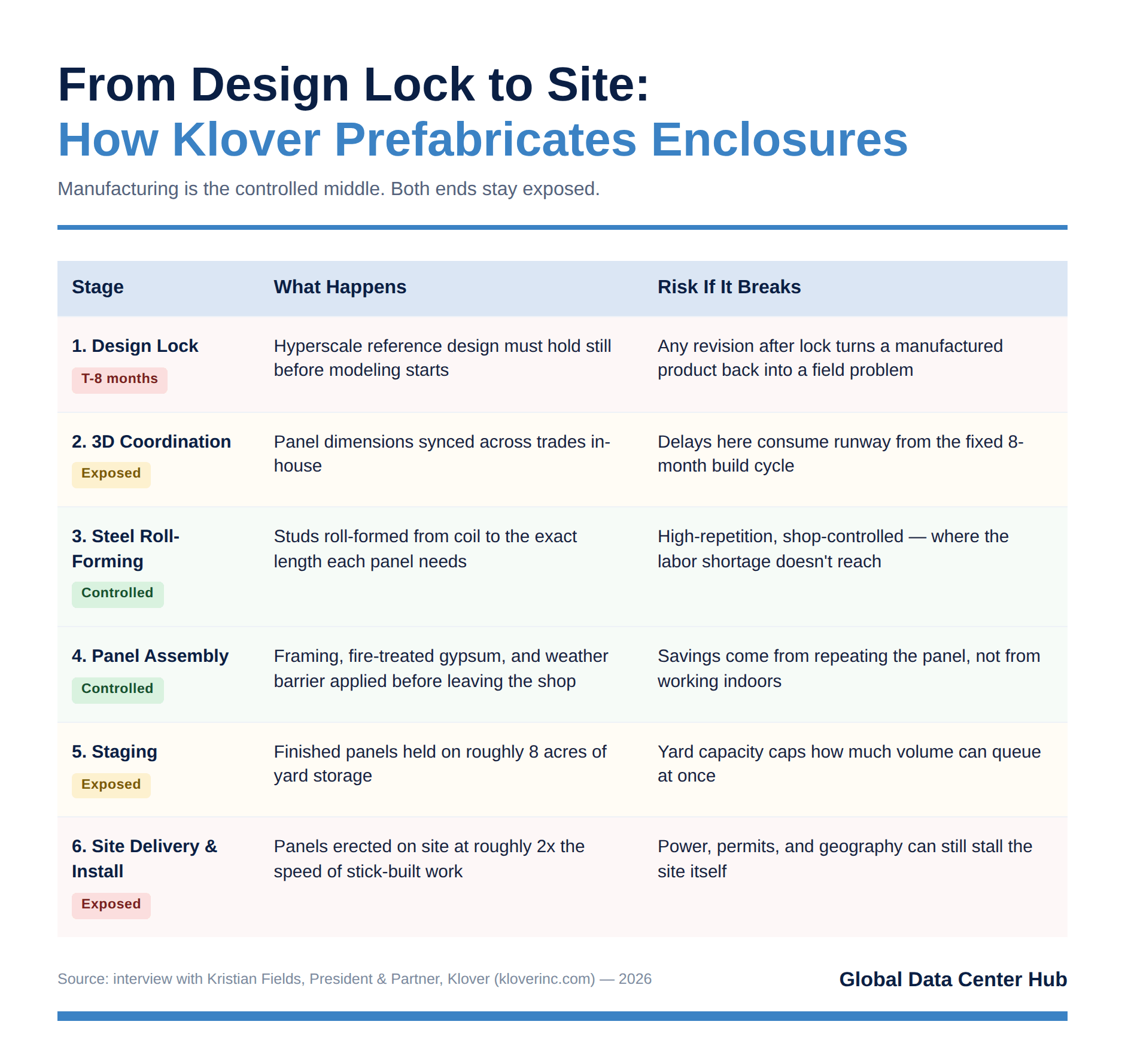
On the Northern Virginia work, the scope is exterior: framing, wall panels, and building enclosure on three-story buildings built to suit for hyperscale, with one or two developer-driven and leased back to the end user. Coordination happens in-house through 3D modeling. Studs are roll-formed from steel coil to the exact length each panel requires. The panels are pre-assembled with the weather barrier before they leave the building.
The panels on that job grew from a typical 20 feet to over 45 feet tall, with structural steel introduced to carry the height. Fields says the method cuts the exterior enclosure installation timeline by at least half. That figure is his, and I have not been able to verify it independently.
The model has to begin early. Fields describes bringing it in roughly eight months before any product is needed on site, so each piece can be coordinated with other trades and manufactured to exact specifications.
Behind the facility sit about eight acres of storage for staged product, with another 50,000 square feet of manufacturing coming online this autumn. The firm is in discussions with large battery backup suppliers about modular enclosures for electrical houses.
The Craft Labor Shortage Behind The Shift
None of this is happening because building walls on site is difficult. It is happening because the people who would build them on site are not available.
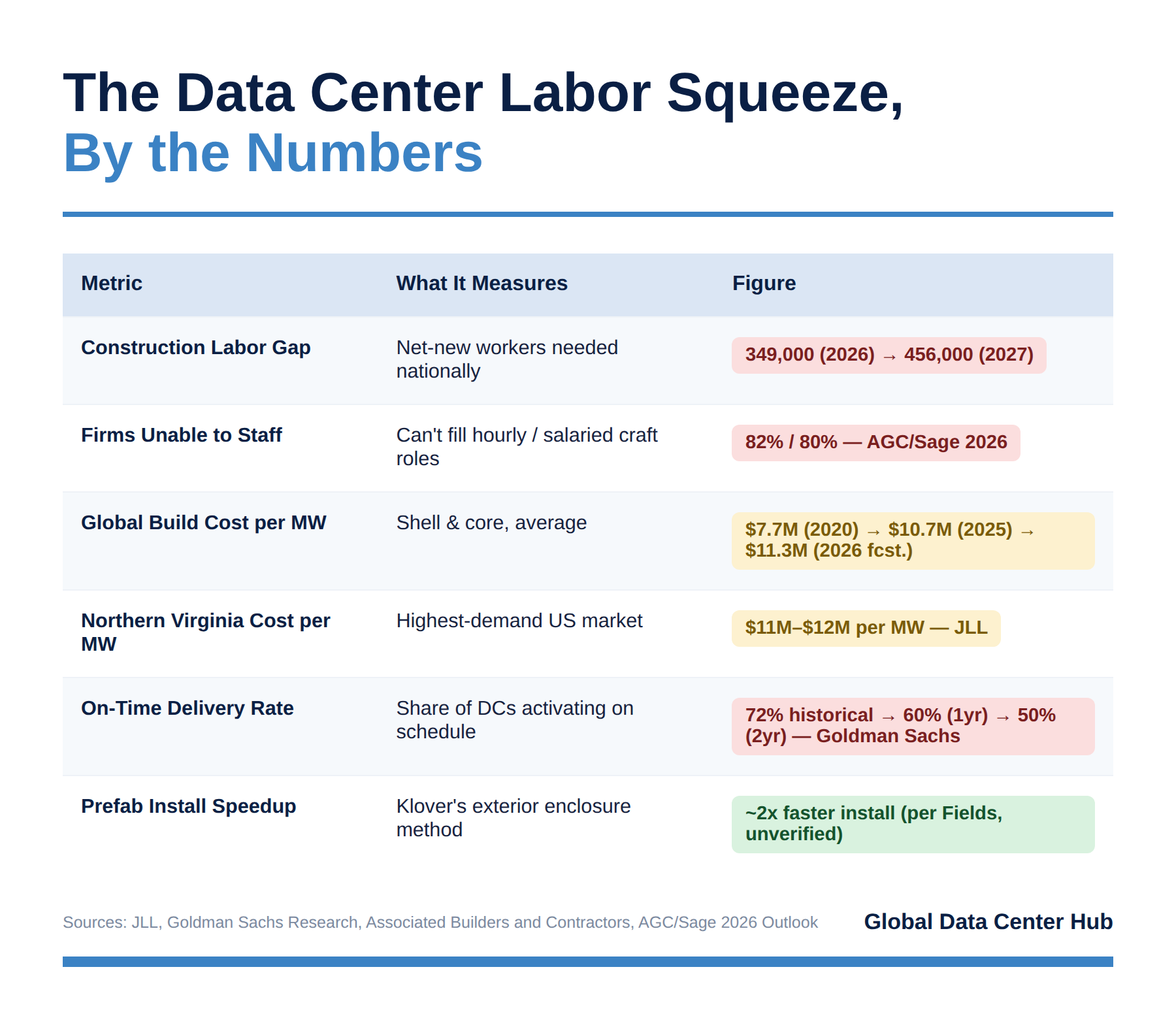
Associated Builders and Contractors estimates the United States construction industry needs 349,000 net-new workers this year, and 456,000 next year. Most of this year’s shortfall traces to retirements rather than to new projects. The AGC and Sage 2026 outlook finds 82 percent of construction firms cannot fill their hourly craft positions and 80 percent cannot fill salaried openings. Those figures reflect trying and failing, not wishing for more people.
Fields is running every conventional response, and running them well. Two in-house recruiters hire trade and professional staff continuously. Per diem and housing arrangements let crews travel to the work. Safety, quality, and installation training happen in-house after hire, because waiting for the market to supply trained installers is not a plan.
That is the ‘pay-more strategy’ executed about as competently as it can be. It still runs out: when projects grow past what any adjacent labor market can supply, and when sites sit far enough from population centers that no per diem makes the trip worth taking. Both conditions are becoming ordinary because power availability now drives site selection, and power is not where the electricians are.
Data Center Cost Curves Versus Delivery Dates
The market reads labor scarcity as a cost line. JLL puts average global data center construction cost at $7.7 million per megawatt in 2020 and $10.7 million in 2025, and forecasts $11.3 million for 2026, core and shell only, excluding land and IT. In the United States, JLL places Northern Virginia between $11 million and $12 million per megawatt. Read that curve alone, and the conclusion is comfortable: building costs more, and buyers with this much capital can absorb more.
Goldman Sachs Research reads the same conditions differently. Historically, only about 72 percent of data centers scheduled to activate within the following four quarters came online on time. Goldman now forecasts roughly 60 percent over the next year and roughly 50 percent over the next two, and names supply chain and labor shortages as the most common causes of delay.
Fields is describing the second problem while the market prices the first. Cost is what a developer pays to hold the date. The Goldman number is what happens when paying does not hold it.
The sharper point in our conversation was not about factories at all. Fields put the efficiency down to repetition: you drive efficiency out of something when you can make it repeatable. That is an industrial argument, not a construction one. The saving does not come from the roof over the work. Build the same panel four hundred times and the four hundredth costs a fraction of the first. Build four hundred different panels indoors, and you have moved an expensive problem into a building you now also pay for.
The Standardization Prefabrication Requires
Repetition is not a contractor property. It belongs to the customer.
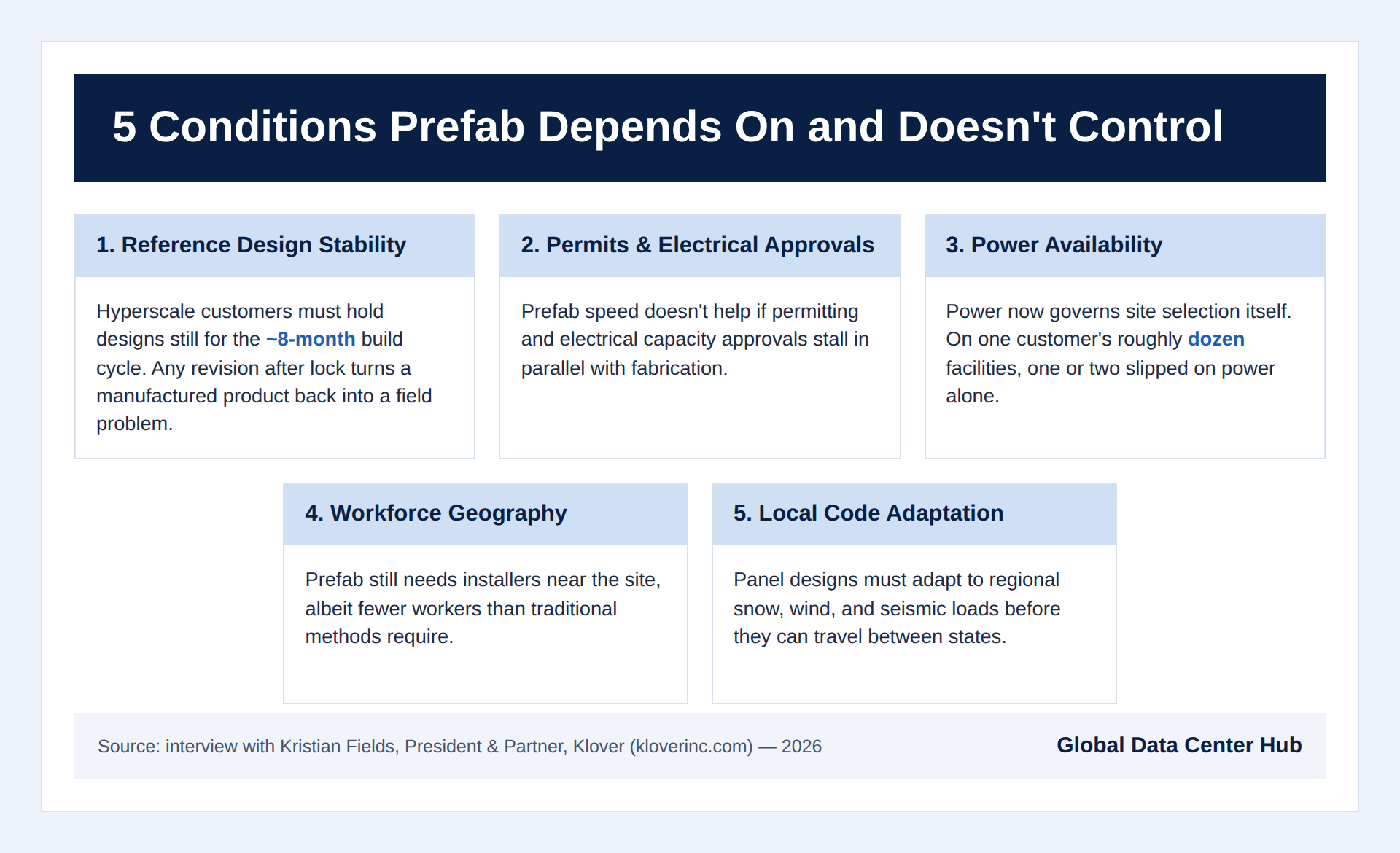
For this to do what the schedule needs it to do, hyperscale end users have to hold their reference designs still for the eight months it takes to model, coordinate, roll, and stage the product. That is the part I would underwrite hardest, because it is the part Klover does not control. Reference designs move as rack density and cooling architecture change, and facility sizes move with them. Every revision after the model locks turns a manufactured product back into a field problem, which is exactly where the labor shortage was waiting.
Fields named the rest of the dependencies himself, and to his credit he did not pretend they were his to solve. Permits and electrical capacity approvals have to clear. Township and community acceptance has to hold. Power availability governs whether the end user proceeds at all; on one customer’s roughly dozen facilities, one or two slipped on that alone. Geography is bounded by where the workforce lives, which is why the firm has not pushed into western Pennsylvania. Designs must adapt to local snow, wind, and seismic conditions before they can travel between states.
Announced Capacity Versus Energized Capacity
The most useful thing about talking to a contractor is that the constraint stops being abstract. A developer discusses labor as a line item. Fields discusses it as whether a crew is standing on a site in Sterling on a Tuesday.
His answer to that is the best one available, and it comes with a condition the market has not priced: it requires the largest buyers in the sector to allow for manufactured construction and stop changing their minds for six months at a stretch.
That condition sits underneath Goldman’s 72 percent falling to 50 percent. Announced capacity is not the same as energized capacity. Power decides whether a campus can run. Labor decides whether the building exists to be energized at all. The two constraints now point at the same gap, and neither closes by paying more.