
Welcome to Global Data Center Hub. Join investors, operators, and innovators reading to stay ahead of the latest trends in the data center sector in developed and emerging markets globally.
Digital Realty opened the 6.4-megawatt Nairobi Two Data Center, NBO2, in Karen, Nairobi, on September 7, 2026.
The building sits about 300 meters from Nairobi One, the carrier-neutral facility that iColo opened in 2019, and the two now operate as a single campus.
NBO2 is built for cloud, enterprise, network and data-intensive workloads, and it takes the Karen campus beyond 14 megawatts of available IT power across a site of more than 34,000 square meters.
The opening coincided with the transition of the iColo brand to Digital Realty in Kenya and Mozambique.
Digital Realty disclosed no development cost, no pre-leasing level, no occupancy, no customer commitments and no lease economics for the facility.
NBO2 Power Design And Certifications
NBO2 carries 3,600 square meters of technical space, listed by Digital Realty as 11,811 square feet.
Power runs on a 2N architecture and cooling on N+2.
The building holds ISO 27001 certification for information security and PCI-DSS certification for payment card workloads.
The Karen site sits roughly 13 kilometers from the Nairobi central business district.
Kenya Campus Connectivity And Teleport Access
Customers at the campus can reach more than 100 networks, two internet exchange points and a satellite teleport.
The teleport gives customers a route into locations where terrestrial fiber is limited.
Digital Realty describes the campus as a base for content delivery, cross-border connectivity, data sovereignty strategies and resilient digital services.
The company has not published a network count for NBO2 itself.
iColo Brand Transition And Open Items
The iColo name retires in Kenya and Mozambique, and the assets move under the Digital Realty brand and its PlatformDIGITAL framework, which spans more than 300 facilities across over 55 metropolitan areas in more than 30 countries.
Wanja Muriithi, Country General Manager for Digital Realty Kenya, said the opening and the brand transition are part of the same story of Kenyan digital economy growth and iColo’s evolution within a global platform.
The launch event was held at the Catholic University of Eastern Africa, during the Datacloud Africa and ITW Africa 2026 conference, which ran in Nairobi from September 7 to 10.
Three things remain unsettled. Kenyan government guidelines on priority data center locations are still pending.
Digital Realty has not confirmed whether the Karen campus proceeds to a third building and a captive substation.
It has not named the cloud providers or regulated institutions taking capacity in NBO2.
The Fastest Growing Power Source Is Captive
The number that decides whether NBO2 scales is 630.1 megawatts, the captive generation capacity Kenyan businesses had installed by December 2025, up from 402.3 megawatts in June 2023.
Coverage of the opening has treated Kenya’s clean grid as favorable backdrop, and the regulator’s own data says that grid stopped growing almost two years ago while private power did not.
An investor who reads this opening as a capacity story is underwriting the wrong constraint.
Zero Grid Megawatts Against 151 Of New Demand
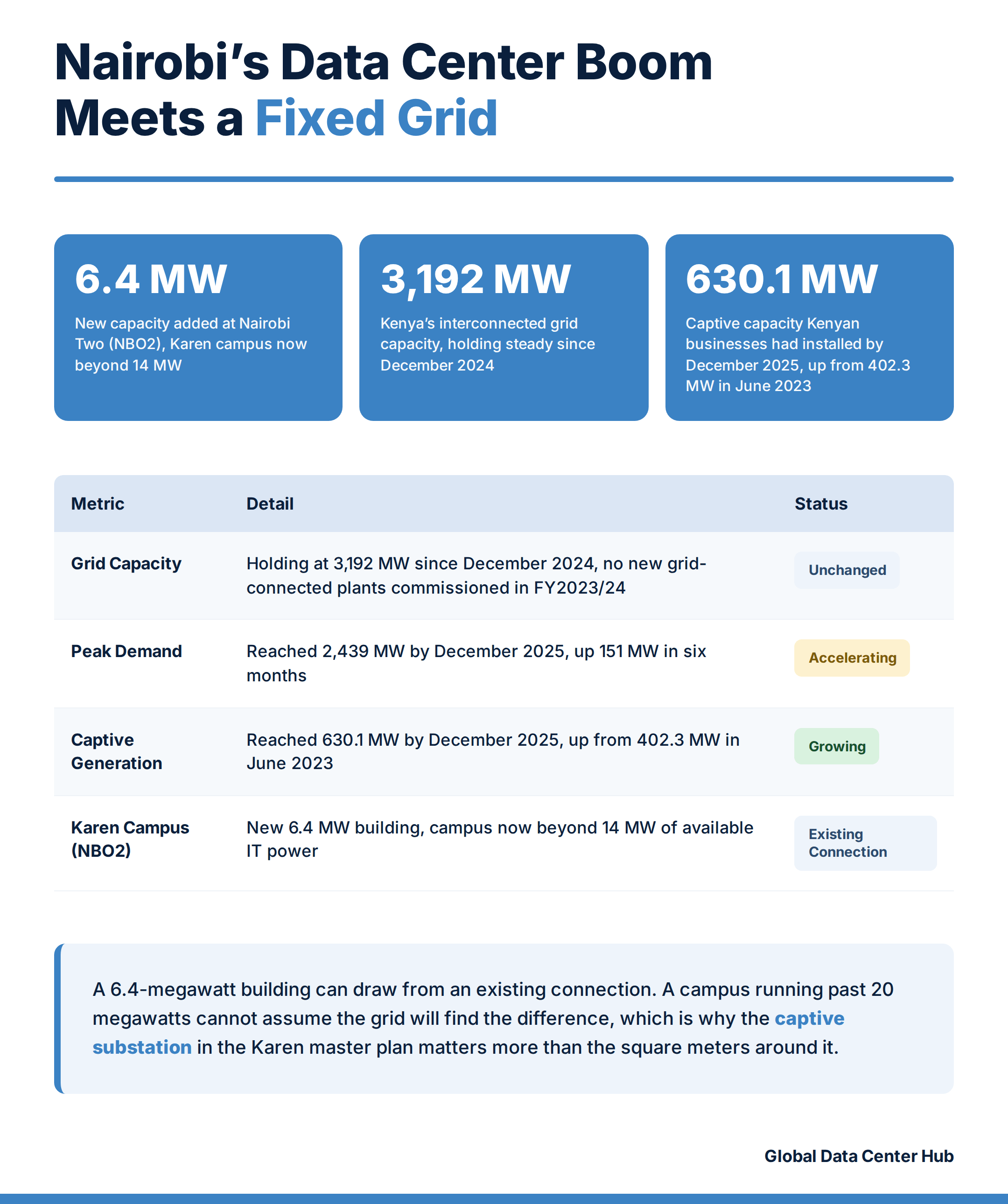
Kenya’s interconnected generation capacity has been stuck at 3,192 megawatts since December 2024, unchanged through June and December 2025.
No new grid-connected plants were commissioned in FY2023/24, and the retirement of the 60-megawatt Kipevu 1 diesel plant that year pulled interconnected capacity down from 3,311 megawatts.
Every addition since has been captive solar serving commercial and industrial users, which never touches the national grid.
Those figures come from The Kenyan Wallstreet’s reading of EPRA data published in April 2026.
Demand moved in the other direction.
Peak demand reached 2,439 megawatts by December 2025, a rise of 151 megawatts in six months, after a 139 megawatt increase in FY2024/25 that was the largest single-year jump in the dataset.
The two geothermal plants licensed for the Menengai field, at 35 megawatts each, would be absorbed by demand growth within months of coming online.
For anyone building compute in Nairobi over the next twelve to twenty-four months, that arithmetic converts the power plan from a design detail into the gating item.
A 6.4-megawatt building can use an existing connection, but a campus exceeding 20 megawatts cannot assume the grid will cover the gap.
That is why the captive substation in the Karen master plan matters more than the surrounding square meters.
The Grid’s Twenty-Two Percent Loss Sits Inside The Tariff
Kenyan system losses have stayed above 22 percent across six years of data, against an EPRA threshold now set at 16.5 percent.
That 5.57-point gap is energy the utility bought and never billed, and it is recovered through the tariff every commercial customer pays.
A data center in Nairobi buys power at a price that carries someone else’s unbilled consumption.
The green case is thinning at the same time.
Renewables supplied 78.79 percent of grid energy in the second half of FY2025/26, down from 84.65 percent in FY2022/23.
Imports rose from 4.85 percent of generation to 12.03 percent over the same span, thermal output climbed 24.27 percent in absolute terms, and carbon dioxide from power generation increased 27.11 percent in FY2024/25.
Two of the three reasons to put a rack in Nairobi rather than Johannesburg were cheap power and clean power. Both are moving the wrong way.
Tenants with hard carbon mandates will start asking for contracted supply rather than the grid average and contracted renewable supply in Kenya means signing directly with a generator.
Networks Follow Tenants, Not Power Or Floor Space
The third reason, interconnection, is where the campus is strongest and where NBO2 starts from behind.
On the day NBO2 opened, tech.africa counted 130 networks at Africa Data Centres’ Nairobi facility, against 15 at Nairobi One, 9 at PAIX Kenya and 4 at iXAfrica Data Centres’ NBOX1.
Digital Realty’s more than 100 networks describe what is reachable across its campus, including carriers and cloud on ramps, so the two counts measure different things.
They still point the same way. Nairobi’s exchange traffic concentrates at a competitor’s address, and a new building does not move it.
Cross-connects follow tenants, and tenants move over quarters.
The number worth tracking through 2027 is the network count at Nairobi One, because that is where a shift would appear first.
Underwrite The Power Connection, Not The Megawatt
Private Capital should price the power plan before the capacity. Ask for the grid connection agreement, the captive generation design, and the capital cost of the substation, and treat any campus without those three as a single-building asset regardless of its master plan. Firms that skip this and underwrite on megawatts and occupancy will pay for capacity that cannot be energized on the schedule the model assumes.
Operators face a sequencing decision rather than a capital one. Committing to captive supply now puts an operator in front of the anchor tenants that arrive with the next wave of local cloud and regulated workloads. Waiting means competing for the same frozen grid alongside every other applicant, at a moment when demand is adding roughly 150 megawatts every six months.
Public Markets should price nothing off this announcement. Digital Realty disclosed no cost, no pre-leasing and no lease economics, so the contribution is unmeasurable from the release. Holders who treat African footprint expansion as an earnings signal are marking a position on a press release.
The Substation Decides Kenya’s Next Five Years
Kenya is about to sort its operators into two groups. One group owns its supply. The other waits in a queue that has not moved since December 2024.
That sort happens over the next four to eight quarters, and it will be visible in which campuses sign hyperscale anchor tenants rather than in which ones open buildings.
Digital Realty now holds the strongest carrier-neutral platform in Africa and a Nairobi campus with room to triple.
Whether it commits the capital for the captive substation, and says so publicly before customers ask, is the question this opening leaves open.