
Welcome to Global Data Center Hub. Join investors, operators, and innovators reading to stay ahead of the latest trends in the data center sector in developed and emerging markets globally.
In March 2026, ByteDance secured roughly 500MW of data center capacity from VNET Group, one of China’s largest carrier-neutral operators. At first glance, it looks like a standard hyperscale colocation deal.
For infrastructure investors, however, the agreement signals how the next phase of AI infrastructure will be financed, sequenced, and de-risked.
The main constraint in AI is no longer models or GPUs it is power-ready megawatts, and those controlling it will dominate deployment, as the ByteDance–VNET deal demonstrates.
The Shift to Capacity Reservation
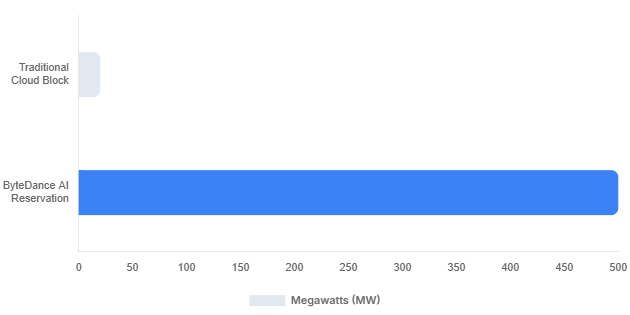
Historically, hyperscalers expanded data center capacity incrementally, building new facilities in 10–30MW blocks tied closely to regional demand. This model limited upfront risk but slowed scaling for rapidly growing workloads.
AI infrastructure is changing that approach. Leading platforms now secure hundreds of megawatts years in advance, and the ByteDance–VNET deal exemplifies this shift. By locking in capacity early, companies ensure that power availability and grid constraints do not limit future AI growth.
As of September 2025, VNET Group operated 783MW of capacity, with 582MW already utilized. ByteDance’s 500MW commitment represents a massive expansion, signaling that megawatt reservations have become a strategic necessity for sustaining large-scale AI deployment.
The Capital Formation Sequence Behind AI Campuses
The ByteDance–VNET agreement highlights the capital formation process for hyperscale AI campuses. These projects are rarely financed as speculative real estate; they follow a structured sequence that aligns infrastructure risk with tenant demand.
The first stage, platform equity, funds early development activities such as land acquisition, regulatory approvals, power interconnections, and engineering design. These initial steps carry significant risk and require capital capable of absorbing uncertainty.
Next, anchor tenant commitments provide revenue visibility and substantially reduce demand risk, supporting project underwriting and enabling developers to plan large-scale deployments with confidence.
Finally, infrastructure debt allows financing once long-term commitments are in place, and ByteDance’s 500MW commitment transforms VNET’s pipeline into financeable, strategic infrastructure.
These early-stage risks particularly around power, permitting, and delivery mirror the execution constraints highlighted in The Hidden Constraint in Emerging Market AI Infrastructure.
Why Carrier-Neutral Operators Are Benefiting
The ByteDance–VNET deal highlights the rising role of independent, carrier-neutral operators in AI infrastructure. While hyperscalers historically built their own facilities, the scale and speed of AI deployment are shifting this model, especially in China.
Operators like VNET Group, GDS Holdings, and Chindata Group secure power early, use modular construction, and access capital markets to deliver hundreds of megawatts of AI-ready capacity quickly.
Partnering with these operators allows hyperscalers to expand infrastructure faster and with lower risk, focusing on AI deployment rather than building every facility themselves.
The Financial Engineering Behind AI Infrastructure
The ByteDance–VNET deal highlights the high cost of hyperscale AI infrastructure. A 500MW campus can run into billions, making careful financing and risk management essential.
VNET Group recently completed a $137 million equity placement and is reportedly exploring offshore debt, while credit agencies like Moody’s upgraded its corporate rating, citing strong demand for hyperscale infrastructure.
For investors, the lesson is clear: anchor tenants improve financeability. Once capacity is committed, AI data centers can access debt at lower risk premiums, following the same financial logic long used in power, pipelines, and transportation sectors.
Power Is Becoming the Core Competitive Advantage
The ByteDance–VNET deal underscores a key shift: energy availability is now a core competitive advantage for AI infrastructure. Modern GPU clusters require high power densities, often exceeding 30 kilowatts per rack.
At scale, these clusters need hundreds of megawatts of reliable electricity, shaping where AI data centers can be built. Regions that can supply power quickly attract the most investment.
In China, this has driven clusters in provinces like Inner Mongolia and Hebei, which offer large-scale renewable energy and align with government strategies for digital infrastructure growth.
By securing capacity in these corridors, ByteDance reduces the risk that grid constraints will limit future AI expansion, making power a decisive strategic asset.
What Infrastructure Investors Should Watch
For investors evaluating the next phase of AI infrastructure, the ByteDance–VNET agreement highlights several key signals. Hyperscalers are increasingly making megawatt-scale capacity reservations, locking in infrastructure supply years ahead of demand.
Carrier-neutral operators are emerging as strategic partners, providing development expertise and access to capital markets for rapid hyperscale expansion. At the same time, power availability is becoming the decisive constraint shaping where AI infrastructure can scale.
Regions that align grid capacity, land availability, and financing will capture the majority of investment. Consequently, AI data centers should be evaluated using frameworks similar to those applied in traditional infrastructure sectors.
Projects succeed when they combine long-term demand visibility, reliable energy supply, and disciplined capital structures, creating a foundation for sustainable AI growth.
This concentration of capital into power-aligned regions reflects the broader geographic clustering of AI infrastructure outlined in Asia-Pacific: $150B+ AI Data Center Infrastructure Enters the Industrial Phase.
The Emerging Playbook
The ByteDance–VNET agreement reflects an emerging AI infrastructure playbook. Leading companies are securing power-ready sites early, locking in large anchor tenant commitments, and leveraging those commitments to raise infrastructure financing.
By building capacity at scale before demand peaks, infrastructure becomes a strategic advantage rather than a reactive measure. Companies that execute this approach will shape the global landscape of AI deployment over the next decade.
In this race, the most valuable asset may not be the next AI model it may simply be the megawatts required to run it.