
Welcome to Global Data Center Hub. Join investors, operators, and innovators reading to stay ahead of the latest trends in the data center sector in developed and emerging markets globally.
A data center deal now breaks at the moment the power bill arrives before the rent does.
Regulators and utilities are moving the cost of new generation and grid upgrades, plus the risk of cancellation, onto the campus that creates the demand.
The old model treated electricity as an operating cost bought from a utility, with tenant credit carrying the risk.
Keep using that model and you size the capital stack for a building, then get asked to fund a power plant.
The pressure starts with demand. The International Energy Agency expects data center electricity use to roughly double, from 485 TWh in 2025 to 950 TWh in 2030, in its 2026 Key Questions on Energy and AI.
The same report says data center investment has grown too large to be funded from company balance sheets alone.
Capital markets will be critical to the buildout. So the useful question is where that outside capital goes first. More and more, it goes to the power.
The Power Plant Is Now Part of the Campus
Ireland shows the mechanism in its cleanest form. On December 12, 2025, the Commission for Regulation of Utilities published its decision on how new data centers connect to the grid.
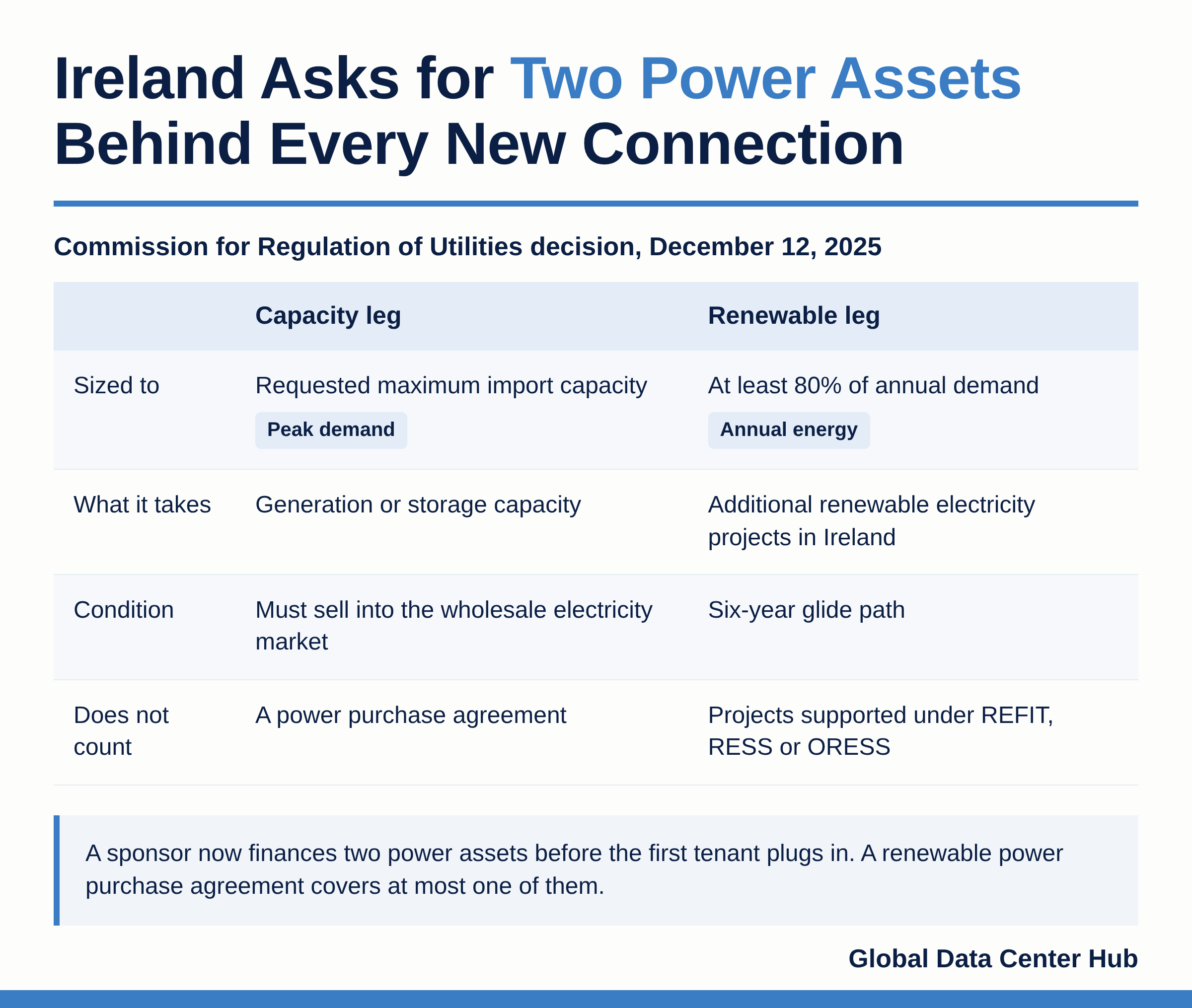
The decision keeps a requirement that new connections provide generation or storage capacity matching their requested maximum import capacity. That capacity must sell into the wholesale electricity market.
Then it adds a second obligation. Data centers must meet at least 80% of their annual demand with additional renewable electricity projects in Ireland, on a six-year glide path.
Projects already supported under existing schemes such as REFIT, RESS, or ORESS do not count.
Read those two rules together. One is sized to peak demand. The other is sized to annual energy. A sponsor now finances two power assets before the first tenant plugs in, and a renewable power purchase agreement covers at most one of them.
The United States is moving in the same direction through a different door. On December 18, 2025, FERC issued an order directing PJM to set rules for data centers co-located with power plants, according to a Baker Botts summary of the order.
Generators serving co-located load from existing plants must pay for all necessary network upgrades. Service to that load cannot start until those upgrades are in service.
Singapore manages the same scarcity by rationing it. On August 21, 2026, the Economic Development Board announced that 200 MW of new capacity had been provisionally allocated to four operators under its second call for applications.
Access to power is decided before the campus is. The workaround many sponsors reach for is onsite gas. It costs more than it looks.
The IEA estimates that serving critical, variable data center demand reliably with onsite gas can require 30% to 70% more generation than the load itself. Every megawatt of compute can need up to 1.7 megawatts of plant.
Tenant Credit Leaves the Power Question Open
The industry has long assumed that a creditworthy tenant and a renewable power purchase agreement make the power side of a deal financeable.
That assumption held when grids had spare capacity and utilities funded network expansion through their own rate base.
It does not hold now because connection rules are being rewritten to make large loads carry the generation, the upgrades, and the cost of leaving early.
Tenant credit answers one question: who pays rent once the hall is live. It says nothing about who funds the substation while the hall waits for power.
Those are different risks, with different timing, and they often sit with different parties.
In Ireland, the gap is written into policy. A PPA with an existing supported wind farm counts toward neither leg. The capacity leg needs dispatchable generation or storage.
The renewable leg needs new, unsupported projects. Neither is a purchase. Both are developments.
Turbines and Transformers Set the Real Schedule
Money is only half the cost. Time is the other half.
The IEA reports that a 70% surge in gas turbine orders in 2025 exposed chokepoints in energy equipment supply chains. It also warns that rising server power density will test supply chains for transformers and power electronics.
A sponsor that wants certainty has to reserve equipment early. That reservation is capital at risk before permits, tenants, and connection rights are final.
Two capital programs announced in 2025 are built around exactly this problem.
On March 19, 2025, ADQ and Energy Capital Partners announced a partnership targeting more than $25 billions of investment across 25 GW of projects, primarily new-build gas-fired generation for data center demand in the United States.
The expected initial combined contribution is $5 billion.
The same day, the AI Infrastructure Partnership, founded by BlackRock, Global Infrastructure Partners, Microsoft, and MGX, announced that NVIDIA and xAI had joined.
The partnership seeks to unlock $30 billion from investors, asset owners, and corporations, and up to $100 billions of total investment potential including debt.
GE Vernova agreed to work with it on supply chain planning. NextEra Energy agreed to collaborate on energy solutions.
Two things stand out. Both programs pair capital with equipment or power development capability, because money without a turbine slot does not energize anything.
And both headline numbers are targets. Up to $70 billion of the AIP figure depends on debt, so lenders still have to underwrite each project on its own merits.
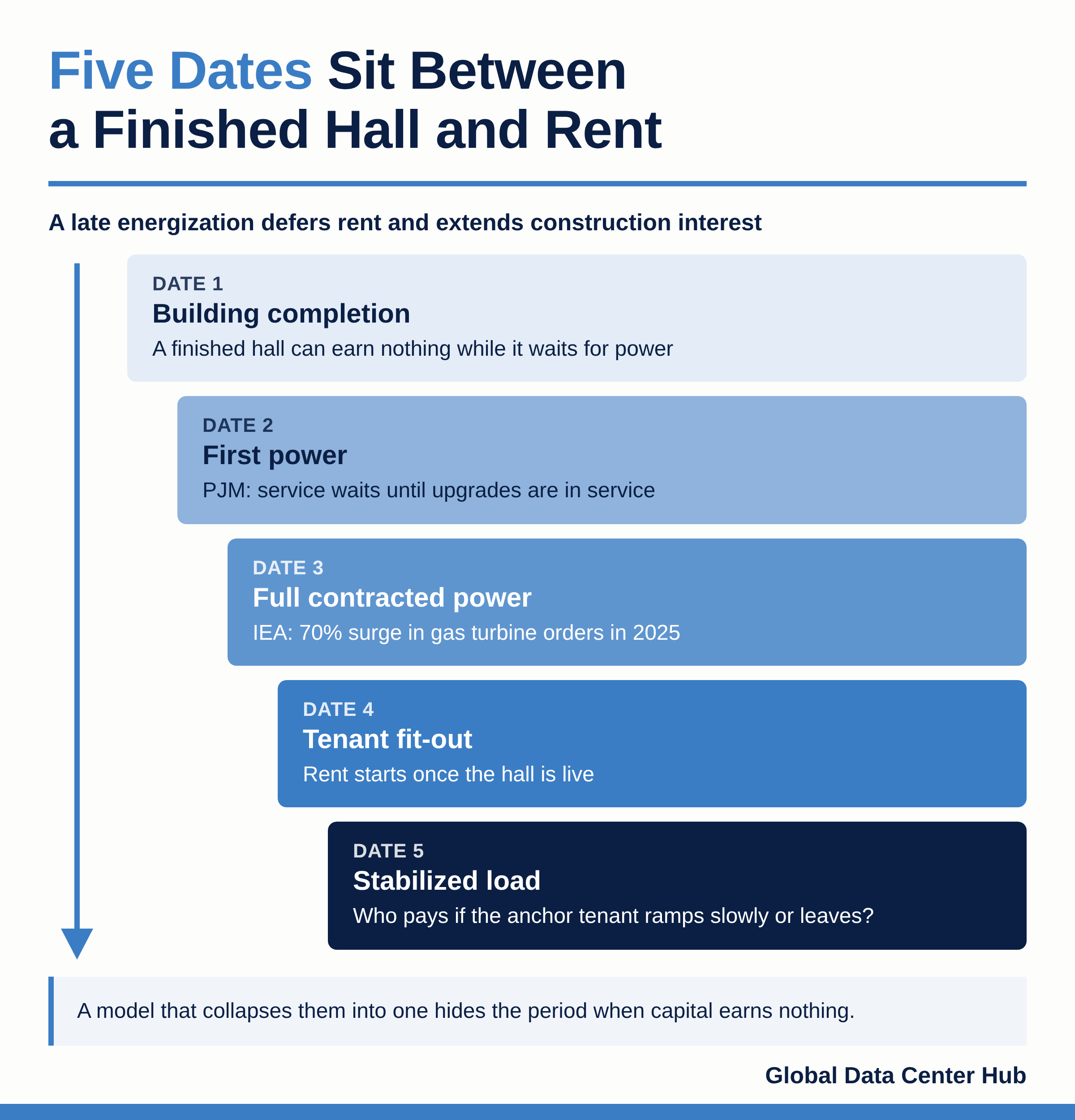
Delay compounds the cost. A late energization defers rent, extends construction interest, and leaves a finished hall earning nothing.
Building completion, first power, full contracted power, tenant fit-out, and stabilized load are five different dates. A model that collapses them into one hides the period when capital earns nothing.
Private Capital Now Funds the Power Before the Rent
For private capital, this is the binding underwriting variable. Infrastructure funds, private equity, private credit, and family offices are being asked to fund an energy package that sits ahead of revenue.
That changes three things at once: the length of the non-earning period, the size of the equity check, and who holds the bill if the anchor tenant ramps slowly or leaves.
Pass-through clauses do not close that gap on their own. A tenant that reimburses electricity consumption may not reimburse connection capital, minimum capacity payments, financing costs during delay, or liabilities that survive termination.
In PJM, upgrade costs for co-located generation are paid before service starts. In Ireland, the generation and storage obligation comes with the connection itself.
So, underwrite the campus as a power project with a building on top. The building is the easy part.
If you price the power package at the term sheet, you negotiate who carries it. If you discover it at energization, you carry it yourself.

Ask for the Connection Agreement Before the Term Sheet
The first check belongs before the term sheet. Ask what the sponsor actually holds: a capacity letter, or enforceable connection rights with stated capacity, milestones, conditions, and identified network works.
A campus without the second is a land position, and it should be priced as one.
The second check belongs in investment committee papers. Ask for sources and uses across the full energy package, covering generation, storage, substations, grid upgrades, equipment deposits, and fuel.
For each asset, name who funds it, who owns it, who operates it, and who repays it if the campus never reaches expected demand.
The third check belongs in the base case model. Split building completion, first power, full contracted power, tenant installation, and stabilized load into separate dates.
Then model delayed energization, slower load growth, higher equipment costs, and dearer debt together, because in practice they arrive together.
The fourth check belongs in lease negotiation. Read the pass-through line by line. Ask which connection costs, minimum capacity payments, and delay costs the tenant reimburses, when reimbursement starts, and what survives termination.
Ask for development-period credit support and a long-stop date tied to unamortized infrastructure.
The fifth check belongs before any equipment deposit. If the plan relies on onsite gas, underwrite it as an operating business with fuel, maintenance, outages, emissions compliance, and the 30% to 70% overbuild the IEA describes.
Confirm the turbine delivery slot in a contract, with the date and the remedy.
The sixth check belongs in the exit case. Ask whether the generation and connection assets can serve another tenant, export to the grid, or keep value if the anchor leaves.
Ireland’s requirement that this capacity trade in the wholesale market gives it a second revenue line. Check whether local rules allow the same before you count on it.
The Cancellation Bill Is Still Being Assigned
Ireland has settled who funds the power. In PJM, the December 2025 order set the direction, and the tariff detail runs through compliance filings.
Singapore decides by allocation, 200 MW at a time. Elsewhere, the answer will be set region by region and contract by contract.
The open question for private capital is the one these rules circle without closing.
When a power plant is ready before the load is, who pays for the gap? Watch the security deposits and termination clauses in final tariffs.
That is where the cost of this cycle will be assigned, one connection agreement at a time.