

Welcome to Global Data Center Hub. Join investors, operators, and innovators reading to stay ahead of the latest trends in the data center sector in developed and emerging markets globally.
Higher interest rates hit data centers through one gap: the time between when rent resets and when debt resets.
An owner whose rent moves first can absorb this cycle. An owner whose debt moves first carries it.
The rates are real. On September 16, the Federal Reserve raised its target range to 3.75% to 4.00%, its first hike in three years (Federal Reserve).
The 10-year Treasury closed at 5.29% on September 30, up from 4.19% on January 2 (FRED). The Fed’s median projection holds the policy rate at 4.1% through the end of 2027 (Federal Reserve).
The money is still moving. Bonds and securitizations backed by data center leases reached $17 billion in the first half of 2026, up 29%, JLL reported (JLL).
Vacancy in major U.S. markets sits at a record low of 1.4%, CBRE reported (CBRE).
Lenders are still lending. They are pricing the calendar.
The Buildout Is One of the Pressures the Fed Is Watching
Fed officials have tied part of the rate picture to AI spending. In July, Governor Lisa Cook named “increased capital expenditures tied to the buildout of AI infrastructure” as one of two unanticipated shocks of 2026 (Federal Reserve).
In September, Chair Kevin Warsh said hyperscalers “are out in the market raising funding, and so the competition for capital is real” (Reuters).
Keep the weight right. TD Economics estimates that about 50 of the roughly 80 basis points the 10-year has risen since late February came from expectations of more Fed hikes (TD Economics).
Reuters lists tariffs and higher energy prices beside AI (Reuters). AI spending is one of several forces the Fed is leaning against.
For an owner, the shape of the pressure matters most.
The Fed’s median shows no cut in 2027. Plan around rates near today’s level and find which side of your balance sheet feels them first.
Debt Reprices First
Construction loans feel a rate move almost at once. They float over SOFR, the overnight rate most construction lending prices from, which stood at 3.90% on September 28 (FRED).
JLL reports construction loans for investment-grade hyperscale tenants at spreads in the low 200s over that rate, for up to 85% of cost (JLL). That puts the all-in cost near 6%.
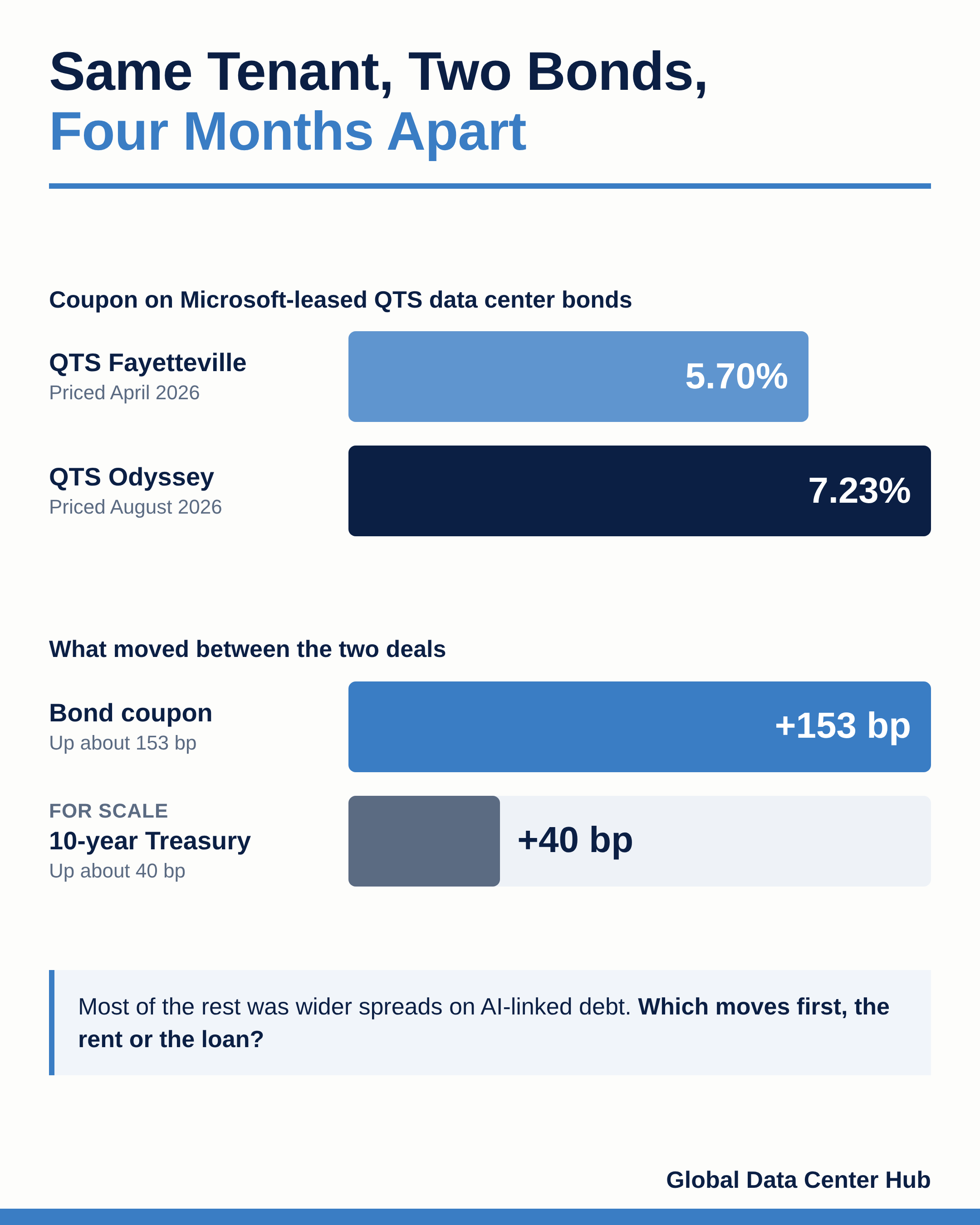
Bonds show the same pressure. In April, a Microsoft-leased QTS campus priced bonds at 5.70%. In August, another Microsoft-leased QTS deal priced at 7.228%, according to the CCIR deal ledger, which draws on press reports (CCIR).
The 10-year rose about 40 basis points between those dates. Most of the remaining gap came from wider spreads on AI-linked debt. The two bonds differ in structure and term, so read the comparison as directional.
Fixed-rate debt delays the hit. It does not remove it. Digital Realty carries a weighted-average coupon of 2.9%, and 90% of its debt is fixed, with maturities peaking in 2029 and 2030 (Investing.com).
Its guidance for new long-term debt moved from 4.0% to 4.5% in February to 4.5% to 5.5% in July (Digital Realty). The higher cost arrives one maturity at a time.
Leases Reprice on Their Own Schedule
Rent moves on two tracks: the yearly escalator and the renewal.
The escalator is the slow track. The three Northern Virginia hyperscale buildings Digital Realty agreed to buy on June 29 carry 15-year leases with rent rising 3.6% a year (Digital Realty 8-K).
The Fed projects 3.7% PCE inflation for 2026 and 2.3% for 2027 (Federal Reserve). This year, that escalator roughly keeps pace with prices.
If the 2027 forecast holds, it pulls ahead. A fixed escalator protects the owner as long as inflation stays near it.
The renewal is the fast track. Digital Realty’s second-quarter renewals came in 25.4% higher on a cash basis (Digital Realty). Leases above one megawatt renewed 66.7% higher. Leases under one megawatt renewed 5.2% higher (Investing.com).
CFO Matt Mercier put it plainly: “our expiring rates continue to drop over the next several years, while market rates continue to march up” (earnings call).
Short contracts reset most often. Equinix’s revenue contracts carry initial terms of one to five years, then renew automatically in one-year increments, its quarterly filing shows (Equinix 10-Q). Each renewal is a chance to price at today’s market.
New lease terms move cost too. CBRE reports take-or-pay minimums of 60% to 85% of allocated power. It also reports colocation operators beginning to adopt triple-net leases, where tenants pay taxes, insurance and upkeep directly (CBRE).
Both shift cost inflation from the owner to the tenant.
Four Positions on Two Clocks
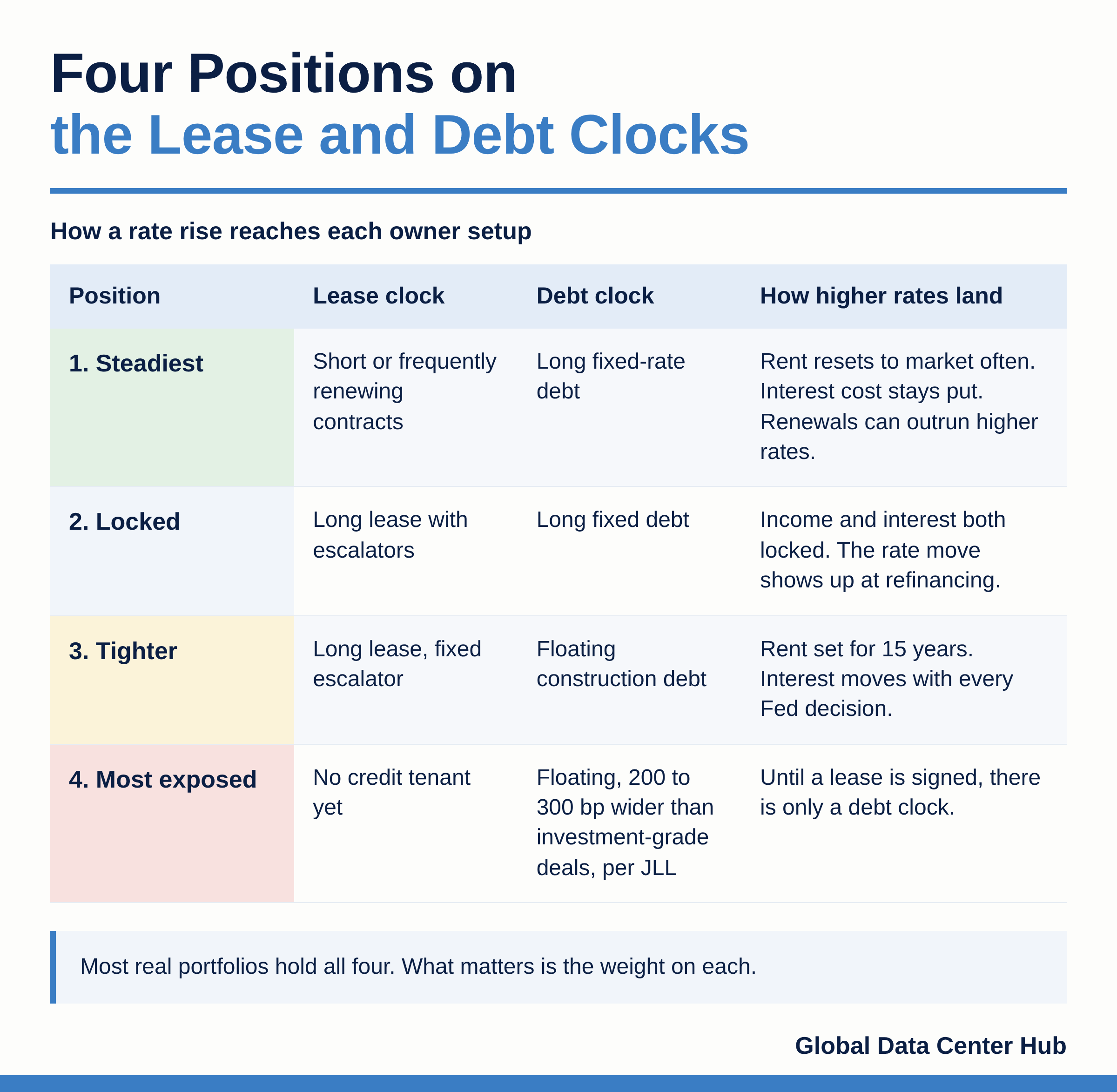
Set the lease clock beside the debt clock and four positions appear.
The steadiest pairs short or frequently renewing contracts with long fixed-rate debt.
Rent resets to market often. Interest cost stays put. Higher rates arrive late, and renewals can outrun them.
Next is a long lease with escalators, funded with long fixed debt. Income and interest are both locked. This position barely notices a rate move until refinancing, when a new coupon meets an escalator set years earlier.
Tighter is a long lease with a fixed escalator, funded with floating construction debt.
Rent is set for 15 years. Interest moves with every Fed decision. The escalator has to cover the gap until the project refinances into fixed debt.
The most exposed is construction without a credit tenant. JLL puts those loans 200 to 300 basis points wider than investment-grade deals, at 70% to 80% of cost (JLL).
With SOFR near 3.90%, that implies 8% to 9% or more all-in. Until a lease is signed, only the debt clock runs.
Most real portfolios hold all four. What matters is the weight on each.
Value Shows the Gap First
Prices move before cash does. Digital Realty expects an initial stabilized cap rate above 6.5% on its June purchase (Digital Realty 8-K).
A cap rate is a building’s yearly income divided by its price. On signing day, the 10-year was 4.38%, a cushion of at least 212 basis points. On September 30, the cushion was at least 121.
If cap rates rise to rebuild that cushion while income holds flat, values fall. A move from 6.5% to 7.0% cuts value by about 7%. A move to 7.5% cuts it by about 13%.
Rent growth is the offset, and here the two clocks matter again. An owner who can re-sign leases 25% higher can grow income into a higher cap rate. An owner on a 3.6% escalator waits for the years to add up.
New building still pays. Digital Realty’s 1.4-gigawatt development pipeline is expected to deliver an 11.5% stabilized yield (earnings call).
That is about 620 basis points over the September 30 10-year. Higher rates thin the margin on existing buildings. On new ones, margins are still wide.

Outside the U.S., the Clocks Run on Other Rates
The same test applies abroad with different inputs.
Gulf central banks hiked with the Fed because their currencies are pegged to the dollar.
Saudi Arabia’s repo rate rose to 4.50% (Reuters). Dollar debt in the Gulf feels U.S. moves directly.
In India, dollar loans price off SOFR. AdaniConneX’s roughly $800 million construction loan priced at about SOFR plus 200 basis points, Bloomberg reported (Bloomberg).
Part of the revenue there comes in rupees. Two clocks become three: rent, debt and currency.
Nigeria cut its policy rate 350 basis points in September, to 23% (Central Banking).
For many operators there, energy is more than 35% of operating cost, Nairametrics reported (Nairametrics). Power sets the math more than the rate does.
What to Check Before the Next Deal
The rate picture will not settle by year-end. The Fed meets again on October 27 and 28. Investors are watching 6% on the 10-year as a pain point, Reuters reported (Reuters).
So put every rent reset and every debt reset on one calendar and find where debt resets first. Compare each escalator with the Fed’s inflation path for the next two years.
Then ask whether the lease moves power and operating cost to the tenant, through take-or-pay floors or triple-net terms.
One question stays open. Renewal spreads this wide depend on tight supply.
CBRE counts less than 1,500 megawatts of future capacity available across primary U.S. markets, about six months of leasing (CBRE).
If that supply loosens, the fast clock slows. Then the debt clock you set today is the protection you have left.