
Welcome to Global Data Center Hub. Join investors, operators, and innovators reading to stay ahead of the latest trends in the data center sector in developed and emerging markets globally.
Capital markets priced the power constraint for the first time in H1 2026. CoreWeave closed an $8.5 billion investment-grade financing backed by GPUs in April. Investors then repriced $14 billion of Oracle-backed data center debt in June secondary trading.
Asia-Pacific and Europe absorbed the H1 2026 primary-market commitments. North America’s defining developments ran through the credit stack and the courts. AirTrunk committed $21 billion to a project near Mumbai. SoftBank announced plans for 5 gigawatts of French AI data center capacity. Maine enacted a statewide data center moratorium.
H2 2026 will test whether a second rated-debt repricing event follows the Oracle precedent. Industry estimates put only 50 to 60 percent of US data center capacity scheduled for the next two years on an on-time trajectory. Delivery is now at the center of the next capital-markets conversation.
In April 2026, a rating agency agreed to call GPU-backed debt investment grade for the first time. In June, the same paper traded at a discount in secondary, with PIMCO selling down.
Those two events reset the central question in global data center investing. Capital markets have priced the power constraint. Can they now price its delivery?
Six months ago, the Q1 2026 Global Data Center Hub piece argued that electric power delivery was the gate on US data center growth.
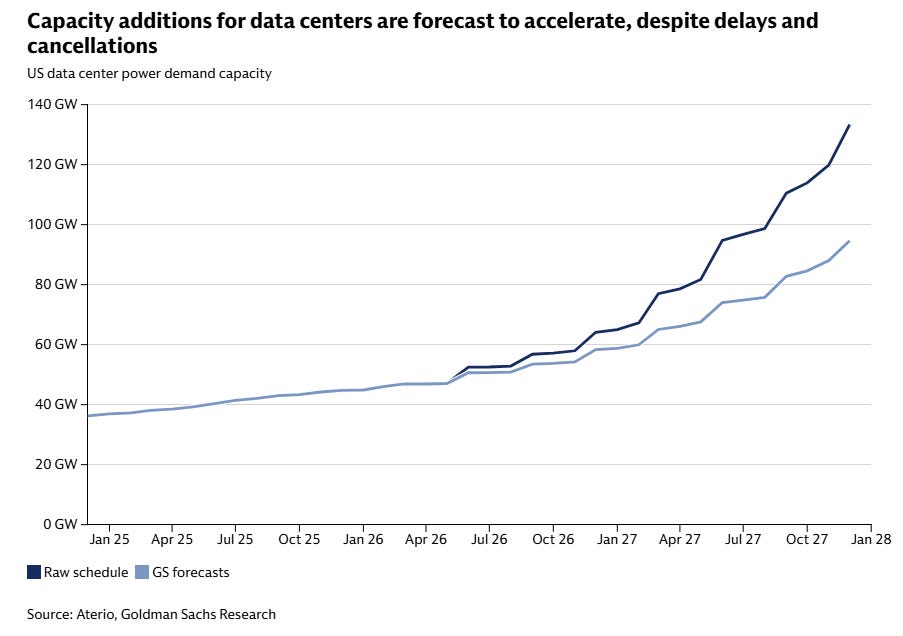
The first half of 2026 extended that argument globally. Industry research now puts only 50 to 60 percent of US capacity scheduled for the next two years on an on-time trajectory, against a 72 percent historical rate.
The Wall Street Journal confirmed in Q2 that the broader US build is behind schedule.
Equipment lead times for critical electrical components continued to exceed 18 months, per the Q1 synthesis, which is driving the slip.
The scale underneath H1 2026 is worth naming. Global hyperscale demand is growing at a 14 percent compound annual rate, and 18 global markets now hold more than 1 gigawatt of operational capacity, up from 13 in 2024.
US data center power demand is projected to more than double from 31 gigawatts in 2025 to 66 gigawatts by 2027, moving data centers from 4.1 percent of US peak summer power to 8.5 percent.
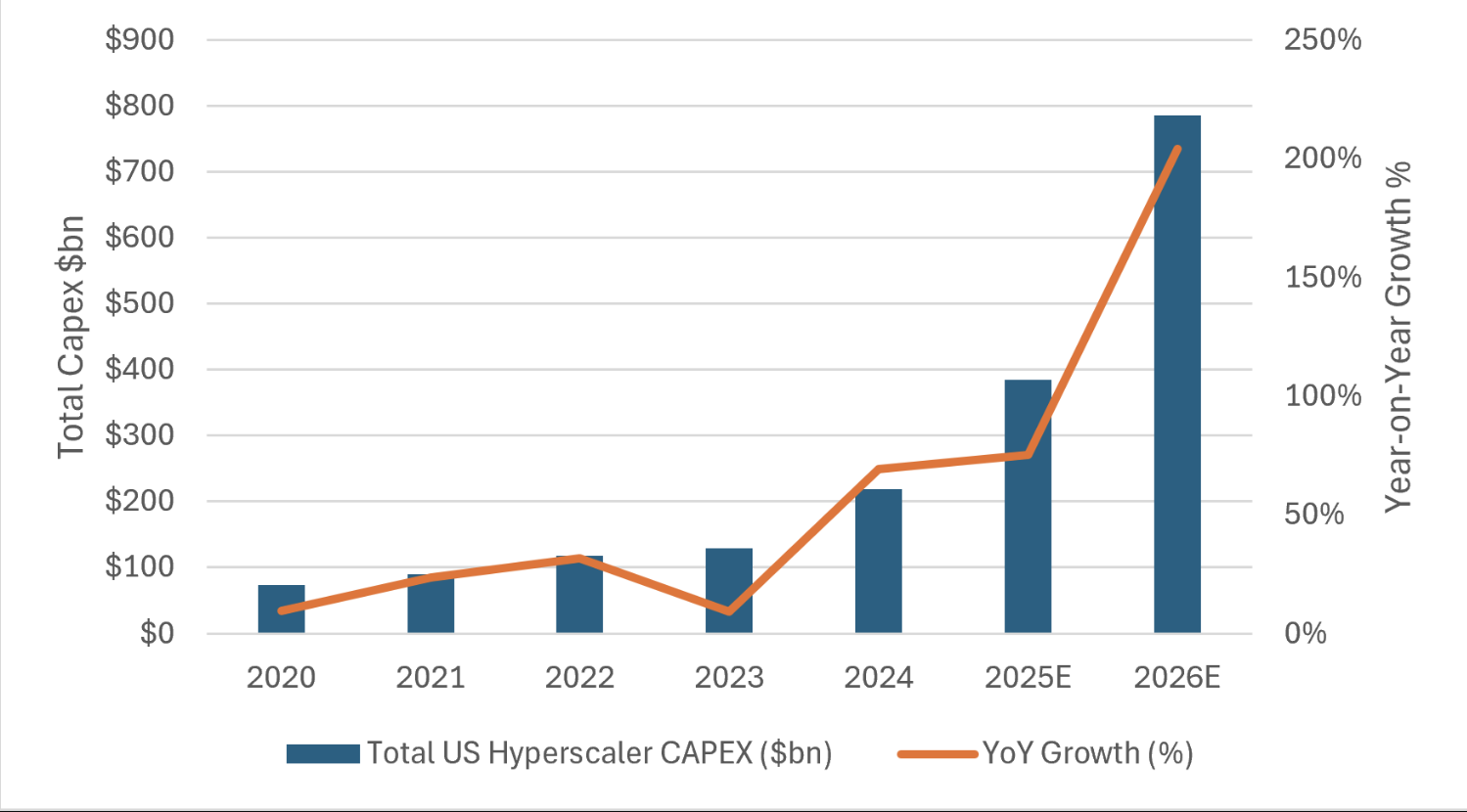
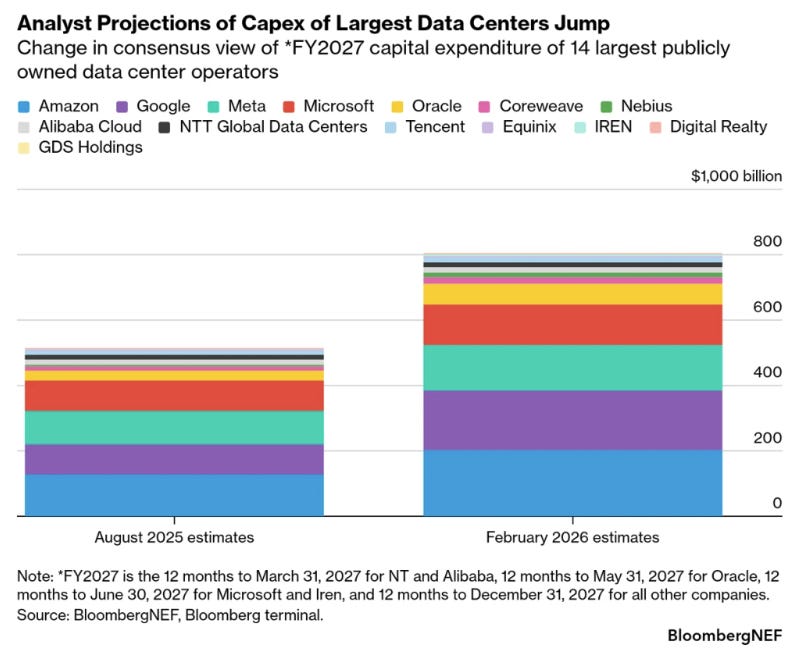
Big Tech capex is up 61 percent in 2026, with Amazon planning $200 billion of AI spend and Google targeting $180 billion. The broader opportunity sits inside a $3 trillion infrastructure investment supercycle.
Private credit still provides 60 to 75 percent of pre-development capital, and neocloud providers control roughly 10 percent of global third-party inventory. These are the base-rate figures the H1 2026 developments sit on top of.
Three H1 2026 developments earn this synthesis. Capital pricing moved from private credit to a rated-debt layer above it.
Social license hardened from county-level opposition to statewide moratorium and central-government intervention.
Geographic allocation reshuffled, with India promoted to primary-market status.
What follows walks each region through the same three questions: what moved on power delivery, capital structure, and social license.
The regions are evaluated, not surveyed.
Where a question did not activate meaningfully in the first half of 2026, the regional section says so.
North America: Capital Priced the Delivery Gap
North America was the H1 2026 region where the capital-markets story landed hardest, with rated debt forming above private credit at the same time the delivery audit went public and Maine moved permitting to statewide policy.
The US power pathway moved from forecast to audit in H1 2026. The 50 to 60 percent on-time rate, measured against a 72 percent historical baseline, is the base case now rather than a tail risk. Utilities continue to estimate that delivering power will take 18 to 24 months longer than hyperscalers and developers expect.
The capital story defined the first half of 2026. CoreWeave closed the first investment-grade financing backed by GPU collateral, at $8.5 billion in April. Hut 8 followed with $3.25 billion of investment-grade senior secured notes for its River Bend project.
Applied Digital surpassed one gigawatt of contracted capacity and raised a proposed $1.59 billion senior secured notes offering plus a $550 million revolver.
Amazon secured a $17.5 billion loan for AI data center buildout, the largest hyperscaler debt raise of H1 2026 and a signal that even the strongest balance sheets now prefer dedicated infrastructure debt over corporate capex.
Bloomberg reported that Meta and Microsoft led an $850 billion data center leasing boom. At that scale, leasing shifts balance-sheet risk from hyperscaler credit to the developers and lenders financing the leased capacity.
The common structure: secure an investment-grade tenant on a long contract, then raise rated debt against the contracted cash flows. Investors repriced more than $14 billion of Oracle-backed data center debt in secondary trading in June, with PIMCO selling down. A secondary market now exists, and it can move against the issuer.
Social license hardened faster in H1 2026 than in any prior six-month period. Maine enacted a statewide data center moratorium. Developers withdrew from projects in New Jersey and Ontario, per Q2 reporting.
The Q1 synthesis counted $64 billion in US data center projects blocked, delayed, or cancelled since 2023. The first half of 2026 moved the response to the state and provincial level, which changes underwriting from a local-permitting question to a jurisdictional one.
Projects advancing through 2026 and 2027 now have to account for policy risk a county council cannot resolve, and that risk is harder to price because the policies are new.
Europe: Capital Routed Around FLAP-D
European H1 2026 saw growth routed around FLAP-D saturation into France, the Nordics, and Spain’s permitting pathway.
European power constraints concentrated in the FLAP-D markets through H1 2026. Vacancy stayed tight and new hyperscale campus starts shifted north and east to reach deliverable capacity.
Zaragoza’s streamlined single-pathway permitting framework, flagged in the Q1 synthesis as the clearest execution path on the continent, drew interest through the first half of 2026 as the counterpoint to FLAP-D saturation.
The Leeds repurposing of former power station sites extended the Q1 theme that recovered industrial land is the fastest route to campus-scale European development.
SoftBank announced plans for 5 gigawatts of AI data center capacity in France in May, naming the capacity in power terms rather than square footage. Mistral AI advanced the sovereign AI theme with an estimated $830 million Paris data center commitment.
Prime Data Centers announced a 550-megawatt campus in Esbjerg, Denmark, and Telis Energie announced a 500-megawatt campus in Lower Saxony, Germany, both in Q1.
The rated-debt mechanics that defined the US capital story did not materially reshape European financing, which stayed closer to the sovereign and strategic capital shape the Q1 synthesis identified.
The United Kingdom government intervened on a $500 million London data center project in H1 2026, moving European social-license risk from local friction to central-government involvement.
EU sustainability mandates, including the Energy Performance of Buildings Directive and transition-plan disclosure, kept the compliance load heavier than in any other region covered.
Across the first half of 2026, Europe routed growth through permitting-cleared geographies rather than fighting the constraint where it bites hardest.
Asia-Pacific: Capital Followed Power to India
Asia-Pacific delivered H1 2026’s largest primary-market commitments and reshuffled the regional league table, with India promoted from diversification destination to tier-one in a single six-month window.
Asia-Pacific’s H1 2026 story is the clearest regional case of the power pathway activating in the market’s favor. The Singapore-Johor-Riau triangle, named in the Q1 synthesis as the strategic node connecting Southeast Asia, kept absorbing Singapore’s overflow.
Thailand and Indonesia moved from secondary mentions to active hyperscaler commitments. Mainland China’s data center demand continued at a mid-teens compound growth rate through the first two quarters, per the Q2 synthesis. Hong Kong and Shanghai remained under government power allocation policies, which kept vacancy elevated.
Microsoft committed over $1 billion to Thailand data center infrastructure and $5.5 billion to Singapore in Q1. AirTrunk, backed by Blackstone and a Canadian pension, committed $21 billion to a data center project near Mumbai in June.
Meta partnered with Reliance on an AI-enabled data center in India in Q2. Amazon and Anthropic expanded their collaboration to include up to 5 gigawatts of new compute alongside an additional $5 billion investment, with capacity landing across multiple regions.
Developers withdrew from a data center project in Australia in H1 2026, per Q2 reporting. South Korea’s regulatory workaround involves developers building sub-10-megawatt facilities in Greater Seoul to bypass the local utility’s mandatory assessment for larger loads.
Southeast Asian regulators continued to use incentives selectively rather than impose moratoriums. Social license stayed closer to a facilitator than a brake across most Asia-Pacific markets evaluated here.
Middle East and North Africa: Gulf Capital Followed Power Abroad
The H1 2026 MENA story is where the region’s capital landed: in Europe and Asia-Pacific more than at home.
Gulf states hold two assets most of the world does not: abundant natural gas and policy infrastructure that can coordinate generation with digital infrastructure buildouts.
The Q2 synthesis flagged gas with carbon capture and storage as a specific opportunity set, with potential US capital expenditures of up to $80 billion attached to the broader technology. Gulf-scale commitments in H1 2026 remained in the announcement phase.
Nexus Core Systems advanced its Morocco data center project through the first half of 2026.
The more notable H1 2026 story is where Middle East sovereign capital landed outside the region: it continued to appear in European and Asia-Pacific stacks, including as a co-investor base in the AirTrunk Mumbai transaction.
Gulf capital priced AI infrastructure globally rather than regionally in the first half of 2026.
H1 2026 produced no material social-license events in MENA. Where power and land coordinate at the state level, the North America and Europe pattern does not translate.
Africa: Capital Arrived, Power Did Not
H1 2026 produced no African capital-markets event at the scale Asia-Pacific absorbed, but it produced one of the most informative delivery datapoints of the first half of 2026.
African activity in H1 2026 was light. South Africa, Kenya, and Nigeria remained the three markets with the most defined trajectories. Kenya’s geothermal advantage remained the specific asset for inference-capable workloads.
A hyperscaler-backed project in Kenya stalled on energy availability in the Q2 window, per the Q2 synthesis. That is the single most informative H1 2026 datapoint on African data center delivery. Capital reached the market and the power did not.
The Q2 synthesis puts Nairobi and Lagos among the highest-loss grid markets globally at up to 24 percent transmission loss, against Singapore’s 0.2 percent, which continues to cap the realistic scale of latency-sensitive inference workloads on the continent.
H1 2026 produced no material social-license events in Africa. The constraint remains structural.
Latin America: Capital Followed Established Grids
Latin American H1 2026 was when the global platform-consolidation trend extended into the region at modest scale.
The Latin American power pathway continued to run through Brazil’s largely renewable grid, Chile’s established solar sector, and Mexico’s progression toward private investment in strategic generation. Through the first half of 2026, Mexico’s opening remained more invitation than installation.
I Squared’s acquisition of Brazil’s Elea in Q2 extended the platform consolidation trend into Latin American infrastructure, matching the global pattern the Q2 synthesis names as capital shifting from single-asset acquisition to platform ownership.
Secondary expansion into Colombia, Peru, and Argentina continued through the first half of 2026, with Bogotá maintaining its first-mover window. The scale of specific H1 2026 capital events in Latin America stayed below the thresholds set in North America, Europe, and Asia-Pacific.
H1 2026 produced no material Latin American social-license events at the scale of Maine or London. Political and energy stability continued to shape where capital was willing to commit, which is a standing Q1 constraint rather than an H1 2026 event.
What the Regional Comparison Reveals
Three cross-regional observations earn mention from the H1 2026 record.
First, the India risk premium compressed in a single six-month window. The AirTrunk $21 billion Mumbai commitment, backed by Blackstone and a Canadian pension, is the clearest signal that the global league table has reshuffled.
Allocators sized the Mumbai transaction at risk-adjusted returns that six months ago would have required a tier-two premium. It priced closer to tier-one.
The Q2 synthesis names the shift directly: India and Malaysia joined Japan, Australia, and mainland China as leading APAC markets. Allocators still sized to the old premium now face either a repricing event on their existing book or a competitive disadvantage on new allocation. The H2 2026 pipeline will reveal which.
Second, social license has become jurisdiction-specific in ways that will matter for underwriting. Maine’s statewide ban and the UK’s central-government intervention on a London project are two different precedents. Neither looks like a one-off.
Permitting and social-license risk now sit alongside interconnection risk in site selection rather than following it. A project that clears capital, power, and site control still has to clear jurisdictional policy, and H1 2026 showed that policy is now set at the state or national level, not the county level.
Third, the regions where capital priced the first half of 2026 most aggressively are the regions where delivery slippage got measured first. North America absorbed the rated-debt events, the US delivery audit, and the Maine moratorium in one six-month window.
Asia-Pacific absorbed the AirTrunk Mumbai commitment in a period of fewer visible frictions.
The constraint shows up together where the pressure is highest. It should be priced as one risk with three indicators, not three separate risks.
H2 2026 Watchlist
Four items earn tracking between July and December. Each carries a decision rule attached.
First, whether a second rated debt repricing event follows the Oracle precedent. If a second secondary trade reprices at a discount in H2 2026, the asset class is systemically liquid rather than one-issuer-liquid, and allocators sized to held-to-maturity exposure face a repricing event on their existing book.
If no second event occurs, the Oracle trade stays a one-off and the rated-debt stack holds its primary-market pricing into 2027 issuance.
Second, whether India’s Mumbai pipeline signs power contracts commensurate with the announced capital. If energization matches commitments, India’s tier-one promotion is confirmed. If power lags capital, H1 2026 India starts to look like the US pipeline: capital racing ahead of grid.
Third, whether a second US state follows Maine. If one does, jurisdictional-policy risk becomes a national underwriting input and site selection has to add a political-sort layer. If Maine remains alone, the precedent stays local.
Fourth, whether the H2 2026 hyperscaler earnings cycle confirms or revises 2026 capex pacing. If the 61 percent year-over-year increase in Big Tech 2026 capex from the Q2 synthesis holds, the baseline for 2027 rated-debt issuance stays intact.
If pacing softens, H1 2026 rated-debt structures underwritten against that trajectory face refinancing risk sooner than currently priced.
Q1 2026 was when power became the constraint. H1 2026 was when capital priced it and started trading it. H2 2026 will test whether that pricing holds.