
Welcome to Global Data Center Hub. Join investors, operators, and innovators reading to stay ahead of the latest trends in the data center sector in developed and emerging markets globally.
Edition No. 72
THE WEEK’S THESIS: THE BUYER BRINGS THE POWER
The signed customer is now the asset that gets financed. Power, land and buildings matter. But this week, money moved fastest toward projects with a named buyer already locked in.
DayOne took its customer book to Nasdaq. CoreWeave committed to India as the only tenant on a new campus. Lenders are reportedly building vehicles that lend against chip buyers’ promises to pay. The tenant came first, and the capital followed.
The projects still waiting have everything except a buyer. TeraWulf has the power contract and no tenant. Applied Digital and atNorth have Finnish power and are still marketing it. Then there are the projects with a buyer and no permit, which is the constraint further down.
The structure behind DayOne’s filing is in The Mechanism below.
MARKET SIGNALS
Google pays for nuclear output it doesn’t own. Google and Constellation signed a 20-year deal to add 890MW through upgrades at 11 existing reactors. What counts as new supply on PJM’s books is still open.
Amazon builds beside a dedicated gas plant. AWS filed a preliminary plan for 36 data centers on 1,100 acres at the Homer City Energy Campus, about 50 miles east of Pittsburgh. A 4.5GW gas plant being built by Homer City Redevelopment will power the site. More than 1GW of that output goes back to the grid. The campus is sized to its power plant, and the grid gets the surplus.
Washington and Seoul pick a Texas power builder. The US Commerce Department and South Korea selected Related Companies, NextEra, and Lewis Energy Group to develop Project Star in Encinal, Texas. The $22.3 billion campus will provide 6.47GW of gas-fired power for an adjacent 5GW data center site. Korea and the US will jointly own the power campus under their trade deal. Sovereign money now funds the power block, and the data center follows it.
Onsite engines become a repeat purchase. Wärtsilä booked an order for 282MW of onsite power at a US data center built by an unnamed independent power producer. Fifteen gas engines arrive in 2028, with full operation in 2029. It is Wärtsilä’s seventh US data center order. Its US data center total now tops 3GW. Seven orders are a product line.
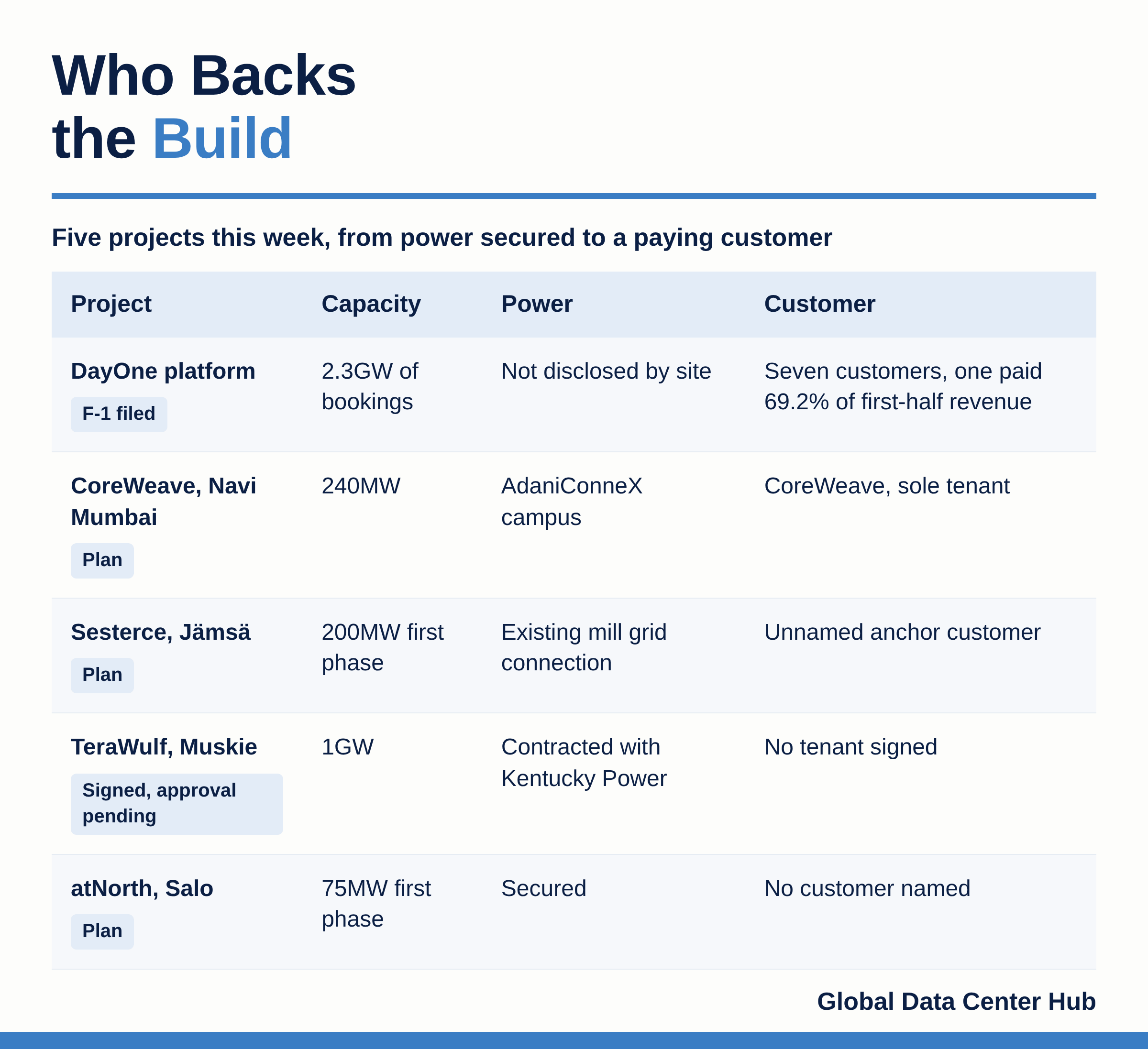
Finland’s old paper mills turn into AI campuses. Sesterce plans an AI campus worth more than €10 billion at the former Kaipola paper mill in Jämsä. The first phase is 200MW, rising to 600MW, and the company says an unnamed anchor customer is already committed. It also pledges 1MW of new renewable supply on the Finnish grid for every 1MW it uses. Old mills come with grid connections, and the connection is the scarce part.
CAPITAL WATCH
Broadcom, SpaceX, Oracle and the lenders. Broadcom is arranging more than $50 billion in debt to fund OpenAI’s custom chips, the Wall Street Journal reported. SpaceX is reportedly in talks to borrow ~$40 billion for Nvidia chips, split between ~$10 billion of bank loans and ~$30 billion of investment-grade debt. Oracle is reportedly weighing a vehicle that buys chips with investor money and leases them back to Oracle. Chips are leaving company balance sheets and moving into lease vehicles.
Firmus pulls its IPO. Nvidia-backed Firmus shelved its planned ~$5 billion Australian listing amid growing scrutiny of AI spending, Reuters reported. One Asia-Pacific operator stepped back from public markets in the same week another filed for New York. The next test is whether public buyers pay up for the one with signed tenants.
GLOBAL LENS: THIS WEEK BY REGION
North America: power contracts set the build order
TeraWulf signed an amended electric service agreement with Kentucky Power that doubles contracted capacity at its Muskie campus to 1GW. The second 500MW phase moves up from 2030 to 2029, pending state commission approval. The first 500MW starts ramping in 2028. No tenant has signed, so TeraWulf is selling a power date. In this market, the date is the product.
Brookwood’s city council voted to back the county development authority’s agreement with Applied Digital for its $3.2 billion Delta Forge 2 campus in Alabama. The vote followed weeks of local pushback over environmental impact and transparency. The Alabama Public Service Commission still has to approve the power agreement with Alabama Power. Local consent is done. The power contract is the last gate.
Europe: Finland’s power draws the developers
Applied Digital signed an agreement for access to up to 1GW of potential power in Finland, its first project outside the US. Initial power is expected from 2028. The company is already marketing the site to hyperscalers and says it structured the deal to limit early capital at risk. A US developer bought its first foreign option, and it bought Finnish power.
atNorth plans a new campus in Salo, west of Helsinki, at about €2 billion. atNorth has secured power for the first 75MW phase, with a path to 230MW through a Fingrid substation. Customer servers could add up to €10 billion more, by the company’s estimate. Securing first-phase power is what lets atNorth announce before naming a customer.
Asia-Pacific: tenants arrive before the buildings
CoreWeave plans to enter India with 240MW across three 80MW buildings at AdaniConneX’s Taloja campus in Navi Mumbai. It will be the sole tenant, with an option to double capacity. The first phase is expected in mid-2028 and will run NVIDIA Vera Rubin. A US AI cloud is committing to India at a single campus, at hyperscale size.
The New South Wales planning department approved Stockland’s A$630.4 million data center at Macquarie Park in Sydney. The 10-story building has 49MW of total power and 34.3MW of IT load. The consent bars its backup generators from selling power into the grid. Those generator and emissions caps are now the template other Sydney projects will face.
CONSTRAINT OF THE WEEK: PERMISSION IS THE BOTTLENECK
Permission is now the scarcest input in this market. Finland’s Supervisory Agency ordered Google to suspend site work at planned data centers in Muhos and Kajaani. Regulators cite tree clearing, new roads, and drainage changes made before environmental assessments were done. The company said it fell short of its own standards. The sites stay frozen until those assessments are complete.
Raleigh’s city council voted 7-1 for a six-month moratorium on new data centers. Residents had asked for 32 months. Staff must write rules on noise, water and pollution by April 6, under a 2024 state law that bans downzoning. Six months sounds short. It still stops every new filing in the city.
In Melbourne, Monash council rejected Centuria’s 38MW, A$137 million expansion at Clayton. Its own planners had recommended approval. Councilors pointed to Victoria’s new plan, which proposes 150-meter buffers from homes and self-supplied renewable power. Those rules don’t start until 2027. The council applied them early anyway.
In India, the Andhra Pradesh High Court let Adani’s Vizag campus keep building for Google’s AI hub, at the developer’s own risk. A public interest case challenging state approvals is still open. The court said money spent now can’t be used to argue for relief later. The next bottleneck is legal risk on capital already in the ground, and lenders will price it.
THE MECHANISM
Two customers carry the book, and the listing funds the build
DayOne is a data center platform headquartered in Singapore. It was the international business of China’s GDS until it spun out in 2025, DCD reports. It runs campuses across Malaysia, Singapore, Indonesia, Thailand and Japan, with Finland and Spain in development. On Oct. 6 it filed a Form F-1 for a Nasdaq listing under the ticker DODC.
Revenue reached $484.3 million in 2025, up from $178.1 million a year earlier. The first half of 2026 alone brought $512.0 million. The company lost $367.1 million in 2025. It has 962MW in service and 1,328MW under construction.
Seven customers hold 2.3GW of bookings due by the end of 2028. Finishing them will cost about $11.4 billion, by the filing’s estimate. One customer paid 69.2% of first-half revenue. The filing describes it only as a global technology company with a leading short-form video platform. The second-largest paid 15.1%, and Malaysia supplied 87.0% of all revenue.
So two customers and one country carry a build already backed by $4.35 billion of long-term borrowings. Lenders funded the first gigawatt against those contracts. The listing asks public buyers to fund the next one on the same promise. The filing lists access to power as a core risk, and almost all revenue sits on Johor’s grid.
The share count, price, and proceeds are still blank. Reuters reported in February that DayOne aimed to raise ~$5 billion at a ~$20 billion valuation, per DCD. Customer contracts allow early termination, with penalties applying only after “a certain number of years.” The filing doesn’t say how many.
NOTABLE TRANSACTIONS
Macquarie Capital: investment in Zerra, amount undisclosed
Macquarie Capital’s Infrastructure Principal team invested in Zerra, a hyperscale developer headquartered in Singapore. AGP, which founded Zerra, remains the majority owner. The amount wasn’t disclosed.
What makes it notable is the order of the steps. Macquarie first joined Zerra’s Western Downs Digital Park in Queensland as a consortium partner and adviser. Then it bought into the developer itself.
Western Downs plans up to 1.44GW across four stages and holds a long-term lease commitment from Anthropic. Zerra’s wider pipeline tops 2GW across Australia, Japan and India. This is Macquarie Capital Principal Investment’s fifth investment since April.
Watch the Western Downs development application, which is still under assessment. The tenant has committed, so the approval is the gate that binds.
Sabey Data Center Properties: Ares lifts its stake above $500 million
Ares Secondaries funds expanded their minority equity stake in Sabey Data Center Properties. Their total commitment now tops $500 million. Sabey is a joint venture between Sabey Corporation and National Real Estate Advisors. The follow-on builds on a stake first announced in July 2026. The tranche size wasn’t disclosed.
The buyer is what makes it notable. A secondaries fund is adding to a minority stake in a private platform, and the founding partners keep control.
Sabey owns and runs 275MW across US markets and expects its pipeline to reach about 737MW by 2033. National Real Estate Advisors manages money for the National Electrical Benefit Fund, a union pension trust. Pension money and secondaries money now share the same build risk.
Watch how the next 460MW gets funded. More partial stakes would show minority capital can carry a platform this size without a full sale.
AirTrunk: ~$1 billion more for its Tokyo TOK1 campus
AirTrunk, owned by Blackstone and CPP Investments, plans to invest another ~$1 billion in its TOK1 campus in Inzai, east of Tokyo. Reuters described it as an added investment, while DCD, citing Nikkei Asia, reported a ~$1 billion green loan led by SMBC, MUFG, and UOB.
What makes it notable is the repeat. AirTrunk closed a ¥191.6 billion green loan for the same campus in March, then the largest data center financing in Japan.
The new money goes to added capacity and liquid cooling for dense AI racks. AirTrunk puts its Japan capacity at 530MW today and targets more than 1GW. Its CEO said customers are looking to Japan for geopolitical reasons.
Watch for AirTrunk’s own release naming the lenders and terms. Two bank-led financings on one campus in seven months would mean Japan’s lenders treat AI capacity as core business.
THE FRAMEWORK: WHO PAYS FOR THE POWER
Each of this week’s power deals answers one question differently: who builds the supply, and who pays for it. The chart below lines them up.
THE QUESTION FOR NEXT WEEK
Will Google’s Finnish subsidiary satisfy regulators by Oct. 14? Tuike Finland must explain its site work and set out next steps by that date, or face enforcement. A clean answer puts Muhos and Kajaani back on the assessment timeline. A weak one tells every developer in Finland that early site work now carries a real cost.
If you are new to Global Data Center Hub, visit our Start Here page for more information about the newsletter.
If you found this newsletter useful, share it with a colleague.
Have a great week.
— Obinna