

Welcome to Global Data Center Hub. Join investors, operators, and innovators reading to stay ahead of the latest trends in the data center sector in developed and emerging markets globally.
Google plans to send four AI chips into orbit on Thursday, October 1.
The New York Times reported that the test satellite, called MVP, will ride a SpaceX rocket from California.
Google confirmed the launch on its own blog and said the satellite was built with Planet, a company that makes Earth-watching satellites.
Most of the talk about this launch is about rockets. How cheap can a launch get? When will a data center in space cost the same as one on the ground? Those are fair questions. But they skip a simpler one that tells you more.
Every data center is held back by one thing before anything else. On the ground, that thing is usually power. In space, power is easy to get, so something else takes its place.
This piece teaches you how to find that one thing and how to use it to read any big infrastructure claim.
It does not cover the laser links that would join satellites together, and it does not say whether any company in this race is a good investment.
Why Data Centers on the Ground Hit Power First
Every system has one input that runs out first. That input sets the size of everything else.
Think of a restaurant with ten cooks and one oven. The cooks can chop all day. But the kitchen can only serve as many meals as the oven can bake. Hire more cooks and nothing changes. Buy a second oven and the kitchen grows. The oven is what runs out first.
Factory managers have used this idea for decades. The lesson is simple. Find the part that runs out first. Fix that part. Then look again, because a new part will now run out first.
A data center works the same way. It needs land, chips, buildings, water, workers, and electricity. On the ground, electricity is usually the part that runs out first.
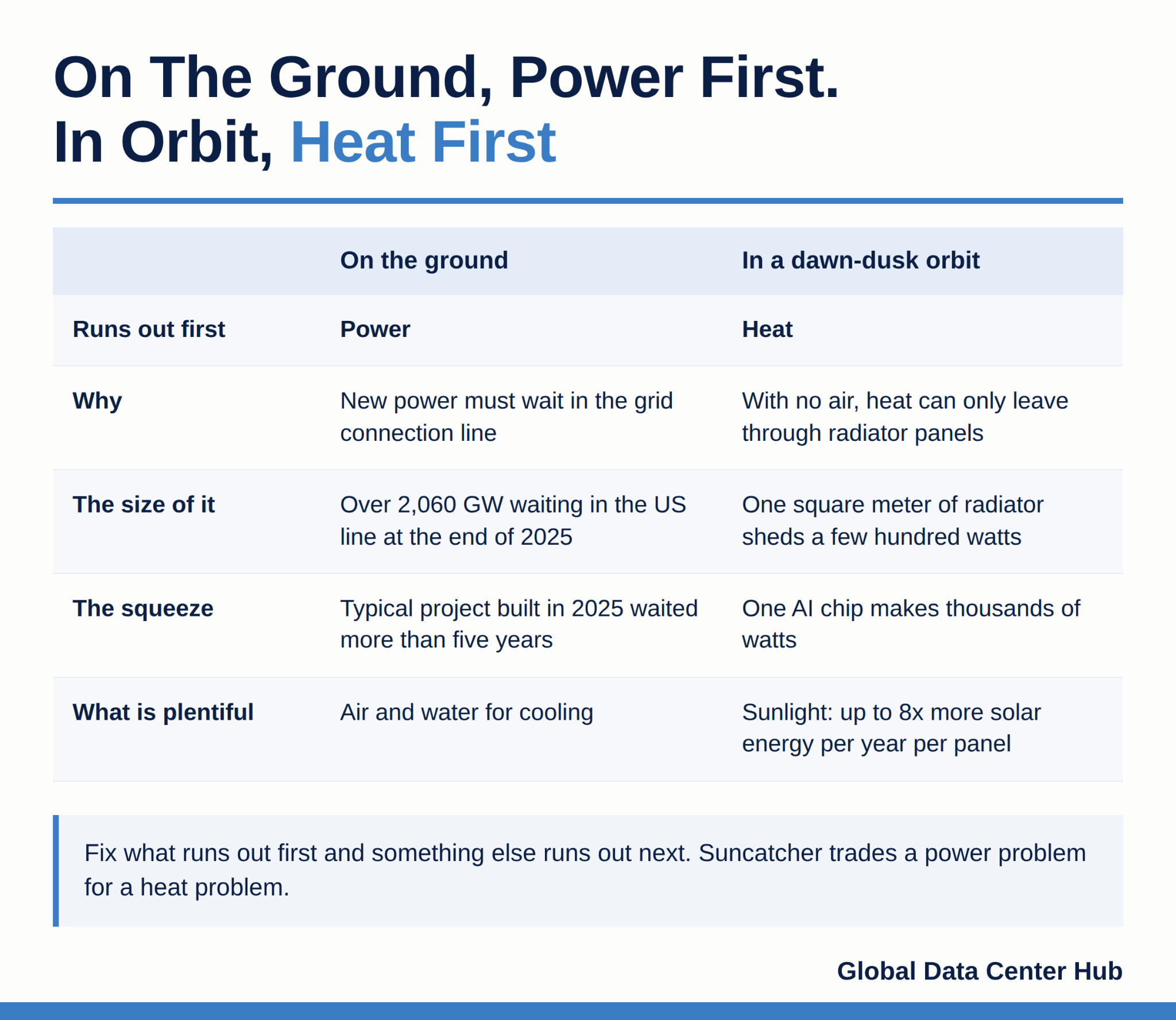
Here is why. A new data center has to connect to the power grid, the network of wires and power plants that carries electricity. New power plants and batteries also have to connect before they can send power to anyone. They wait in a line called the interconnection queue.
At the end of 2025, more than 2,060 gigawatts of these projects were waiting in that line in the United States, according to Lawrence Berkeley National Laboratory. A gigawatt is a billion watts, enough to run a very large data center campus. The typical project built in 2025 waited more than five years to get through.
So on the ground, you can have the land, the money, and the chips, and still wait years for power. Power is the oven.
Google’s Project Suncatcher starts from that fact. Its idea is to move the computers to where power is easy to get. In a special orbit that follows the line between day and night, called a dawn-dusk orbit, a satellite’s solar panels face the sun almost all the time.
Google’s research paper says a panel there can collect up to eight times more solar energy per year than the same panel on the ground at a middle latitude, such as the United States or Europe.
That is the opportunity. It is real. But it comes with a risk that follows from the idea itself. When you fix the thing that runs out first, something else takes its place. The question for Suncatcher is what that new limit is.
How to Read the Space Data Center Cost Claim
The most repeated claim about Suncatcher is about cost. Headlines say space data centers could match the cost of ground data centers by the mid-2030s. To see what that claim means, you have to look at what is being compared.
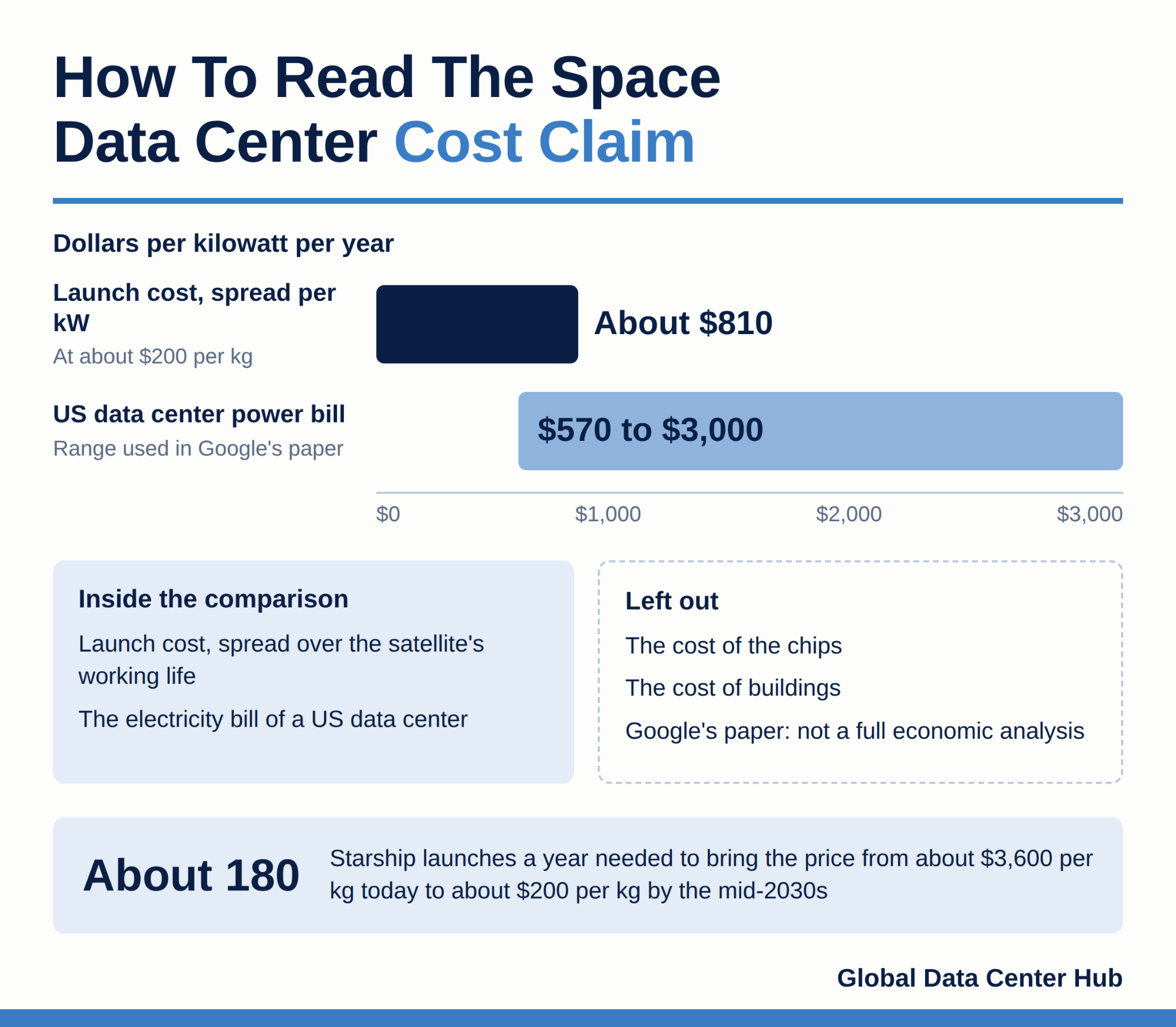
Google’s research paper does the math this way. Today, launching one kilogram to low Earth orbit costs about $3,600 on a reusable Falcon 9 rocket, the figure the paper uses. The paper projects that the price could fall to about $200 per kilogram by the mid-2030s.
At that price, the paper spreads the cost of launching a satellite over the years it works. It turns that into a cost for each kilowatt of power the satellite provides, for each year. A kilowatt is a thousand watts, about what a microwave oven uses.
For a satellite built like SpaceX’s Starlink satellites, the paper puts that cost at about $810 per kilowatt per year.
Then it compares that number to what ground data centers in the United States spend on electricity. The paper puts that range at $570 to $3,000 per kilowatt per year. Since $810 falls inside that range, the paper calls the two costs roughly comparable.
A new reader sees this and thinks space data centers will cost the same as ground data centers. That is the surface reading.
A careful reader asks a different question. What is on each side of the comparison?
On one side is the cost of launching the satellite. On the other side is the electricity bill. The paper itself says the comparison leaves out the cost of the chips and the cost of buildings. It also says plainly that it “does not constitute a full economic analysis.”
So, the claim is narrower than the headlines. It says the launch bill could match the power bill. The full cost of a space data center is a separate question the paper leaves open.
The claim also depends on a lot of rockets. To bring prices down to about $200 per kilogram, the paper estimates the world would need about 1,800 more launches of SpaceX’s Starship, or about 180 a year. The whole cost story rests on one company’s rocket flying that often.
There is a fair counter-read. Electricity is one of the largest costs a data center pays, year after year. Matching it would matter. And Google states the limits of its own math in the paper, which is more than many plans do.
So the skill is this. When anyone tells you two things will cost the same, list what sits on each side. Then ask what was left out. The answer often tells you where the real limit is.
Why Heat Is the First Limit in Orbit
Every watt of power a chip uses turns into heat. A chip that uses a thousand watts makes a thousand watts of heat. That heat has to go somewhere, or the chip gets too hot and stops working.
On the ground, this is a solved problem. Fans blow air across the chips. Water carries heat away. The air and water take the heat out of the building.
In space, there is no air. There is no water to spare. There is only one way to get rid of heat. The satellite has to glow it away as invisible light, the way a stovetop glows heat into a kitchen. Engineers do this with flat panels called radiators. Heat moves from the chips to the panels, and the panels send it out into space.
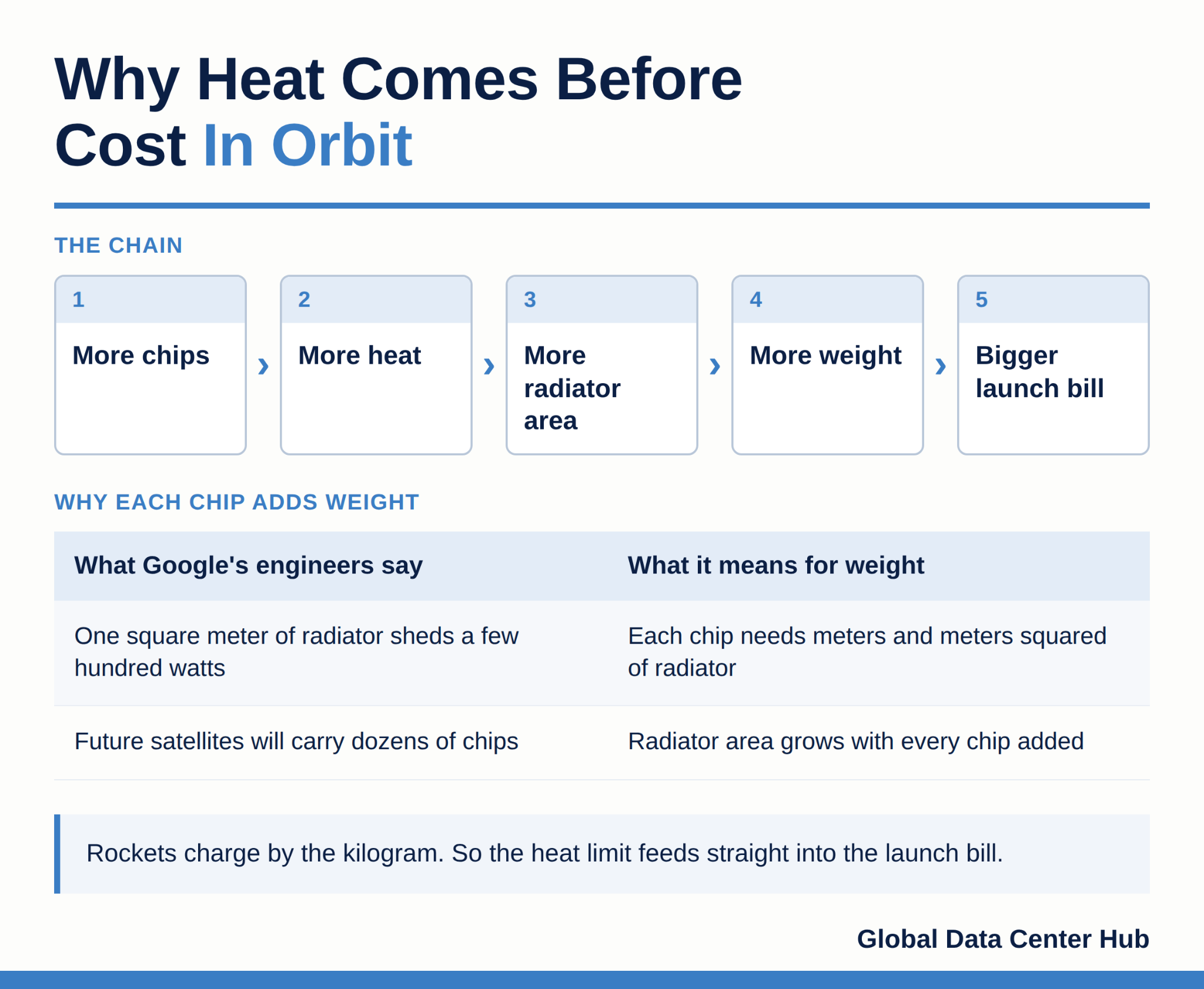
Radiators work, but they are slow. In a video Google released about the project, one of its engineers explained the gap in plain terms. A square meter of radiator gets rid of a few hundred watts.
A chip small enough to hold in your hand makes thousands of watts. The engineer said that means “meters and meters squared of area per TPU.” A TPU is Google’s own AI chip.
Now look at the test satellite. The New York Times reported that MVP runs on about 1 kilowatt of power and carries four chips. The Times also reported that the chips will run for about 15 minutes and then shut off to cool down. The smallest possible test already has to stop and rest.
Google’s engineers say future satellites will carry dozens of chips. In the same video, they said they are aiming for much more power than has been done before on a spacecraft.
Here is where heat connects back to cost. Rockets charge by the kilogram. More chips means more heat. More heat means more radiator area. More radiator area means more weight. And more weight means a bigger launch bill. So the heat limit feeds straight into the cost question.
There is a real counterfactor. The cooling methods are not new.
Google’s engineer said the thermal technology has plenty of history on past spacecraft. Google’s blog says the team tested its setup in a thermal vacuum chamber, a sealed room that copies the cold and airless conditions of space.
The team is also looking at heat pipes and pumped fluid loops, which carry heat out to the radiators. Better tools may raise the limit over time.
So the honest reading is that heat sets the pace. On the ground, power sets how fast data centers can grow. In orbit, the evidence so far says heat will.
The 15 Minute Clue on Google’s Test Satellite
Of everything disclosed about this launch, one detail deserves more attention than it gets. It is the 15 minute work cycle.
The share of time a machine can run at full power is called its duty cycle. A car engine that can only run for 15 minutes before it must cool down has a low duty cycle. It still works. But it does less work per hour than an engine that can run all day.
This matters because of how the cost math is built. The paper’s figure of about $810 per kilowatt per year spreads the launch cost over the power a satellite provides. If the chips can only use that power part of the time, each kilogram launched does less work.
The cost of each hour of useful computing goes up. This is the point where a plan like this could break: the launch price falls as hoped, but the chips cannot run long enough to make each launch pay.
There are two fair ways to read the 15 minutes.
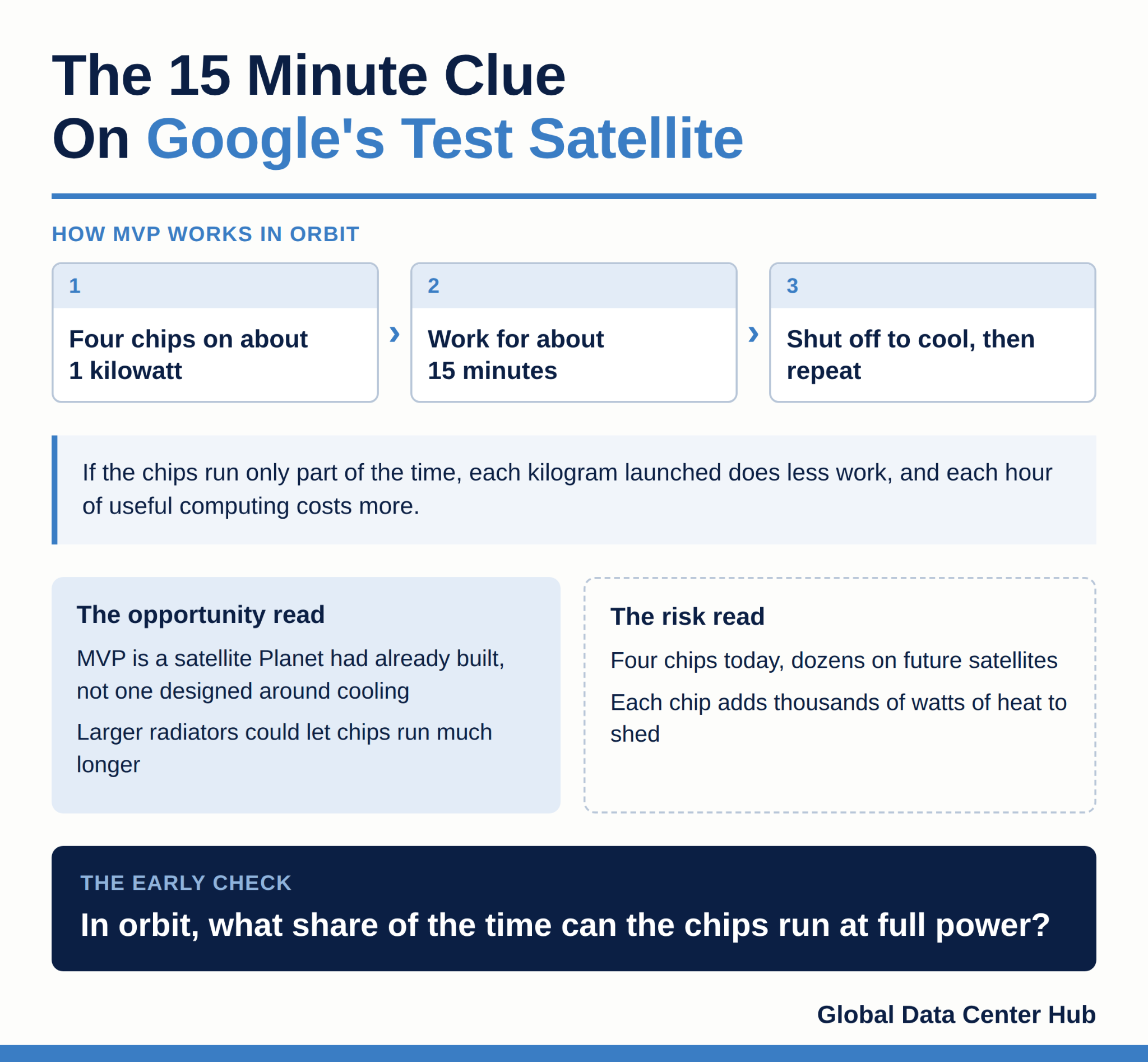
The opportunity read says MVP is not built for this job. According to the New York Times, a Planet engineer said Google wanted to be in orbit this year, so it put its chips into a satellite Planet had already built.
A satellite designed from the start around cooling, with larger radiators, could run much longer. By this reading, the 15 minutes reflects a rushed test more than the idea itself.
The risk read says the problem grows with size. MVP has four chips. Future satellites will have dozens. Each new chip adds thousands of watts of heat, and each watt needs radiator area. By this reading, the 15 minutes is an early look at the limit that will decide how big these satellites can get.
Both readings lead to the same early check. The question to ask is simple: in orbit, what share of the time can the chips run at full power? The evidence that answers it will come from MVP itself.
The New York Times reported the satellite is planned to operate for about a year. Its results, and the radiator size of later designs, will show whether the duty cycle rises.
The place to ask this question is at the very start, before you compare any space computing cost to a ground data center. A cost per kilowatt means little until you know how much of the time the kilowatt can be used.
Reading Heat Before Cost in Every Data Center Deal
The lesson from Suncatcher is bigger than one satellite. It is a way to read the whole sector. Find what runs out first. When someone says they fixed it, ask what runs out next.
For operators, the people who build and run data centers, what runs out first on the ground has not changed. Power is still the oven. James Manyika, who leads research at Google, told the New York Times not to expect “anything usefully operational in the next few years.”
So the work of getting grid connections, signing power deals, and planning around multi-year waits stays the same. Projects being planned today should assume their power will come from the ground.
For private capital, the funds and investors who back new companies and projects, the lesson is a question to ask of every plan. SpaceX has filed with the Federal Communications Commission for up to 1 million computer satellites.
Blue Origin has filed for up to 51,600. A filing tells you what a company hopes to launch. It does not tell you how the satellites will get rid of their heat. A plan that talks only about launch prices has named one limit and skipped the next.
For public markets, the investors who own listed shares and bonds, the lesson is about scale. Alphabet, Google’s parent company, has guided to $175 billion to $185 billion in spending this year, mostly on ground-based AI infrastructure, according to Fortune.
Planet builds the Suncatcher satellites, but the value of its contract has not been disclosed. Next to the ground spending, the space test is small. That tells you where the real limit still sits for the companies that matter most.
The principle outlasts this launch. Every system is limited by one thing first. Solving it moves the limit somewhere else. The next time a builder tells you they solved the power problem, ask them one question: what did you run out of next?