
Welcome to Global Data Center Hub. Join investors, operators, and innovators reading to stay ahead of the latest trends in the data center sector in developed and emerging markets globally.
Google Cloud plans to double its technical infrastructure in Brazil by 2030. It said so at Google Cloud Summit Brasil 2026 in São Paulo on September 24.
Eduardo López, Google Cloud’s president for Latin America, put a time frame on it.
The company built its Brazil capacity over nine years, from 2017 to 2026. It now plans to double that capacity in four.
If you read only the headline, you see twice the buildings and twice the power. López answered that reading at the press conference. He said Google measures the plan in processing power and service capacity.
He said floor space is a separate number, because newer hardware does more in less room.
The one idea I want you to take away is simple. A capacity pledge counts work. You have to translate it into megawatts, buildings, leases, and cable access before anyone can lend or build against it. I use the Bankability Gap to show you how.
The Bankability Gap is the distance between capacity someone announces and capacity that can line up power, money, permits, equipment, customers, and steady returns.
What a Capacity Pledge Measures
A capacity pledge is a public promise to grow how much work a company can do in a place. The work here is cloud computing. A hyperscaler is a company that runs cloud computing at very large scale. Google Cloud is one.
Think of a bakery that plans to double the bread it sells. It could open a second shop.
It could buy faster ovens for the shop it has. It could rent oven time from the baker down the street.
Every path doubles the bread. Each one means something very different for the landlord and the power company, so you want to know which path the bakery takes.
Google’s own words name what it will double. Its Brazil blog post says the plan covers computing, storage, and high-performance processing. Those are measures of output.
You can read them as how much work the machines will do. The count of buildings and the draw of electricity are separate numbers you have to find.
That is where the Bankability Gap starts. A pledge sits at the first step on the path from announced to built. To move along that path, the pledge has to become things a bank, a landlord, or a power company can count.
For you, if you build around Google in Brazil, the pledge cuts both ways. On one side, it is a clear signal of demand.
Google is telling the market that Brazilian companies will use far more cloud computing by 2030. On the other side, the signal arrives in a unit that differs from what a builder sells. A builder sells space and power.
The pledge counts processing. Until the two are matched, you know demand is rising, and you still need to learn what share of it lands on your site.
Reading Compute Growth in Megawatts
A megawatt is a unit of electric power. It is the number a data center developer, a power company, and a lender all watch. A rack is a tall metal shelf that holds computer servers. A data center is a building full of racks.
Here is the reading skill I want you to practice. A newcomer sees “double the capacity” and doubles everything: racks, halls, megawatts. I ask one question first. What does each new rack do compared with each old one?
López gave the reason this question matters. He said advances in hardware let Google do more with less floor space. He also said the number of racks or buildings is no longer the main measure.
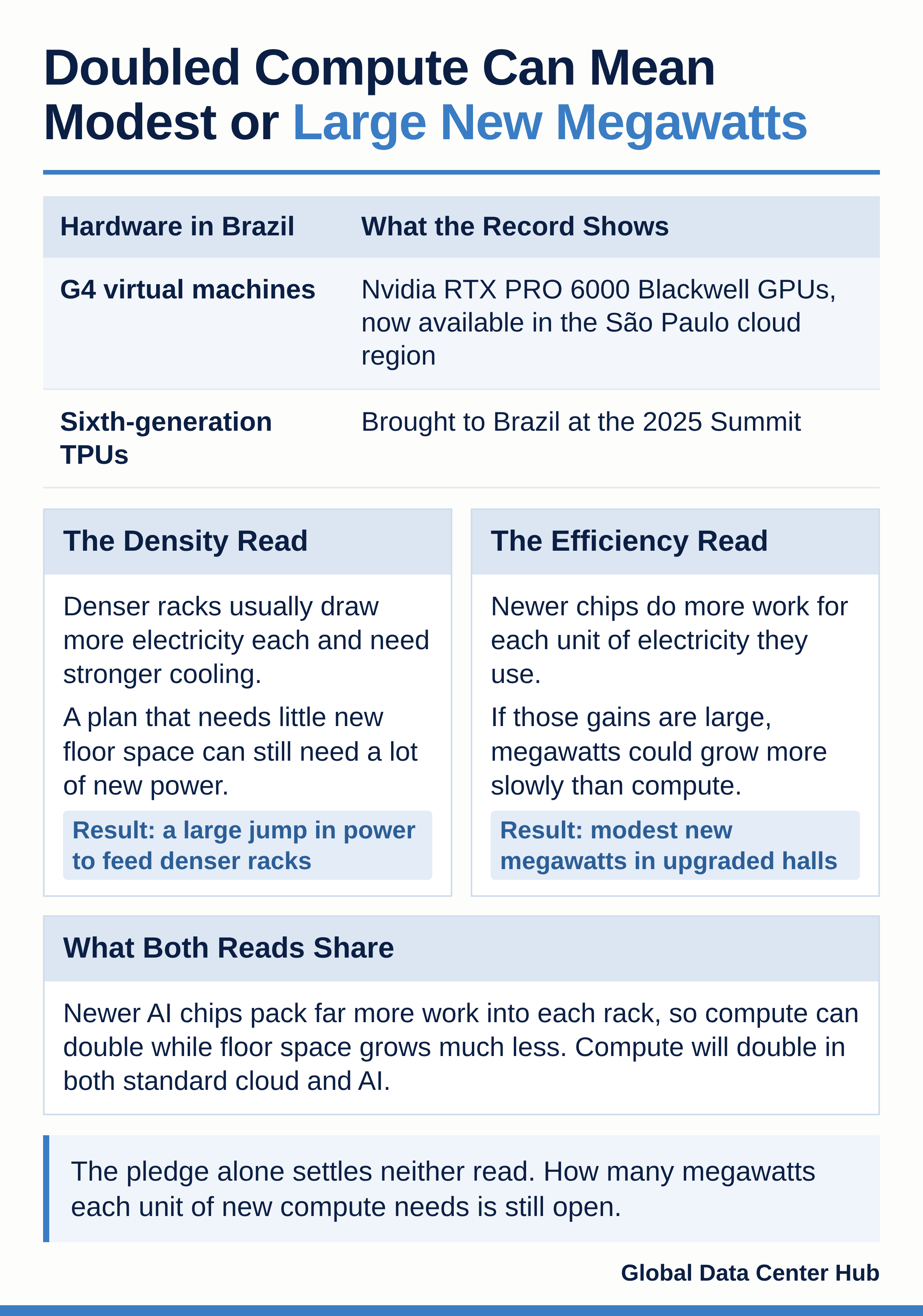
The hardware news from the Summit shows why. Google’s blog post says G4 virtual machines with Nvidia RTX PRO 6000 Blackwell GPUs are now available in the São Paulo cloud region.
A GPU is a chip built for heavy math; the kind AI uses. At the 2025 Summit, Google brought its sixth-generation TPUs to Brazil, according to Flávio Franco, a Google Cloud director for Latin America. A TPU is Google’s own AI chip.
Newer AI chips pack far more work into each rack. So compute can double while floor space grows much less. The same building can hold far more output after an upgrade.
Now read the power line, because it moves on its own. I call the first reading the density read. Denser racks usually draw more electricity each, and they need stronger cooling. So a plan that needs little new floor space can still need a lot of new power.
The second reading is the efficiency read, and it is just as real. Newer chips also do more work for each unit of electricity they use. If those gains are large, megawatts could grow more slowly than compute. Franco said compute will double in both standard cloud and AI.
The public record leaves open how much new power each part will need.
So you hold both reads at once, and the pledge alone settles neither. Doubled compute could mean modest new megawatts in upgraded halls. It could also mean a large jump in power to feed denser racks.
Keep the pledge in one hand and ask for megawatts with the other. A doubling in compute is a fact about output. The megawatt figure is the fact about the grid.
How the Build or Lease Choice Moves Megawatts
The structural driver is where the new compute will live. A hyperscaler has three options: upgrade existing buildings, build new ones, or lease space from a developer.
A lease is a long-term rental contract, and the developer who owns and rents out the building is the lessor.
López named two of these paths. He said doubling could mean expanding current facilities or building new ones, depending on demand. He said investment planning is always tied to demand. He gave the same answer when asked about a large new data center in Brazil by 2030.
Google did not publish an investment figure. López said the company does not usually disclose one.
The path chosen decides who waits on the decision. Picture a family that needs more room. If they add a floor to their own house, the builder they hire gets one job. If they rent the apartment next door, the landlord gets a tenant for years. If they buy furniture that folds away, nobody new gets paid for space at all.
The family has more room in every case. You can see the money flow to different people.
The same thing happens here. If Google upgrades its own halls, most new spending goes to chips and cooling gear. If it builds new sites, land sellers and builders take part. If it leases, a São Paulo lessor signs a long contract and the power company must deliver more electricity to that building.
Equipment is the second driver. López pointed to ReData, Brazil’s special tax regime for data centers. He said ReData helps lower the cost of running these facilities, especially when buying components.
Cheaper components make upgrades more attractive. When upgrades cost less, more of the doubling can happen inside buildings that already exist.
The counter-factor sits in the same place. Upgrades still need power and cooling that older halls may lack. If an older building cannot take the extra load, the cheaper route stops working there, and new space comes back into play.
The two drivers can also work together. A tax break that lowers equipment costs frees money for new power and cooling in the halls that can take it.
You should expect a mix of paths, and the public record has yet to say how the mix will split.
Hyperscaler Cable Landings as the Site Signal
For new capacity to land on your site, one thing has to go right. The site has to sit near the hyperscaler’s own subsea cable landing.
A subsea cable is a bundle of fiber that runs along the ocean floor and carries internet traffic between countries. The landing point is the beach where the cable comes ashore. Latency is the delay data feels as it travels. Long or indirect routes add delay.
López explained Google’s rule. He said Google aims to keep its data centers close to the landing points of its own subsea cables. He said relying on other connections to reach its facilities would add latency. The record shows where that rule points today.
Google’s own announcement says its Firmina cable, which Google built, lands at Praia Grande, Brazil, on the coast of São Paulo state.
Fortaleza shows you how to read this signal with care. Fortaleza is Brazil’s main hub for subsea cables. López said Google already has a cable landing there, Monet, at Praia do Futuro. He also said most of Google’s infrastructure sits in São Paulo, and that all regions are under study.
He said cable decisions are made globally and that the job of the regional team is to show demand. He added that Google is exploring alternatives for the future.
The tension axis gives you two honest reads of a city like Fortaleza. The opportunity read says a Google landing already exists there, the city is a major cable hub, and Google says every region is under study.
The concentration read says today’s infrastructure sits near the larger cluster of landings in São Paulo, so new capacity tends to follow that cluster first. Both reads come from the same public facts, and both apply to any deal of this kind.
Both reads lead you to the same early question. Where do this hyperscaler’s own cables land, and how much of its network comes ashore there? The answer sits in public view.
Hyperscalers announce their cables, with landing points, on their own sites, and their leaders talk about where data centers go. Ask the question at site screening, before you sign an option on land.
A land option is a paid right to buy a plot later. The answer costs you nothing before the option and a great deal after it.
Every Capacity Pledge Needs a Megawatt Translation
The lesson carries well past Brazil. A capacity pledge is a promise about output. Every party that builds, lends, or invests around it needs a translation into its own unit.
Those units are megawatts, buildings, leases, and network links.
If you work in private capital, such as an infrastructure fund or lender, your question is what backs the loan or stake.
A developer in São Paulo pointing to Google’s doubling has shown demand. Ask for the lease tying that demand to the building and the megawatts the power company has agreed to deliver.
You can finance a signed lease and a power agreement. A pledge in compute units is where that path begins.
If you follow public markets, your question is what shows up in reported numbers.
Listed data center operators, power companies, and equipment makers report revenue and load in their own units. A doubling in compute may show up mostly as equipment sales if Google upgrades.
It may show up as new leases and new grid load if Google builds or rents. Read their guidance for which path they expect.
If you run an operator, such as a developer or a landowner, your translation comes first in the deal. Convert the pledge before you price the site. Ask how many megawatts it implies. Ask whether the hyperscaler plans to expand, build, or lease.
Ask how close the site sits to that hyperscaler’s own cable landing. Ask what the local tax regime does to the cost of equipment.
If you work for a government or a development lender trying to attract data centers, the cable question is yours too. Landing points shape where buildings go, and so does the tax regime on equipment. Both sit within your reach.
One number in the Brazil pledge is still open, and it matters to every reader above.
How many megawatts does each unit of new compute need? Google has told the market how far it plans to grow its work. When you see the first power agreement or lease tied to that doubling, you will have your answer.