

Welcome to Global Data Center Hub. Join investors, operators, and innovators reading to stay ahead of the latest trends in the data center sector in developed and emerging markets globally.
TL;DR
Fiber has become a gating constraint on data center development. The markets absorbing power-driven spillover carry land and grid headroom without dense, diverse route inventory. Route construction runs on permitting timelines, so it cannot be compressed after land capital is committed.
The market still underwrites connectivity as abundant and fast to provision. That assumption formed when facilities carried north-south user traffic across existing metro rings. AI-grade clusters generate east-west traffic between processors and require an order-of-magnitude increase in strand count per rack, which those rings were never engineered to carry.
Disciplined capital screens for fiber before it options land. Route diversity is verified by physical survey, secured through long-dated dark fiber rights, and modeled as a base-case cost and schedule item on every secondary-market site. Sponsors who apply that sequence acquire at a discount the undisciplined bidder creates.
Connectivity now decides whether a power-available site is developable.
The old underwriting model treated fiber as a short-lead utility, ordered during construction and energized before commissioning.
Sponsors who still underwrite that way commit land capital against a route that does not exist and will not exist inside the development window.
That model worked for twenty years. It worked because facilities were built where fiber already was.
Power scarcity moved the sites. Fiber did not follow.
Two constraints are now moving in opposite directions.
Interconnection queues and transformer lead times have closed the primary hubs to new mega-scale development, so capital is dispersing into secondary and tertiary metros with available land and available power.
Route density is not dispersing with it, because building fiber is a right-of-way problem before it is a capital problem.
The question worth asking is not where capacity is being announced.
It is where announced capacity can actually be absorbed, and the interval between substantial completion and rent commencement is where levered returns are decided.
The strand count is the mechanic
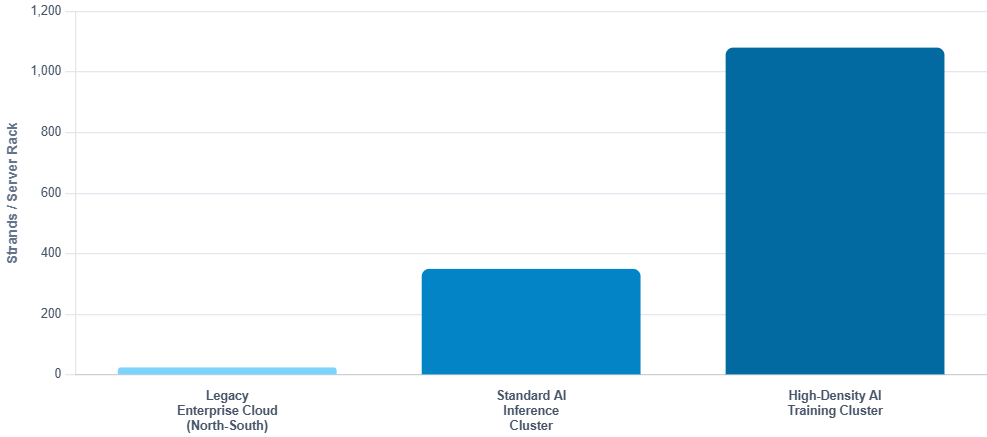
Legacy colocation was engineered for north-south traffic.
A user made a request, a server answered it, and the fiber count per rack was measured in tens. Metro rings were sized for exactly that load.
AI training changed the direction of the traffic.
GPU clusters synchronize across thousands of parallel processors, so the dominant flow runs east-west, between machines inside the hall and between halls across a campus.
Strand demand per rack rises by an order of magnitude. A route that carried a legacy colocation campus cannot carry an AI campus without a high-count overlay, and that overlay is a construction project measured in quarters.
Diversity is the second half of the problem.
AI-grade tenants require two physically separate paths, and two routes that look diverse on a carrier diagram frequently share one duct or one bridge crossing.
Verification requires an engineering survey. It does not come from a network map.
Consider a regional operator in a power-rich secondary metro. It optioned land, secured a grid allocation, and signed a letter of intent with an AI tenant on a twenty-six-month delivery.
Connectivity diligence came last in the sequence.
The two diverse routes serving the parcel converged at a single river crossing four miles out, and building a genuine second path required a new easement across rail land.
The tenant walked before the easement cleared. The land is still owned. The power allocation is still held. Neither one earns anything.
The market is wrong about provisioning speed
The industry has long assumed that connectivity is abundant, cheap, and fast to provision.
That assumption held when facilities were sited inside dense metro rings built for enterprise traffic and when strand requirements per rack were measured in tens.
It does not hold now, because power scarcity has relocated development into markets that were never carriered for AI density.
AI-grade tenants require a combination of strand count and physical diversity that thin markets cannot supply within any timeline a development pro forma can tolerate.
Fiber is no longer the last item on the checklist. It is the first filter.
The cost is time
Supply-side friction is real and it is measurable.
Cable lead times stretched from a few months to more than a year at the peak of the cycle.
Manufacturing lines reallocated toward higher-margin AI-grade fiber, which created a secondary shortage in conventional telecom grades.
Certified splicing and civil labor is short by tens of thousands of technicians globally, and a large share of that labor is committed to subsidized rural broadband programs.
Permitting is worse than the supply chain.
Right-of-way approvals cross municipal, rail, utility, and private easements, and each one runs on its own calendar.
Make-ready costs on utility poles have multiplied in several US programs.
A middle-mile lateral of only a few miles routinely takes twelve to twenty-four months to clear.
Policy is not stabilizing the market. NTIA’s 2025 BEAD overhaul removed the fiber preference and wholesale access requirement, weakening subsidies for the corridors now targeted by data center capital.
Regulatory gates are tightening on the other end at the same time.
Virginia moved to withhold final site plan approval until interconnection conditions are certified.
New York froze environmental permits on facilities above 20 megawatts for a year under the Responsible Data Center Development Act.
EirGrid held Dublin connections closed from 2021 and reopened them only against an on-site dispatchable generation mandate.
Every gate pushes another cohort of projects toward markets with thinner routes.
Hyperscalers are moving faster than everyone else on the response.
Multi-billion-dollar commitments to cable manufacturers and to dark fiber inventory are removing allocation from the merchant market before a mid-market sponsor reaches the table.
Three lenses on the same constraint
For independent operators, the binding variable is qualification. A parcel that clears on acreage, power, and tax abatement can still fail on route diversity, and the failure surfaces after the option payment.
Site selection has to be re-ordered so that connectivity screening runs first and eliminates parcels before any other diligence dollar is spent.
For private equity and infrastructure investors, the binding variable is the yield date.
Asset value depends on when cash flow starts, so a twelve-month slip in connectivity delivery degrades the equity IRR before a single rack is energized.
Contingency has to carry the fiber build as a base case. Treating it as an exception is what broke the last vintage of secondary-market underwriting.
For public equity, the key variable is dispersion. Carrier-dense assets with diverse metro rings, subsea landings, and direct cloud on-ramps generate compounding cross-connect revenue as capacity grows.
Generic wholesale halls in fiber-thin markets compete on power price and rack rate, which are commoditized inputs that compress over time.
The multiple gaps between those two asset types is widening, and nothing in the supply picture closes it.
The disciplines that hold
Screen fiber before land. Apply a hard distance rule to verified dense route inventory and kill the parcel before spending on power studies or incentive negotiation.
Verify diversity by survey. Accept engineering-grade route confirmation only and treat any carrier diagram as a marketing document until a surveyor contradicts it.
Model the route as the base case, including full lateral costs, a 12–24-month permitting window, and a contingency floor for infrastructure builds at every secondary-market site.
Own the access. Secure long-dated dark fiber rights across multiple underlying providers so that pricing and schedule control sit with you and not with a carrier’s allocation committee.
Reset the commercial terms. Tie rent commencement to connectivity milestones, not shell completion, and require anchor offtake to cover baseline capex before long-haul extensions begin.
Aggregate the route. A single lateral to one facility rarely clears on a standalone basis, but a route engineered to serve a corridor captures every developer who arrives after you.
Run that sequence and connectivity stops being a risk you manage. It becomes the reason you win parcels the next bidder cannot underwrite.