
Welcome to Global Data Center Hub. Join investors, operators, and innovators reading to stay ahead of the latest trends in the data center sector in developed and emerging markets globally.
TL;DR
Eskom is marketing roughly 6 gigawatts of surplus generation to Amazon, Microsoft and Google, and no agreement has been signed. Eskom chairperson Mteto Nyati confirmed the discussions to the Financial Times on August 12, 2026. Eskom has returned 5.9 gigawatts of generating capacity to the grid since April 1, 2025, and South Africa has now run 455 consecutive days without load shedding.
Transmission delivers more than R35 billion of Eskom’s core earnings, close to 40 percent of the group total, and President Cyril Ramaphosa confirmed on August 3, 2026 that those assets leave the company. The National Transmission Company South Africa is to be carved out into an independent state-owned Transmission System Operator. Moody’s has said the removal could be credit negative and flagged a possible downgrade.
South African data center operators identify grid access and wheeling as the binding constraint, not generation. Teraco is building a 120-megawatt solar plant and has contracted wind supply from NOA, targeting more than half its consumption from new-build renewables by the end of 2027. Teraco requires Eskom to transport that power, not to produce it.
Forty Percent Of Earnings Is Leaving Eskom
Transmission accounts for close to 40 percent of Eskom’s core earnings, and on August 3 the President confirmed those assets are being carved out of the company.
Coverage of the hyperscaler talks has treated that decision as a separate story about governance and unbundling politics. It is the same story.
The asset Eskom is losing is the asset Amazon, Microsoft and Google actually need, and the asset Eskom is selling is the one they have spent five years engineering their way around.
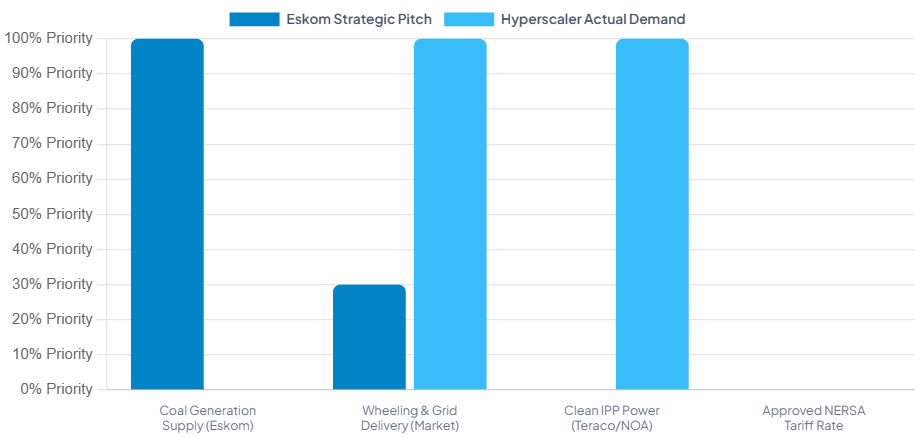
Hyperscalers Buy Delivery, Not Generation
Nyati’s framing was explicit. Eskom has power it cannot sell, and power-hungry sectors are the customer class that fixes that.
The framing assumes generation is the scarce input. In South Africa it is not.
Teraco, the country’s largest operator, has already answered the question Eskom is asking. It contracted its own generation.
The 120-megawatt solar plant reaching commissioning around the end of 2026 is Teraco’s, and the wind supply from NOA is Teraco’s.
What Teraco cannot build is the path from a generator in one province to a facility in another.
That path is Eskom’s, and Teraco’s own position is that it will always need Eskom for exactly that.
This is a different product with different economics. Selling coal-fired megawatt-hours is a commodity sale into a customer base with carbon-free procurement mandates.
Selling transmission service is a regulated fee on someone else’s electrons, and it is the business every operator in the market is already trying to buy.
Over the next twelve to twenty-four months, the contracts that get signed in South Africa will be wheeling arrangements and grid connection agreements.
The gigawatt supply contract Eskom is pitching is not the deal the market is structured to sign.
The Counterparty Is Being Redrawn Mid-Negotiation
A hyperscaler power agreement runs ten to fifteen years. Eskom cannot currently describe what it will be in three.
The sequence matters. Electricity Minister Kgosientsho Ramokgopa approved a revised unbundling strategy in December 2025 that kept the transmission assets inside Eskom Holdings.
Creditors and foreign government funders objected.
Ramaphosa reversed the decision in his February 2026 State of the Nation Address and appointed a restructuring task team under Treasury director-general Duncan Pieterse.
Eskom’s board lobbied for months to keep the assets, and in July the dispute became a public fight with Business Leadership South Africa.
On August 3 the President endorsed the task team’s Phase I report and the assets go.
The task team’s own condition is the part investors should read twice.
The transfer must respect lender requirements and avoid triggering defaults.
Eskom’s debt is secured against those assets. That makes creditor consent the gate on the entire restructuring, and it means the perimeter of the entity a hyperscaler would contract with is not settled by a presidential endorsement.
It is settled by bondholders, and they have not signed either.
Nyati has said the board shares the vision of a TSO owning the assets at the appropriate point in the future.
That is a timing dispute, not agreement, and timing is the whole question for a counterparty pricing a fifteen-year obligation.
There Is No Price To Sign Against
No hyperscaler tariff class exists in South Africa.
Any specialized rate requires approval from Nersa, the energy regulator, through a public consultation process.
That is not a formality. A discounted rate for three of the most profitable companies on earth, granted while municipal arrears to Eskom stand at roughly R119 billion and grow by about R3 billion a month, is a politically loaded determination.
Municipalities account for 42 percent of Eskom’s sales, and the City of Johannesburg alone owed R5.28 billion as of June 11, 2026.
Nersa would be asked to approve a concession to foreign technology firms inside a system where domestic customers are not paying.
Eskom cannot pre-commit a price, so the discussions Nyati describes are, at this stage, discussions without a number.
Everyone Here Is Underwriting An Unfinished Entity
Private Capital. The investable asset in South African data centers is grid position, not power supply.
Diligence the connection queue, the executed wheeling agreement, and the substation capacity before anything else, and treat a letter of intent from Eskom on generation as carrying no value in the model.
Funds that price this market on the surplus narrative will overpay for sites with power availability and no delivery path, and will discover the difference at connection, when the cost is stranded capital rather than a repriced bid.
Public Markets. Eskom’s credit is mid-restructuring and the outcome is not resolved.
More than R35 billions of core earnings is being separated from the obligor, Moody’s has flagged the move as potentially credit negative with a possible downgrade, and Fitch has flagged execution risk and further delay.
The offsetting revenue story requires signed hyperscaler contracts that do not exist and cannot exist before Nersa acts.
Holders pricing the operational recovery, which is real, should hold that separately from the balance sheet question, which is open.
Operators. The window is now and it is short. Wheeling frameworks and connection terms negotiated before the TSO is stood up will be negotiated with a counterparty that still wants the volume.
Operators who secure grid access and executed wheeling agreements in the next four quarters lock terms under the current regime.
Everyone after them negotiates with a new entity whose mandate is nondiscriminatory access, which sounds better and prices worse for whoever is first in line.
Wheeling Rights Outlast The Surplus
The surplus is a cyclical position. It exists because demand collapsed while supply recovered, and it closes the moment either reverses.
The transmission network is the durable asset, and it is changing hands.
South Africa hosts roughly 70 percent of Africa’s data center capacity, and the local market is forecast to exceed $5 billion by 2031.
That growth gets built against grid access, not against generation availability, and the entity that will control grid access does not yet exist.
NTCSA needs to build 14,500 kilometers of high-voltage line over a decade, against roughly 33,000 kilometers built in the previous century, and it is seeking R134 billion to accelerate.
Its chief executive Monde Bala has said it cannot deliver that alone.
The question for the next four quarters is not whether Amazon or Microsoft buys Eskom’s coal.
It is who signs the wheeling contracts while the counterparty is still being assembled, and what those terms look like once the assembly is finished.