
Welcome to Global Data Center Hub. Join investors, operators, and innovators reading to stay ahead of the latest trends in the data center sector in developed and emerging markets globally.
This article is the 19th article in the series: Ground to Grid: A Free 21-Lesson Guide to Mastering Data Center Development
Why Operations Is Where the Return Lives
A data center earns its return over years of reliable operation.
Completion only starts the clock. Development gets the asset built. Operations is what makes it pay.
Operations is the long phase that follows handover. It begins at acceptance, when the operating team takes responsibility from the builder.
ISO/IEC TS 22237-7:2018 covers that transition and the management processes that follow it. From that day, the asset has to earn for as long as it stays in service.
The tenant pays for one thing above all: power, cooling and connectivity that stay on, within the limits the contract promises.
Reliability is the product. The building is how it gets delivered.
Maintenance and lifecycle discipline decide how much of the return survives over time.
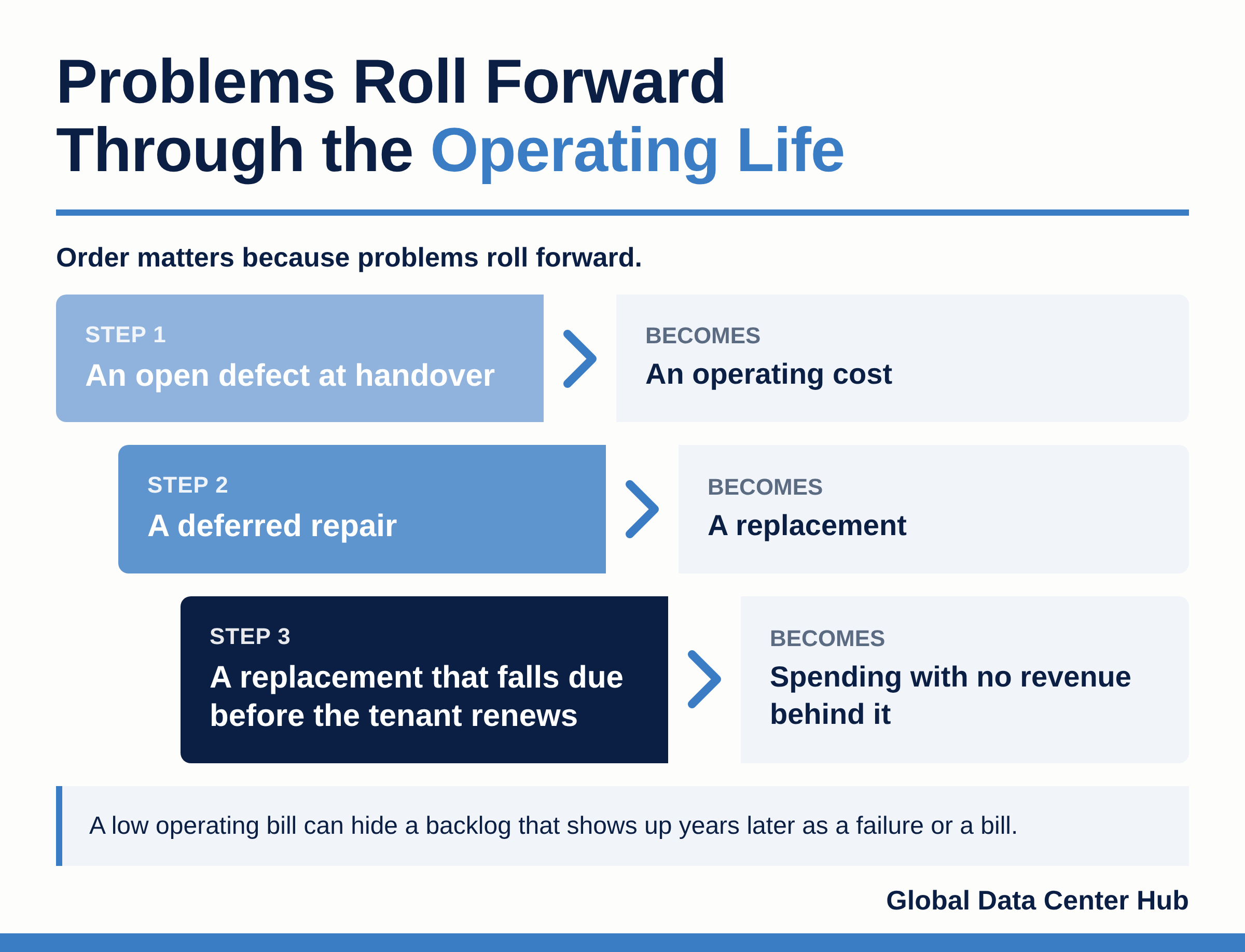
The owner keeps the cash left after service promises are met, maintenance is done and worn equipment is replaced. A low operating bill can hide a backlog that shows up years later as a failure or a bill.
The Pillars of Operation
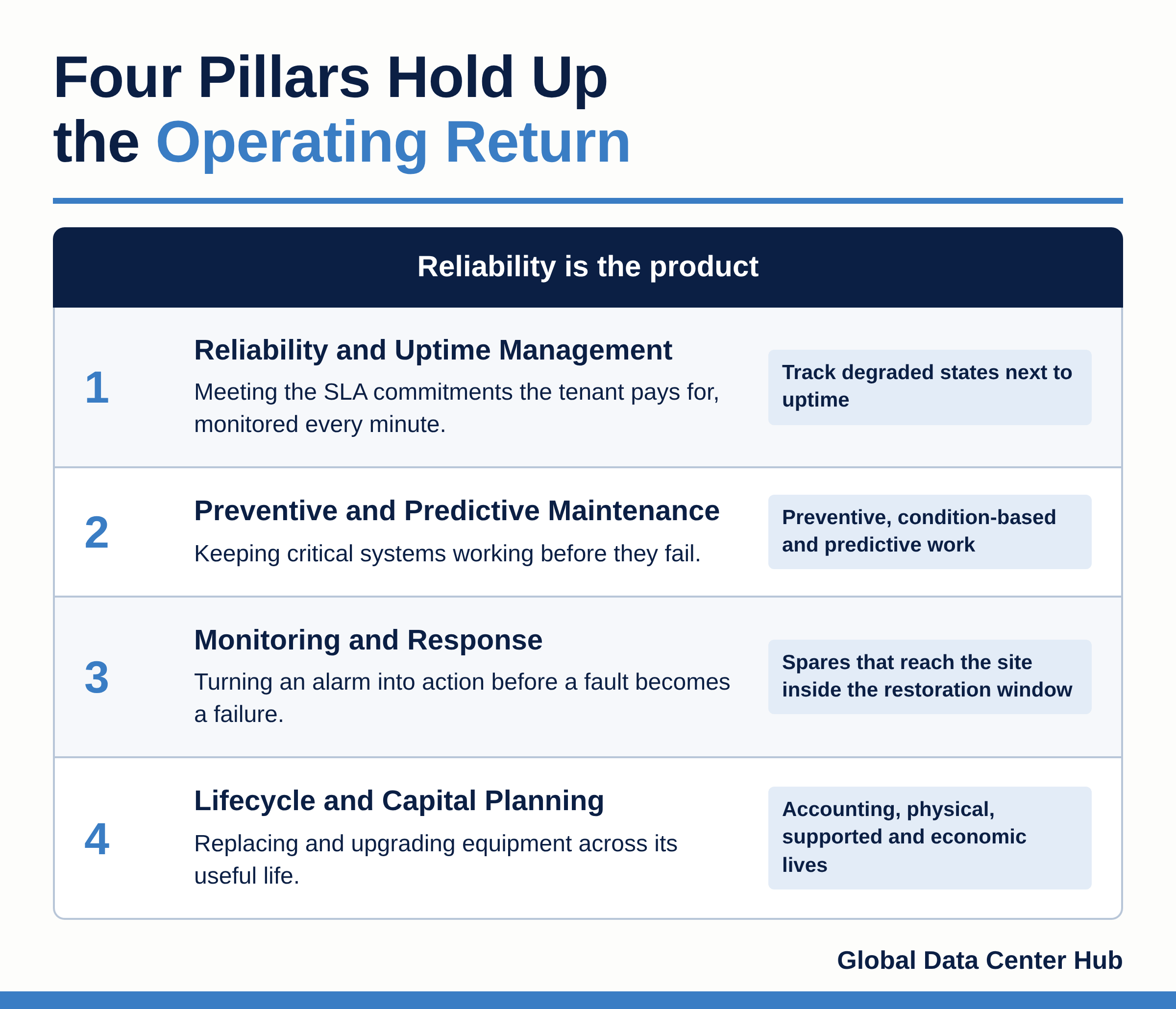
1. Reliability and Uptime Management
An SLA (service level agreement) sets the performance the tenant pays for and the remedy when the operator misses it. Meeting it is the core operating product, and it is monitored every minute of every day.
Power is where most of the risk sits. Uptime Institute’s 2026 outage analysis names power as the leading cause of impactful outages, with UPS systems, transfer switches and generators prominent among the failures.
Uptime can also hide risk. A facility can stay online while part of its protection is gone. A UPS (uninterruptible power supply, the battery system that carries load through a power break) may be bypassed for repair.
The tenant sees no outage, yet the site is one fault away from one.
So, the strongest operating reports track degraded states next to uptime: how long each lasted, which loads were exposed and what protection remained. They answer a simple question. What happens if the next fault arrives now?
2. Preventive and Predictive Maintenance
Maintenance keeps critical systems working before they fail. It is the discipline that prevents the downtime that breaches SLAs.
Preventive maintenance runs on a schedule, by time, use or a set requirement. Condition-based work starts when measurements show wear. Predictive maintenance uses data to forecast a failure before it happens. The right mix depends on what a failure would cost and how fast the asset can be restored.
ISO 55001:2024 sets requirements for an asset management system. It leaves the financial and technical rules for each asset type to the owner. Each asset still needs its own plan.
Predictive tools are arriving, but trust is uneven. In Uptime Institute’s 2026 global survey, 65% of respondents would trust AI for predictive maintenance. Only 16% would trust it to change mechanical and electrical settings on its own. Those figures measure trust. Savings still need proof from a real deployment.
3. Monitoring and Response
Monitoring watches power, cooling and network systems around the clock. Response turns an alarm into action before a fault becomes a failure.
Both depend on the control systems. NIST’s SP 800-82 Rev. 4, released as an initial public draft on September 21, 2026, includes building automation, access control and physical monitoring in its scope.
It is still a draft. Facility controls are operating infrastructure, with their own security and recovery needs.
Fast response also needs parts and people. A spare in a supplier’s network is of little use if it cannot reach the site inside the restoration window.
And in the same survey, 53% of 607 respondents reported trouble finding qualified candidates for open roles.
4. Lifecycle and Capital Planning
Every major asset has four lives: accounting, physical, supported and economic. The supported life ends when parts and vendor help run out. The economic life ends when running it stops making commercial sense. A chiller can work perfectly and still be commercially out of date.
Lifecycle planning replaces and upgrades equipment across those lives, so the asset keeps performing for decades. The plan is built asset by asset, with a clear split between funded and unfunded needs. An approved future budget is different from cash on hand when the switchgear fails.
Liquid cooling brings these decisions forward. On August 27, 2026, Singapore launched SS 726:2026, Liquid Cooling in Tropical Data Centres, which covers operation and integration with existing facilities.
In Latin America, ODATA said on September 17 that installation and first-phase testing of its DeltaFlow system were underway at SP04 in Brazil and QR03 in Mexico. Savings results are not yet public.
Why Operations Determines Asset Value
Reliable uptime keeps tenants. A tenant whose service has stayed within its SLA has a reason to renew and to expand in the same building. Each renewal avoids the empty months of finding a replacement.
Downtime works in reverse. A breach triggers the SLA remedy, usually service credits. It also strains the relationship, and the tenant remembers it at renewal.
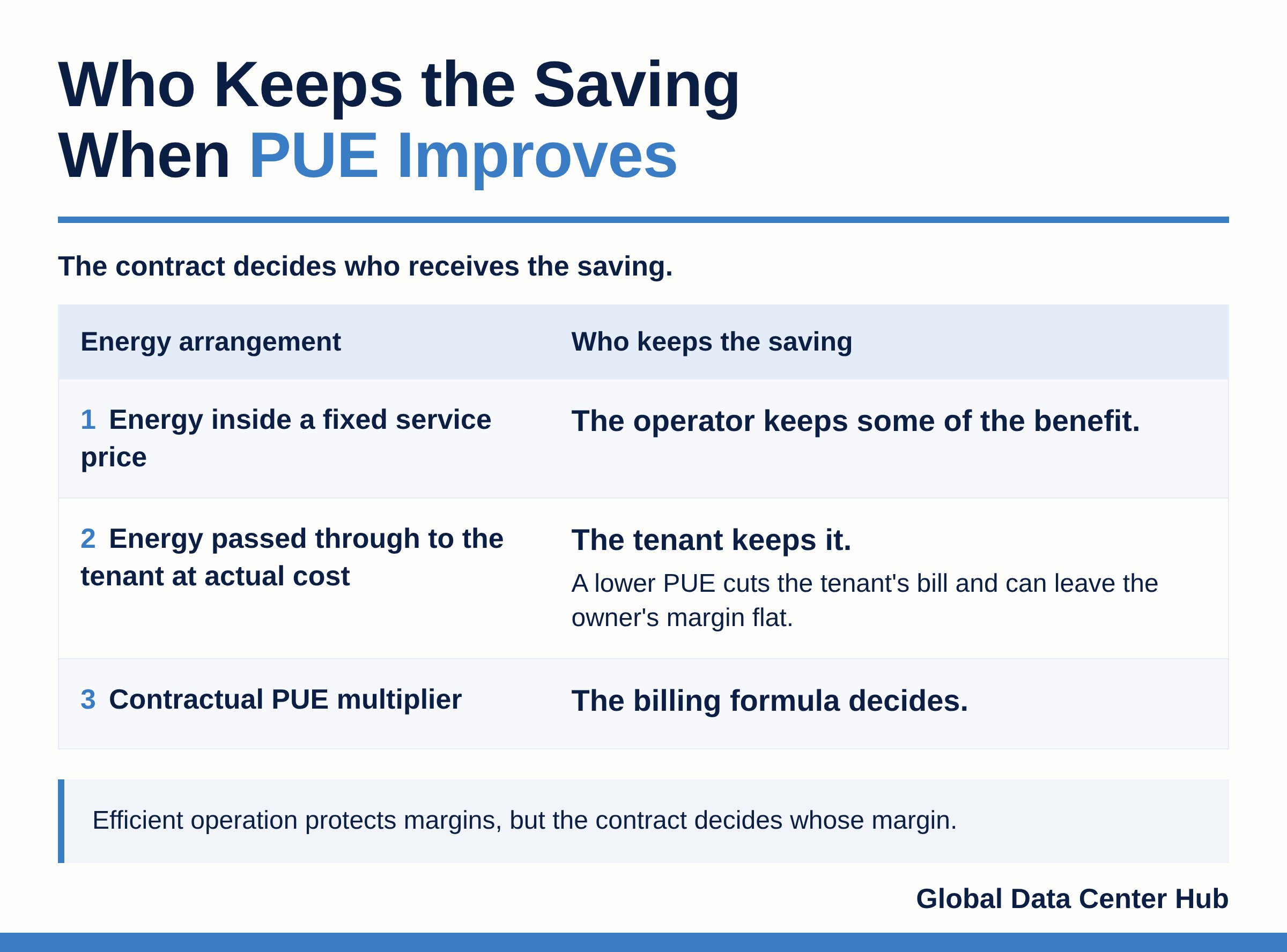
Efficient operation protects margins, but the contract decides whose margin. PUE (power usage effectiveness) divides a facility’s total energy by the energy its IT equipment uses. Uptime’s survey puts the 2026 average at 1.52, across 644 responses.
Google reports 1.09 for its fleet in 2025, a company figure that does not transfer to another building. When energy passes through to the tenant at actual cost, a lower PUE cuts the tenant’s bill and can leave the owner’s margin flat.
When energy sits inside a fixed price, the operator keeps some of the gain. Under a contractual PUE multiplier, the billing formula decides.
PUE also says nothing about useful computing output, which is why Singapore’s Green Data Centre Roadmap tracks facility and IT efficiency separately.
Lifecycle discipline extends the earning life, and it shows up in the cash. Digital Realty’s 2026 outlook, published July 23, includes $400 million to $425 million for recurring capital spending plus capitalized leasing costs.
That is forward guidance. Its definition includes second-generation tenant improvements and leasing commissions, so the line covers the cost of keeping existing revenue.
The same disclosure reports a $94 million insurance settlement, net of income tax, with about $27 million recognized in Core FFO (funds from operations, a REIT earnings measure). A careful reader separates recoveries like that from recurring performance.
No source reviewed for this piece sets a standard maintenance-cost ratio, retrofit return or valuation premium for operating quality. Each asset’s own records have to carry that case.
Where Operations Fails
Deferred maintenance is the most common failure, because it looks like savings.
A documented deferral with a reason, an approval and a date is a managed decision. A task deferred again and again becomes unplanned downtime.
Monitoring and configuration gaps let small faults become large ones. On March 26, 2024, the PDX01 data center Cloudflare uses in Oregon lost power. Cloudflare’s April 8 postmortem says the facility’s initial assessment pointed to incorrectly set breaker coordination settings.
Breaker coordination makes the breaker closest to a fault trip first, so the rest of the system stays up.
Cloudflare calls this a preliminary finding and one contributing factor. Its own APIs and dashboards recovered about seven minutes after the power loss, without human intervention.
The equipment was installed. The settings decided how it behaved.
A missing capital plan leaves aging equipment to fail in service. The worst timing is a major replacement that falls due before the tenant renews. The owner then pays ahead of the revenue meant to fund it.
The last failure starts before operations does. An operating team that inherits a facility without current drawings, approved settings, an asset register and trained staff is running a building it was never prepared to run.
Open construction items with no owner drift into the operating budget.
Strategic Implications
For developers: Involve operators early in design reviews, when changes are still affordable. Before completion, document all open items with assigned owners and fix dates, and hand over current drawings, approved protection settings, and configuration backups.
For investors: The operating record is where the return is proven. Start with uptime and tenant retention. Then ask what sits behind them: the degraded-state log, the maintenance backlog and the capital plan.
Before you credit an efficiency project to the owner, read the energy clause. Under a pass-through, the tenant keeps the saving.
For operators: Reliability is the product. Report degraded states next to uptime every month. Give every deferral a reason, an approval and a completion date. Then test the response itself.
Check that critical spares can reach the site inside the restoration window, and that the site can handle a fault when its most experienced engineer is away.
For policymakers: Reliable operation is what makes the sector dependable infrastructure. Say clearly which rules bind, to whom and from when.
The European Commission’s September 21, 2026 proposal for a data centre rating scheme still faces a two-month scrutiny period. Until it clears, no one can price the obligation with confidence.
Key Takeaway
The build is a cost. The operation is the return.
A data center that is developed brilliantly and operated poorly is a bad investment.
The tenant pays for the years of service that follow handover. Uptime, sustained over those years, is what actually pays.
So, when you evaluate a data center, ask how it has run, and how it will keep running, before you ask how it was built.
The maintenance backlog, the degraded-state log and the capital plan will tell you whether the return in the model is still there.
Do you think operational excellence or development skill is more often the deciding factor in a data center’s returns, and why?