
Welcome to Global Data Center Hub. Join investors, operators, and innovators reading to stay ahead of the latest trends in the data center sector in developed and emerging markets globally.
This article is the 21st article in the series: Ground to Grid: A Free 21-Lesson Guide to Mastering Data Center Development
Why Scaling Is the Payoff of Good Development
The final test of a data center development is whether it can grow.
An asset designed to scale captures the next wave of demand at low cost. One that was not designed for it has to be rebuilt to expand.
Growth comes at the end of the development lifecycle, but it loops back to the start.
The choices that make expansion cheap or expensive are made at conceptual design, years before anyone needs the extra capacity.
Substation position, pipe sizes and spare plant space are fixed early. They are hard to change later.
That is why phasing a planned site and retrofitting a live one are different jobs. A planned phase adds capacity next to running halls. A retrofit changes the halls customers are already using.
The payoff arrives only when a customer accepts the new capacity and starts billing.
On October 29, 2026, Digital Realty reported that leases signed in the third quarter commence, on weighted average, 17 months after signing. Every month in that gap, an expansion carries cost before it earns.
The Three Paths to Growth
1. Multi-Phase Expansion
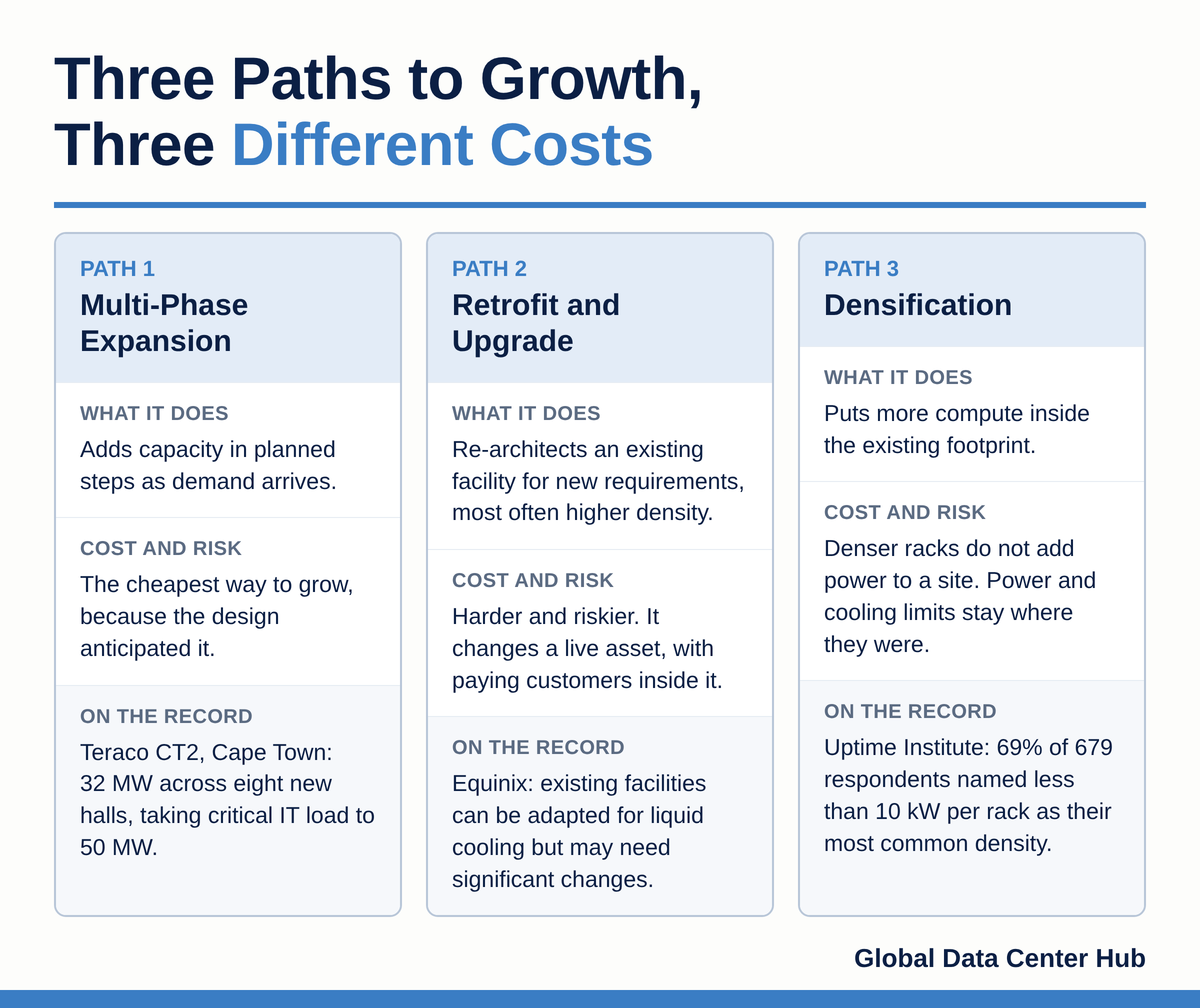
Multi-phase expansion adds capacity in planned steps as demand arrives. It is the cheapest way to grow, because the design anticipated it. The land, the power route and the plant space were set aside at the start.
Teraco’s CT2 campus in Cape Town shows the pattern. On November 10, 2025, Teraco reported 32 MW of new capacity across eight new halls, taking the facility’s critical IT load to 50 MW. It says the site is designed to support liquid-to-liquid cooling.
Each phase has to work on its own. You should be able to test, accept and bill it while the rest of the campus runs, even if no later phase is ever built.
2. Retrofit and Upgrade
A retrofit re-architect an existing facility for new requirements, most often higher density. Equinix’s October 29, 2026, overview says existing facilities can be adapted for liquid cooling but may need significant changes.
This path is harder and riskier. It changes a live asset, with paying customers inside it.
3. Densification
Densification puts more compute inside the existing footprint. AI workloads drive much of it, because AI racks often exceed the density older halls were designed for.
The starting point is low. In Uptime Institute’s August 2026 survey, 69% of 679 respondents named less than 10 kW per rack as the most common density in their facility.
In a separate question, 52% of 607 respondents said they had built or upgraded space for high-density IT in the past 12 months.
Denser racks do not add power to a site. The building’s power and cooling limits stay where they were.
Why the Ability to Scale Was Set at Design
A phased design leaves headroom: spare power, spare cooling and spare space reserved for later. A facility built to its limits has none of that. It has no cheap path to grow.
Density exposes the difference fastest. Schneider Electric’s White Paper 133 traces a liquid-cooled system from the server to outdoor heat rejection (moving heat to the outside air).
Every link on that path has a limit. Equinix’s May 2026 explanation notes that pipe sizes can cap future cooling flow even when floor space is free.
So, the expansion path is a design decision, made long before it is needed.
The cheapest moves are reservations. Protect the substation position, cable routes, pipe routes, plant yards and fiber entrances.
Installing equipment early is a different decision, because it ties up capital before demand is known.
Holding power for later phases also comes at a cost. Virginia’s State Corporation Commission says new large-load customers that contract for service on or after January 1, 2027, must take and pay for service for at least 14 years.
Why Retrofitting Is the Hard Path
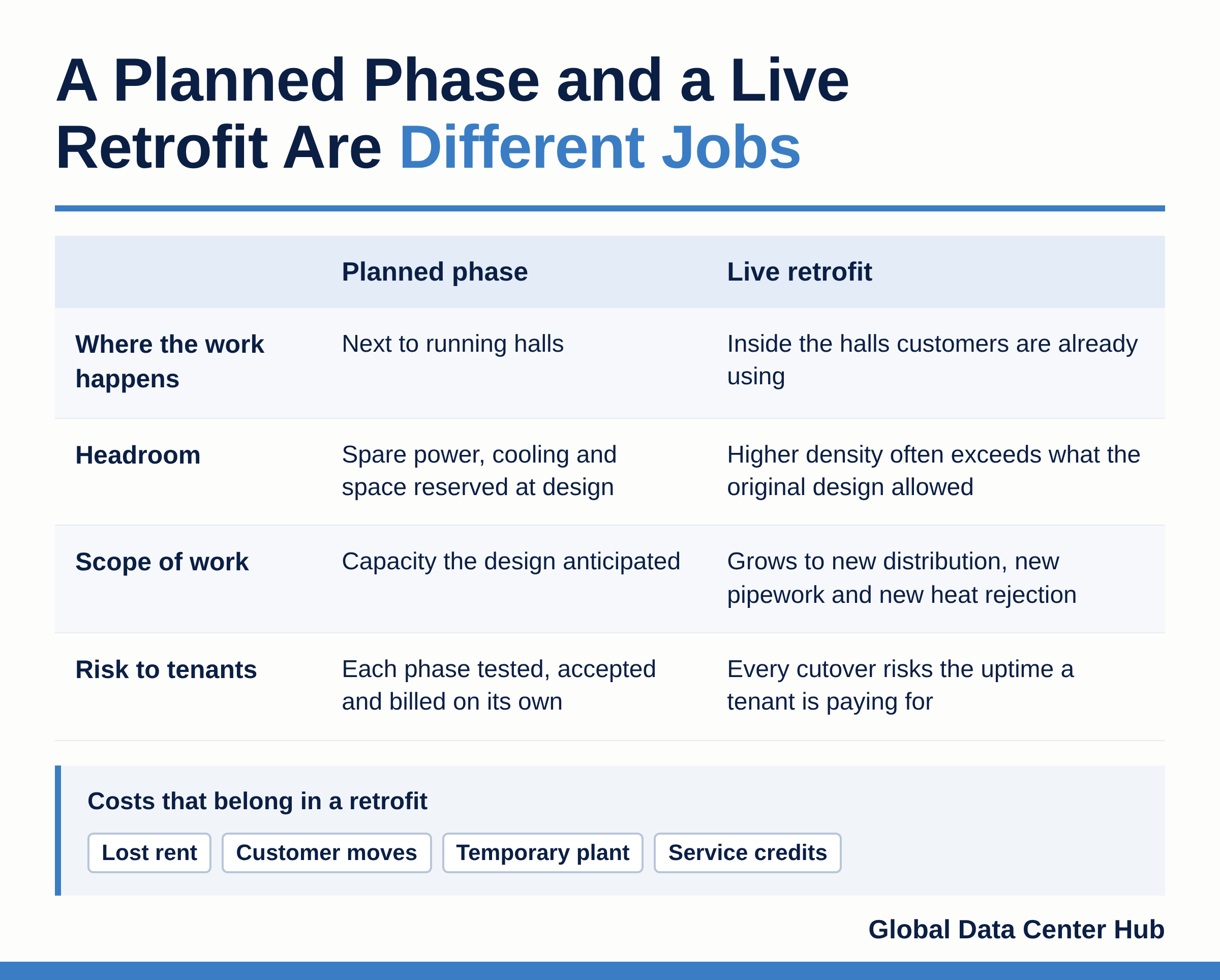
A retrofit works inside a running building. ASHRAE’s retrofit guidance names live-environment constraints, operating procedures and commissioning as central concerns. Every cutover risks the uptime a tenant is paying for.
Higher density often exceeds what the original power and cooling design allowed.
Then the job grows from new racks to new distribution, new pipework and new heat rejection.
The full cost is hard to see in advance. Lost rent, customer moves, temporary plant and service credits all belong in the project. Public data on retrofit cost compared with new build is thin, so each case needs its own estimate.
For scale, Core Scientific estimates its average site build-out at $11 million to $12 million per MW, before tenant fit-out of $1 million to $2 million per MW.
Facilities that planned for growth face a smaller version of this problem. Their headroom was bought early, when it was cheap.
Real-World Example: Core Scientific
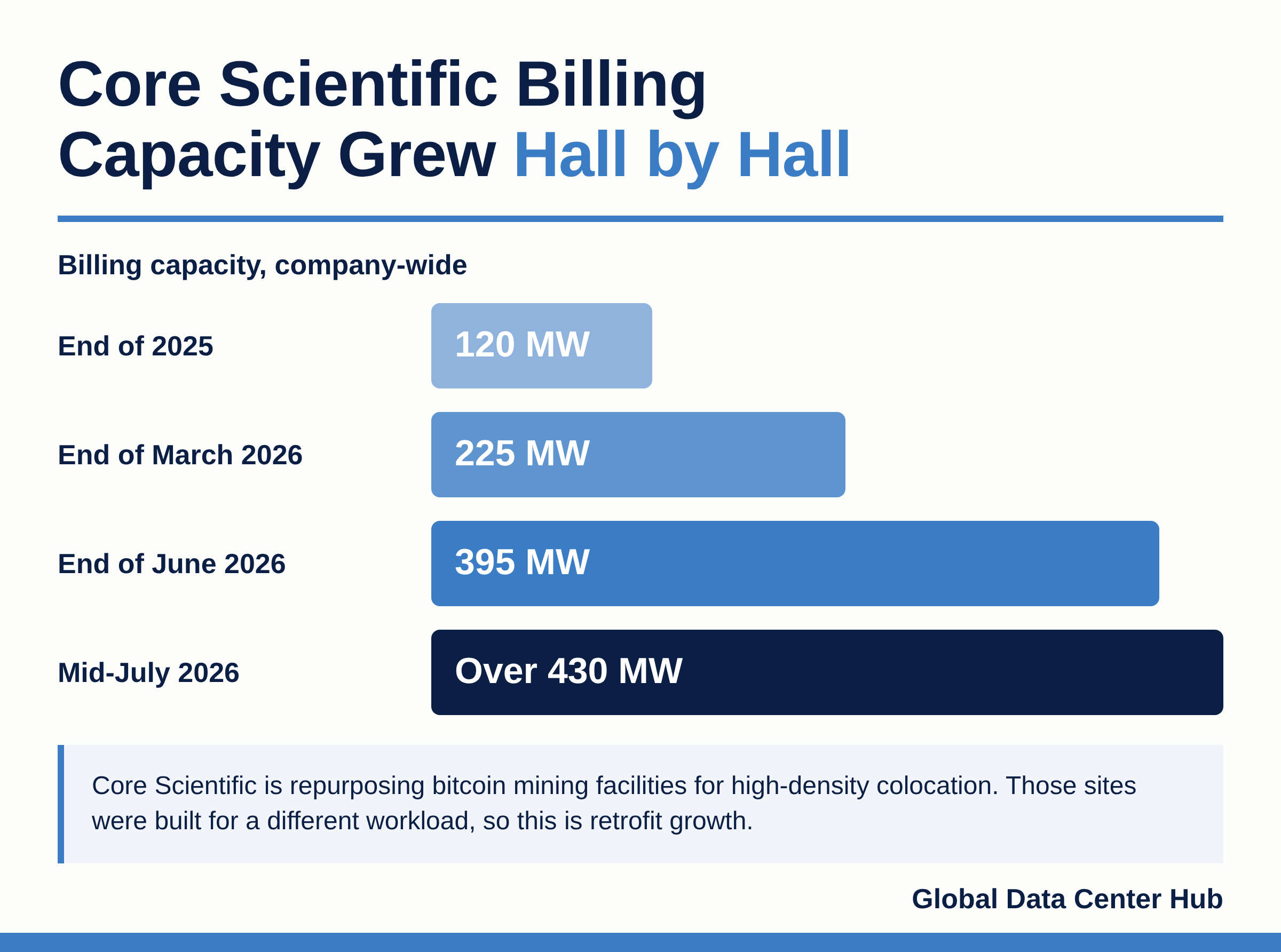
Core Scientific is repurposing its remaining bitcoin mining facilities for high-density colocation. Those sites were built for a different workload, so this is retrofit growth.
Much of the work is under contracts with CoreWeave. A proposed CoreWeave takeover ended on October 30, 2025, after stockholders rejected it, according to the company’s March 2026 proxy.
The company’s July 28, 2026, presentation shows how a retrofit turns into revenue hall by hall. Billing capacity was 120 MW at the end of 2025, 225 MW at the end of March and 395 MW at the end of June. It passed 430 MW by mid-July.
The leased figure is larger, at about 590 MW under the CoreWeave contracts. The deck labels that number as leased power on one slide and as infrastructure on another.
The billing figures are companywide. Check each boundary before comparing them.
Funding follows the same stepwise logic. CoreWeave-funded build-out costs are credited back against hosting payments at no more than 50% of monthly fees until repaid.
For an added 70 MW, Core Scientific funds about $104 million of capex itself, with no credit attached.
Third-quarter results, due November 5, 2026, will update these figures.
Strategic Implications
For developers, design the expansion path at conceptual design. List what you are reserving and what you are installing, and price them separately. The growth you enable cheaply now is the growth you would pay heavily to retrofit later.
For investors, a designed expansion path has value, but only with its conditions intact. Check that utility rights, land control, and shared-system capacity transfer with the asset. If expansion cash flows are already in the valuation, do not count the same capacity again as option value.
For operators: scaling a live facility is a reliability risk. The headroom you inherited sets how safely you can grow. Before each phase, confirm you can test and isolate it without touching occupied halls.
Key Takeaway
A data center development ends when the asset has grown to meet the demand it was built to capture. The first phase going live is the midpoint. The ability to scale is built in at the start. Without it, every expansion becomes a rebuild on a live site. So, when you look at any site, ask where the second phase goes. Then ask what it will cost to put it there.
Looking back across the full development lifecycle, which decision most determines whether an asset can scale, and where in the process does it get made?