

Welcome to Global Data Center Hub. Join investors, operators, and innovators reading to stay ahead of the latest trends in the data center sector in developed and emerging markets globally.
This article is the 20th article in the series: Ground to Grid: A Free 21-Lesson Guide to Mastering Data Center Development
Why Efficiency Is No Longer Optional
Energy efficiency decides how much of a data center’s power, water, and carbon budget goes into useful computing.
It is a continuous operating discipline. It starts at design and runs for the life of the asset.
When the operator buys the electricity, every unit of overhead is a direct cost. So efficiency moves margin, month after month.
Efficiency used to be a cost question. Now it is also a license question. Governments and grid operators increasingly set efficiency, water, and carbon conditions before a facility can connect or expand.
The scale explains why. The International Energy Agency estimates data centers used about 415 TWh in 2024, around 1.5% of global electricity. Its base case projects about 945 TWh by 2030.
The Metrics That Matter
1. PUE (Power Usage Effectiveness)
PUE divides a facility’s total energy by the energy its IT equipment uses. A PUE of 1.30 means 0.30 units go to cooling, power conversion, and lighting for every unit that reaches the servers. Lower is better, and 1.0 is the floor.
The current measurement standard is ISO/IEC 30134-2:2026, published on January 16, 2026. It replaced the 2016 edition.
Averages hide a lot. In Uptime Institute’s 2026 survey, the average facility ran at 1.52. Weighted by IT capacity, the average was 1.36. Larger, newer sites pull the second number down.
PUE has limits. The U.S. Department of Energy describes it as neither a productivity metric nor a complete efficiency metric. It says nothing about water, carbon or how busy the servers are.
2. WUE (Water Usage Effectiveness)
WUE divides annual site water use by IT energy. It shows the trade-off that many cooling systems make between electricity and water.
That trade matters because water is local. Evaporative cooling can lower PUE by consuming water.
Uptime’s operating-data analysis found that well-designed dry and adiabatic systems can match evaporative PUE in several climates while using little or no water.
Regulators are starting to set water goals. Singapore’s Green Data Center Roadmap works toward WUE of 2.0 cubic meters per MWh or below.
3. Carbon and Renewable Sourcing
Carbon intensity measures the emissions behind each unit of power a site consumes. A low-PUE facility on a coal-heavy grid can still carry a heavy carbon footprint.
The GHG Protocol’s current Scope 2 guidance requires two figures where contractual instruments apply. The location-based figure reflects the local grid.
The market-based figure reflects the power a company has contracted for. Hourly matching of clean power was still under consultation in the protocol’s August 2026 summary.
Tracking still lags. In Uptime’s 2026 survey, 79% of respondents tracked PUE. Only 31% recorded Scope 2 emissions.
How Efficiency Is Improved
Cooling is where most efficiency programs start. Fans, pumps, chillers, and heat rejection all sit outside the IT load, so they show up directly in PUE.
Airflow comes first because it is cheap. Containment separates hot air from cold air. Blanking panels and sealed gaps stop cold air from bypassing the servers. Higher operating temperatures follow.
ASHRAE recommends an inlet range of 18°C to 27°C for standard air-cooled equipment. Raising temperatures before fixing airflow can shift energy into server fans, so the order matters.
Liquid cooling reduces the energy spent moving air. ASHRAE recommends hybrid designs for AI racks, with direct-to-chip liquid cooling for processors and air for the rest.
It cautions against relying on air alone above roughly 50 kW per rack. Liquid cooling does not guarantee a low whole-site PUE. Pumps and heat rejection still count.
Renewable procurement addresses carbon. A PPA (power purchase agreement) is a long-term contract to buy power from a specific project at an agreed price. It can fix the price of part of a site’s supply for years. Annual matching is the usual standard.
Hourly matching ties claims more closely to when the load runs, but IEA modeling shows it needs a more diverse portfolio, and it can cost more.
Why Efficiency Is Now a Value Driver
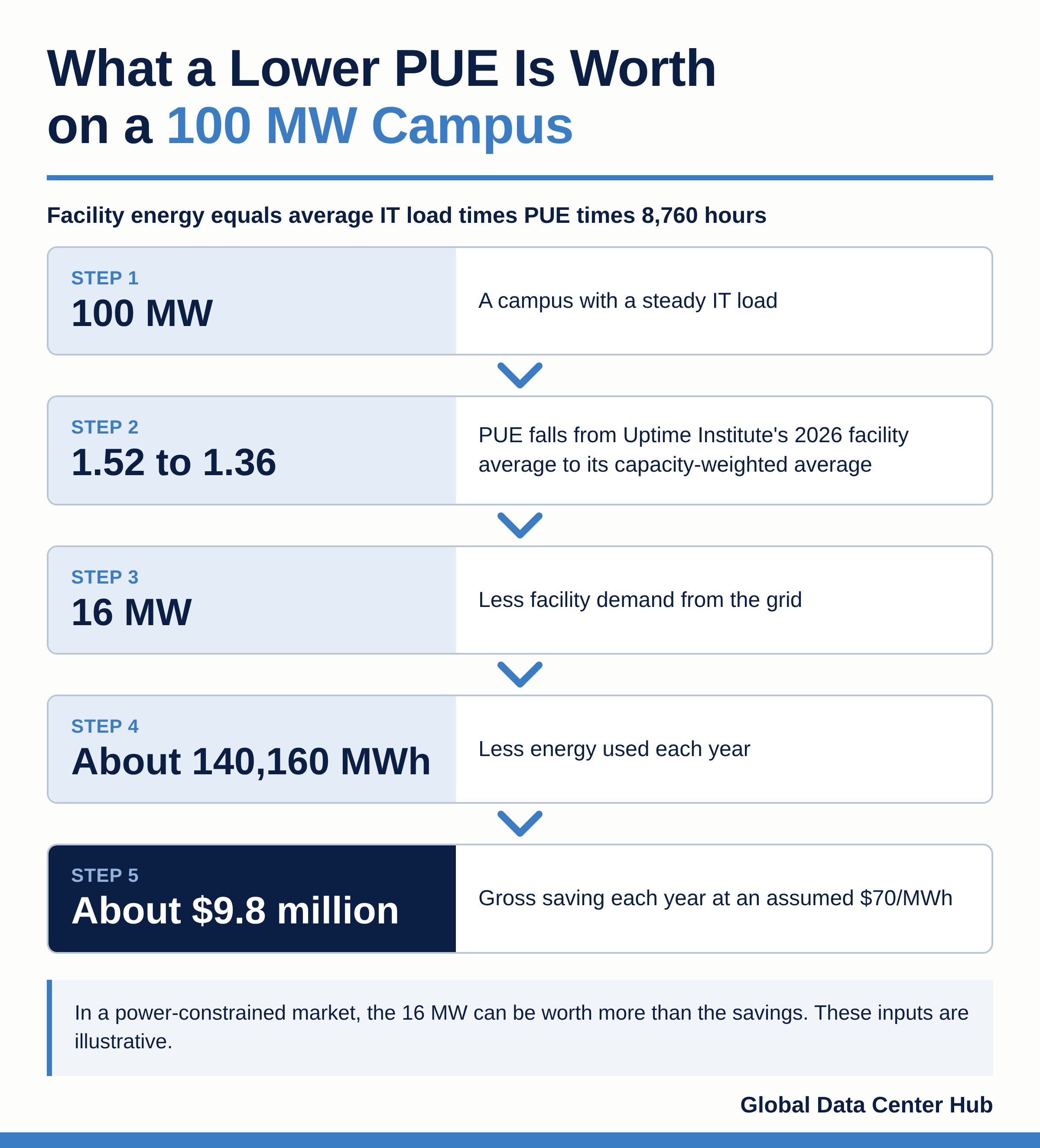
Start with margin. At a constant IT load, facility energy equals average IT load times PUE times 8,760 hours.
Take a campus with a steady 100 MW of IT load. Moving from a PUE of 1.52 to 1.36 cuts facility demand by 16 MW. That is about 140,160 MWh a year. At an assumed $70/MWh, gross savings are about $9.8 million a year. These inputs are illustrative, not a promised retrofit result.
In a power-constrained market, the 16 MW can be worth more than the savings. Lower overhead can make room for more IT load inside the same grid connection, if transformers, generators and cooling allow it.
Leases now carry the metric. A form lease that Blackstone Digital Infrastructure Trust filed in 2026 says the trust expects some leases to make the landlord bear power above an agreed PUE ratio. Efficiency becomes a contract term the owner pays for when it is missed.
Then comes the right to operate. Ireland’s Commission for Regulation of Utilities now requires new data centers to meet at least 80% of annual demand with additional Irish renewable projects.
Japan will hold data centers built from fiscal 2029 to a PUE of 1.3 or lower, measured after two years of operation. The European Commission proposed a rating scheme for sites above 500 kW in September 2026, with first labels expected in 2027.
So, efficiency is now underwritten. Owners, tenants and regulators price it.
The research behind this piece found no dataset that quantifies a valuation or cost-of-capital premium for low PUE. The contract terms and connection rules are already visible.
Efficiency Metrics and What They Govern

Each metric answers to a different party. The owner’s finance team watches PUE. Local authorities watch water. Regulators and capital providers watch carbon.
A Real-World Example: Heat That Earns
Every unit of power a data center uses becomes heat. Most sites pay to reject it. PUE gives no credit for reusing it.
Stockholm turned that heat into a product. Stockholm Exergi, the city’s district heating company, pays suppliers for recovered heat, priced against what the same heat would cost to make in its own plants.
The example is about 2 million Swedish kronor a year per megawatt of heat delivered. It says excess heat now warms about 11,000 apartments.
Odense shows the scale. Heat recovered from Meta’s data center feeds a heat pump plant of about 45 MW, built for Fjernvarme Fyn and ready in late 2019. By 2023, it served more than 12,000 homes.
Denmark abolished a tax on surplus heat use for certified businesses in January 2022, which improved the case for such projects.
Policy is moving the same way. Germany requires new data centers starting from July 1, 2026, to reuse an initial 10% of their energy, according to a law firm summary of the statute.
The lesson is about siting. Heat reuse works only with a nearby buyer, at the right temperature, during the right season. That decision is made before the first foundation is poured.

Strategic Implications
For developers: Efficiency is cheapest to build in at design. Pick the cooling system, the water source and any heat offtake before you lock the site plan.
In Japan, new builds will be measured two years after start-up, so design for the operating number. Retrofitting later is the expensive path.
For investors: A poor PUE is a margin problem and a contract problem. Ask whether the reported figure is an annual operating number or a design number.
Then read the lease for PUE caps and ask who pays for power above them.
For operators: Efficiency is a daily margin lever. Report PUE, WUE, and both Scope 2 figures together, so each improvement shows up where it pays. Fix airflow before you raise temperatures.
For policymakers: Efficiency and water rules cost least when developers know them before design. Publish the measurement method and the start date early, as Japan did.
Key Takeaway
Efficiency is where margin and mandate meet.
A facility that cuts its energy, water, and carbon overhead protects its profit.
It also protects its right to connect, expand and keep operating. The two goals are now one.
So, treat efficiency as a design decision. The owners who can prove their operating numbers will find it easier to win power, approvals, and tenants. The ones who cannot will pay to catch up.
Do you think efficiency improvements are driven more by cost pressure or by regulation and financing terms in your market, and which will matter more by 2030?