

Welcome to Global Data Center Hub. Join investors, operators, and innovators reading to stay ahead of the latest trends in the data center sector in developed and emerging markets globally.
The AI buildout has a funding problem that hyperscalers can hide and neoclouds cannot.
Microsoft, Alphabet, Amazon and Meta pay for data centers out of operating cash.
One tier down, the same chips, the same power contracts and the same grid queues have to be paid for with someone else’s money.
For most of this cycle, that someone was a lender. CoreWeave’s Q3 2026 shows a second source moving to the center: its own customers.
That is why this quarter matters, more than the revenue beat. Demand for compute is not in question. Power is still the bottleneck.
What the print tests is who pays for the gap between signing a contract and collecting cash from running it.
The Operating Turn Is Real, and Priced at Scarcity
Start with what went right, because a lot did.
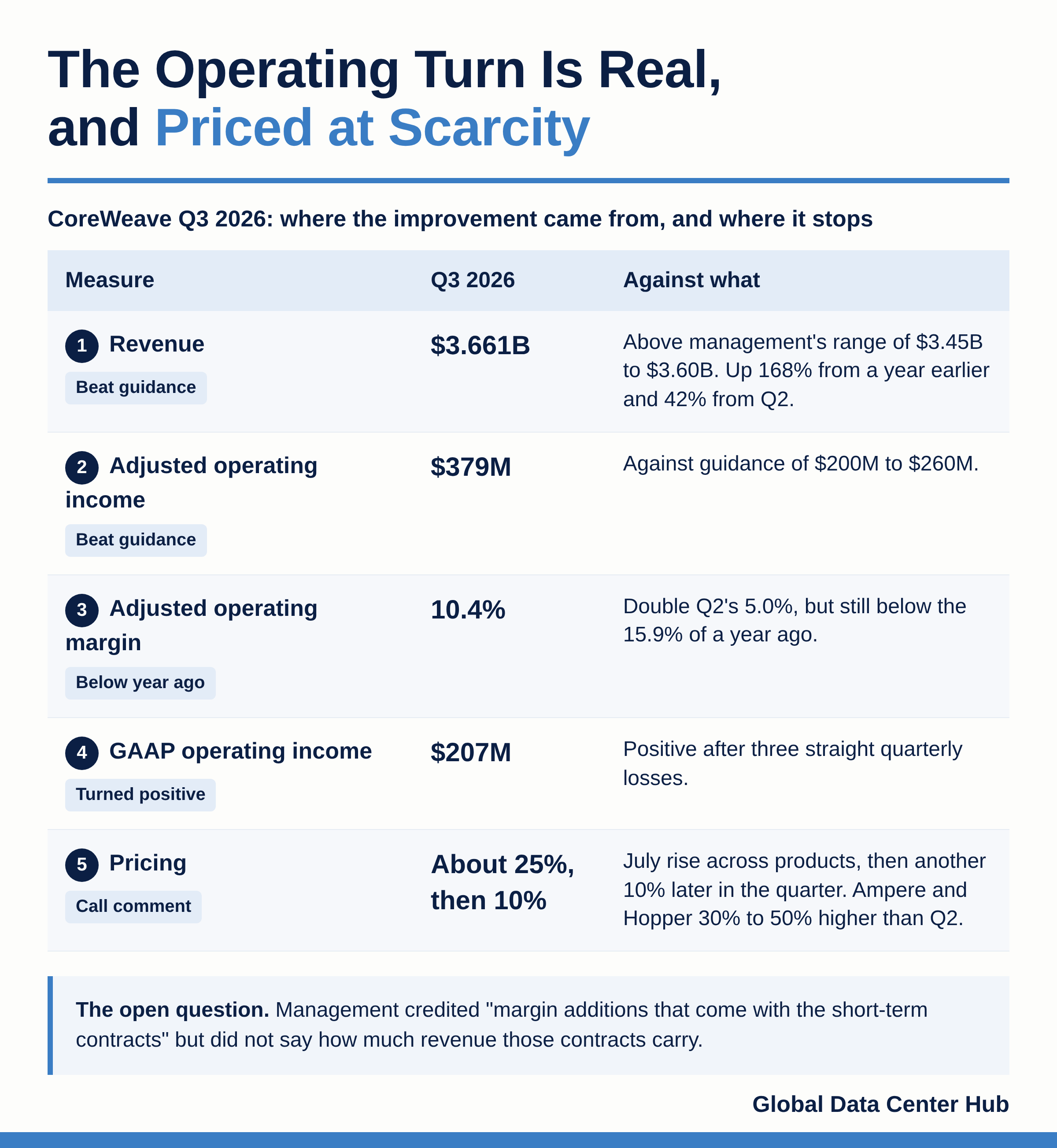
Revenue reached $3.661 billion, up 168% from a year earlier and 42% from Q2.
It cleared the top of management’s own range of $3.45 billion to $3.60 billion and beat consensus by 3.3%.
Profit moved with it. Adjusted operating income was $379 million, against guidance of $200 million to $260 million.
Adjusted operating margin rose to 10.4%, double Q2’s 5.0%. GAAP operating income turned positive at $207 million after three straight quarterly losses.
Pricing helped. Management said prices rose about 25% across products in July and another 10% later in the quarter, and that older Ampere and Hopper GPUs priced 30% to 50% higher than in Q2.
Those are call comments, not a disclosed price index. If they hold, they cut against the main bear case on GPU clouds: that older chips lose earning power fast.
The turn has limits. Margin is still below the 15.9% of a year ago. Management credited “margin additions that come with the short-term contracts” but did not say how much revenue those contracts carry.
Part of this quarter is scarcity pricing, and scarcity pricing ends when supply catches up.
Power Is Signed Faster Than It Is Switched On
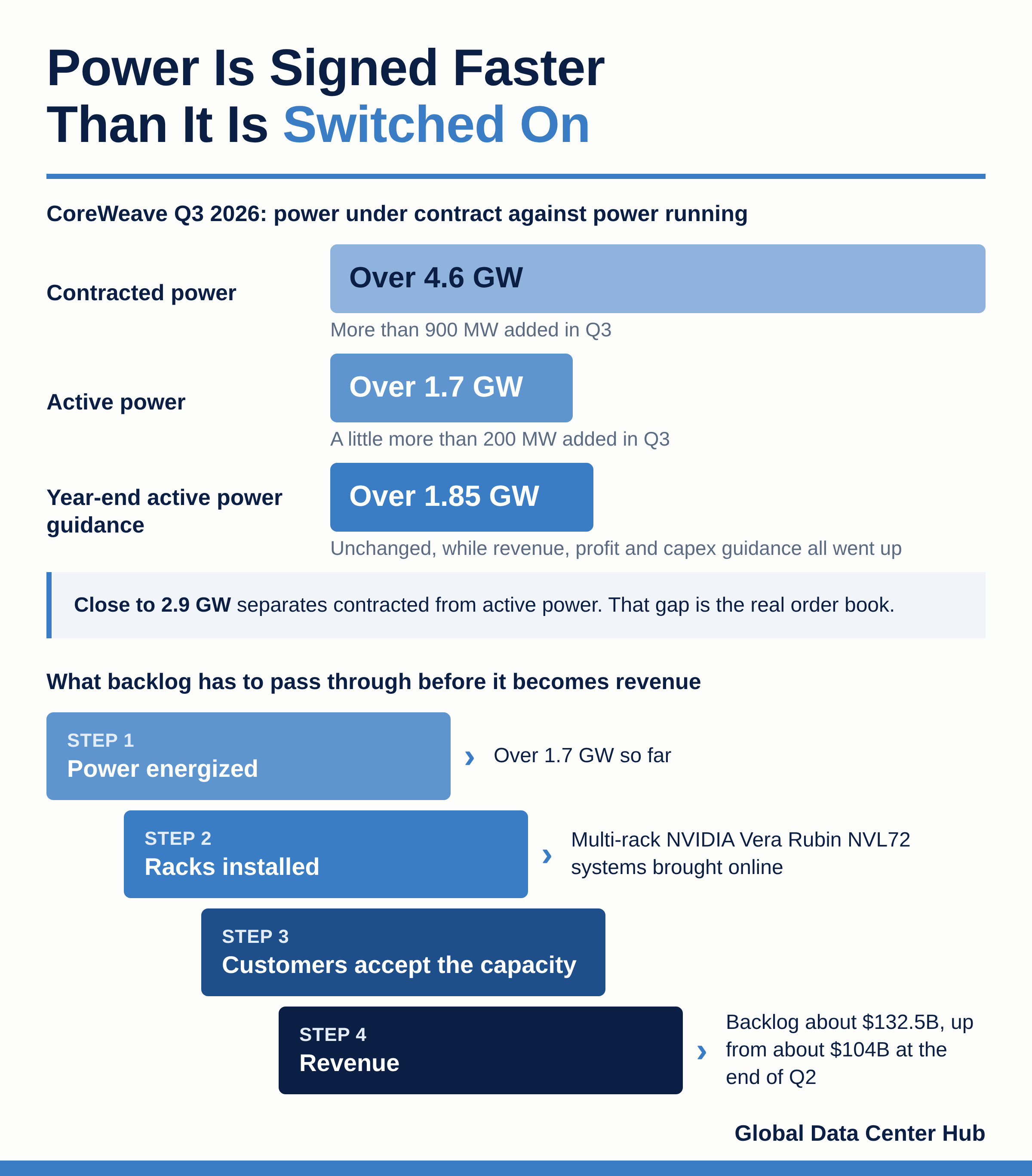
CoreWeave added more than 900 MW of contracted power in the quarter but only about 200 MW of active power. It now has over 4.6 GW under contract and over 1.7 GW running.
That gap, close to 2.9 GW, is the real order book. Backlog rose to about $132.5 billion from about $104 billion at the end of Q2. But backlog turns into revenue only when power is energized, racks are installed and customers accept the capacity.
The company is pushing on every input it controls. It brought multi-rack NVIDIA Vera Rubin NVL72 systems online and signed a multiyear deal for priority access to Solidigm SSD capacity.
It also pulled deliveries forward, which pushed reported capex to $14.5 billion against guidance of $11.5 billion to $13.5 billion.
Note what management did not raise. Year-end guidance for active power stayed at over 1.85 GW. The revenue, profit and capex outlooks all went up.
The amount of power expected to be running did not. The upgrade is coming from price and mix, not from more energized megawatts.
The expansion is now global. More than 1.3 GW of contracted power sits outside the US, including India, Indonesia and Spain.
In India and Indonesia, the hard part is rarely signing a power deal. It is getting the grid connection, transmission and permits delivered on time, none of which the operator controls.
The release does not say how much of that 1.3 GW is live. Until it is, it is a claim on a grid, not a data center.
Customers Became the Cheapest Lender
This is where the quarter’s real news sits.
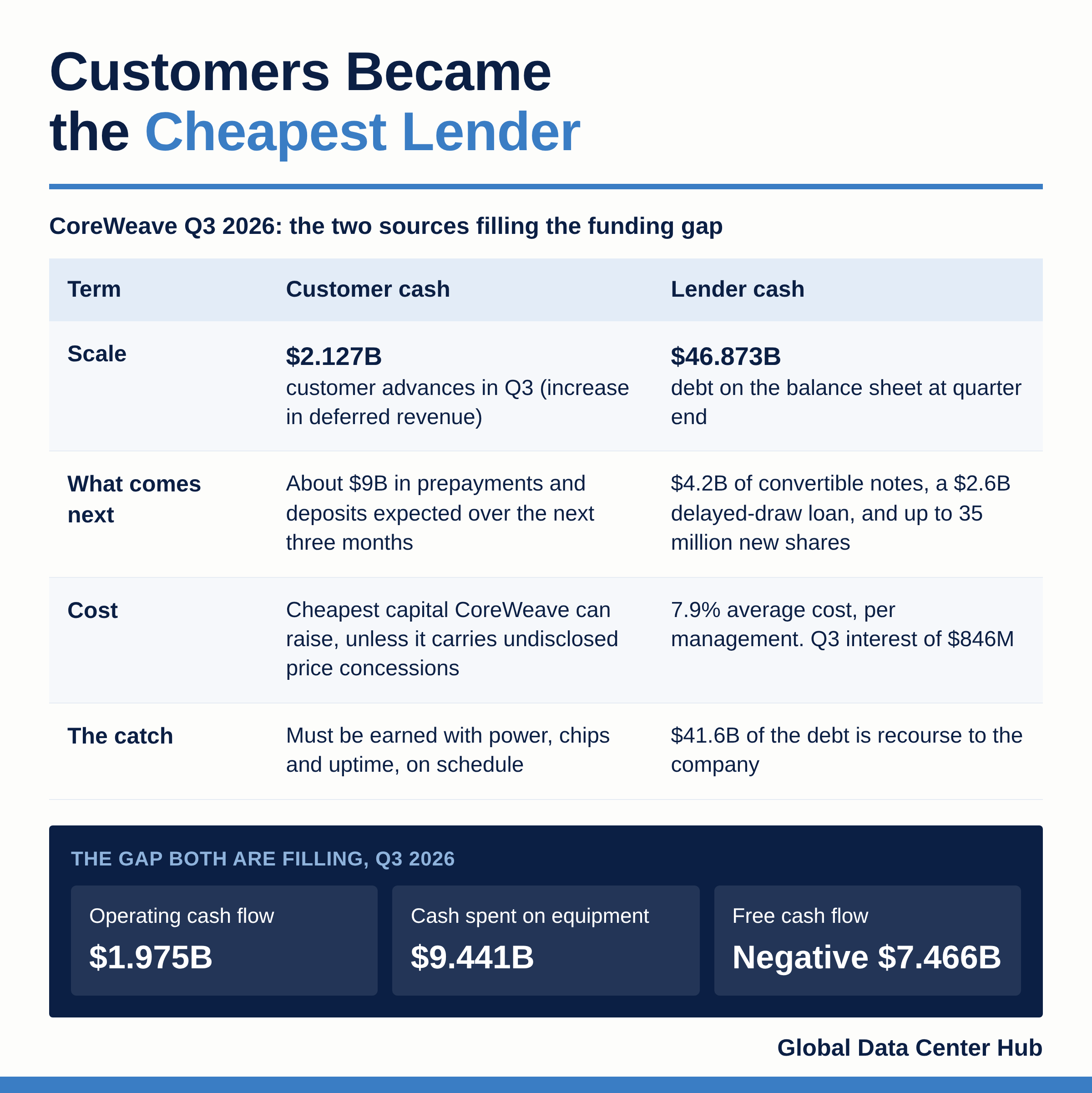
Operating cash flow was $1.975 billion. Inside it, the increase in deferred revenue, meaning cash customers paid before CoreWeave delivered the service, was $2.127 billion.
Customer advances were larger than all operating cash flow combined. Everything else netted out negative, including a $1.741 billion rise in receivables.
Then comes the build. Cash spent on equipment was $9.441 billion, leaving free cash flow at negative $7.466 billion.
That gap has widened every quarter this year, from negative $4.711 billion in Q1 and negative $5.743 billion in Q2.
Lenders still fill most of it. Debt on the balance sheet totals $46.873 billion, and $41.6 billion of that is recourse to the company. Management put the average cost at 7.9%.
The quarter’s release added $4.2 billion of convertible notes, a $2.6 billion delayed-draw loan built for shorter contracts, and a program to sell up to 35 million new shares.
But customer cash is the line that is growing. Intrator said CoreWeave expects about $9 billion in prepayments and deposits over the next three months.
On the call, management said more than $3 billion of that relates to infrastructure already running. Unless it comes with price concessions the company has not disclosed, that is the cheapest capital CoreWeave can raise, set against debt at 7.9%.
It is also capital with conditions. A prepayment buys future service. It has to be earned with power, chips and uptime, on schedule.
And it does not fix the debt already taken. Q3 interest was $846 million, more than double adjusted operating income.
Q4 guidance puts interest at $1.05 billion to $1.15 billion, above the $747 million to $847 million of adjusted operating income that full-year guidance implies.
The business is earning more. It is not yet earning enough to cover what it has borrowed.
Financeability Is Becoming the Moat
The competitive read follows from the funding mix.
Any AI cloud can buy GPUs if it can pay for them. Far fewer can get customers to pay ahead.
Prepayments at this scale need buyers with deep balance sheets and a reason to lock in capacity. They go to the operator those buyers trust to deliver.
On that reading, the quarter favors CoreWeave over smaller rivals. It also ties CoreWeave closer to a short list of buyers. In Q2, the three largest customers made up 36%, 26% and 10% of revenue.
The Q3 split is not yet filed. If the $9 billion comes mainly from the same names, the funding base gets cheaper and narrower at the same time.
Renewals are the second lever. Management sized about $4 billion of yearly revenue opportunity from 2027 renewals, rising to nearly $10 billion with 2028, all outside the backlog.
Renewing paid-off equipment at today’s prices would be the highest-return business CoreWeave runs.
It is also unpriced. Nobody yet knows what Hopper capacity rents for in 2028.

What Resolves Next
Three signals decide whether this is a new funding model or one strong quarter.
First, the $9 billion. If prepayments and deposits land on the stated timeline, customer cash becomes a lasting part of how CoreWeave funds growth. If they slip, the gap falls back on lenders and shareholders.
Second, the contract mix. CoreWeave has not said how much revenue sits on short-term contracts.
Margin built on long contracts compounds. Margin built on scarcity pricing reverses when supply catches up.
Third, power switched on. Guidance implies roughly 150 MW of active additions in Q4.
The test is whether the 2.9 GW gap between contracted and active power starts closing faster than new contracts widen it.
For investors, the test has moved from backlog to cash collected. For operators, power that energizes on schedule is now what earns customer financing.
For policymakers, the issue is concentration: when a few buyers fund the build in advance, they also shape which capacity, and which countries, get built first.
The Bottom Line
CoreWeave’s Q3 showed the business can make money at the operating line. It did not show the business can fund itself.
What changed is who fills the gap. Lenders still hold $46.9 billion of claims, at a cost that outruns operating profit.
But customers put in $2.1 billion this quarter, and management expects about $9 billion more within three months.
That is cheaper money than debt, and a stronger signal than any backlog figure. It is also a promise to deliver on time, at scale, in places where power is hard to get.
For a neocloud, capital structure was always the business. Now the customer is part of the capital structure.