

Welcome to Global Data Center Hub. Join investors, operators, and innovators reading to stay ahead of the latest trends in the data center sector in developed and emerging markets globally.
CoreWeave, Inc. closed a $2.6 billion delayed draw term loan facility on August 10, 2026. JPMorgan and Mitsubishi UFJ Financial Group served as joint lead arrangers and bookrunners.
Proceeds fund the purchase and deployment of high-performance computing infrastructure dedicated to customer contracts.
The facility was issued through CoreWeave Financing DDTL V-V, LLC and is named the DDTL 5.5 facility.
CoreWeave Facility Terms And Contract Length
The DDTL 5.5 facility carries a maturity of approximately five years.
The customer contracts backing it average approximately three years in length.
CoreWeave states that its prior delayed draw term loan facilities were backed by customer contracts extending through the maturity of the debt.
The credit agreement gives CoreWeave the option to renew those contracts or to re-lease the capacity to other customers when the initial contracts end, subject to criteria set out in the agreement.
The facility priced at SOFR plus 5.50 percent. CoreWeave describes the transaction as meaningfully oversubscribed.
Moody’s assigned a rating of Ba2 and Fitch assigned BB+.
CoreWeave states that the facility is backed by a diverse group of AI, financial services and technology customers, and does not name them.
Brannin McBee, co-founder and chief development officer, said lenders are now comfortable financing shorter-dated contracts, which allows CoreWeave to target a wider variety of customers.
Earlier Debt Facilities In 2026
The DDTL 5.5 facility follows two earlier transactions in 2026.
CoreWeave closed the $8.5 billion DDTL 4.0 facility on March 31, 2026.
Moody’s rated it A3 and DBRS rated it A (low).
CoreWeave described it as the first investment-grade rated financing secured by high-performance computing infrastructure and an associated customer contract, and as non-recourse.
CoreWeave closed the $3.1 billion DDTL 5.0 facility on May 18, 2026, through CoreWeave Financing DDTL V, LLC.
Moody’s rated it Ba2 and Fitch rated it BB+. CoreWeave described it as the first publicly syndicated facility of its type and said the structure enables secondary market trading.
It priced at SOFR plus 4.50 percent after tightening by 50 basis points during syndication, and its proceeds supported infrastructure for contracts with two large non-investment-grade customers.
Morgan Stanley and Mitsubishi UFJ Financial Group led that transaction.
CoreWeave states it has secured more than $30 billion of debt and equity capital during 2026 to date.
The company reported second-quarter results the following day, on August 11, 2026, and disclosed 1.5 GW of active power at June 30 and approximately 4.2 GW of contracted power as of August 11.
One Hundred Basis Points Price The Renewal
The number that decides this facility is 100 basis points.
That is the distance between SOFR plus 450 on CoreWeave’s DDTL 5.0 facility in May and SOFR plus 550 on the DDTL 5.5 facility in August, at identical Ba2 and BB+ ratings from the same two agencies.
Coverage of both transactions carried the ratings and carried the spreads and left the two numbers sitting three months apart without connecting them.
The consequence is that the market has already set its first observable price for GPU residual value, and it set it in a press release published the day before an earnings report.
The Ratings Ignored The Two-Year Gap
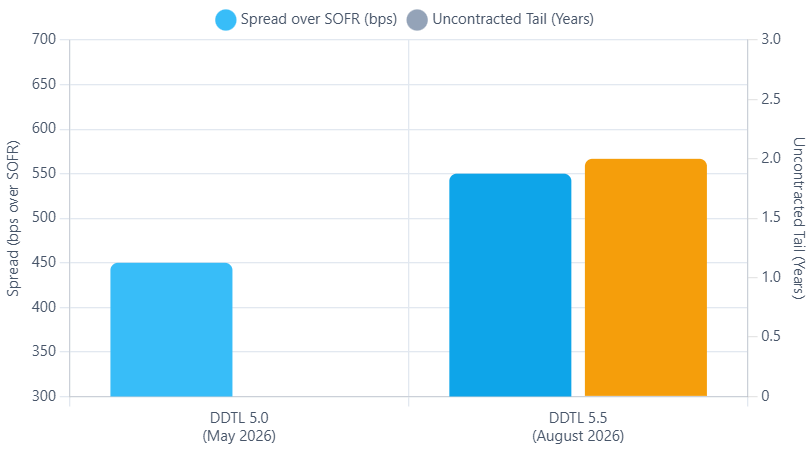
Take the disclosed variables one at a time. The DDTL 5.0 facility rested on two large non-investment-grade customers.
The DDTL 5.5 facility rests on a diverse group of AI, financial services and technology customers.
Diversification of the obligor pool argues for tighter pricing, and the pricing went the other way.
Debt tenor shortened, from roughly five and a half years to roughly five. That argues for tighter pricing too.
One disclosed variable moved against the borrower. In the DDTL 5.0 facility the customer contracts ran through the maturity of the debt.
In the DDTL 5.5 facility they run about two years short of it.
A rating is an opinion about expected loss. A spread is a price.
When the two disagree by 100 basis points inside one program in one quarter, the price is the more informative number.
CoreWeave disclosed a 50-basis point tightening during syndication in May and disclosed nothing equivalent in August. Read the omission as an open question and hold it open.
The Re-Lease Option Is The Actual Collateral
In the March and May facilities, a lender underwrites a customer.
The contract runs to the maturity of the loan, and the credit question is whether the obligor pays.
In the August facility, a lender underwrites a customer for three years and underwrites hardware for two.
The credit agreement makes that explicit.
CoreWeave holds an option to renew the initial contracts or to re-lease the capacity to other customers, subject to criteria the agreement sets, and the release does not describe.
Those criteria are the instrument. They determine which GPU generations count as eligible capacity, what happens if utilization falls before the contracts roll, who values the fleet at the roll date, and what the lender can do if no replacement tenant appears.
None of it is public. Over the next four to six quarters, the first credit agreement whose re-lease terms become visible, through a filing, a rating action or a restructuring, will function as the template, because no arranger will negotiate a bespoke version of a term the market has already standardized.
The Program Is Pricing One Variable At A Time
The sequence carries more information than any single transaction in it.
March delivered an investment-grade rating on non-recourse HPC collateral.
May delivered a public syndication and a secondary market on the same collateral one rating band lower.
August delivered a break in the match between contract tenor and debt tenor, and a number attached to that break.
Each rung isolated one variable and put a price on it. That is how a collateral class becomes an asset class.
Secondary trading matters more here than it did in May.
Two facilities from the same issuer, rated the same, three months apart, now trade against each other.
The 100 basis points stops being a single primary print and starts being a curve, and a curve is what an investment committee can underwrite against.
The next rung either widens the tenor gap beyond two years or drops the collateral quality, and the market will price whichever variable moves.

What Each Desk Now Underwrites
Private Capital. Infrastructure funds, private credit and family offices buying HPC-backed paper should stop pricing off the rating band.
Ba2 and BB+ described both facilities and missed the difference the syndicate charged for.
Ask for the re-lease criteria before indicative pricing and price the unlet tail separately from the contracted term.
Firms that wait will inherit definitions written by whoever closed first, negotiated to clear that deal.
Public Markets. CoreWeave carries roughly $35 billion of debt, and the reporting does not split it by whether the collateral is contract-matched or renewal-exposed.
That split determines how much of the stack rests on a hardware market and how much rests on a customer.
Build the split from the facility disclosures and track it each quarter.
Holders who wait for the company to publish it are holding an exposure that compounds facility by facility and appears nowhere as a line item.
Operators. Any operator financing a GPU fleet now has a market number for two years of uncontracted tail risk, and it is 100 basis points.
Put it into the comparison between a three-year contract at a higher rate and a five-year contract at a lower one, because the financing cost of the shorter contract is now observable.
Operators who price only the revenue difference will keep signing the shorter deal and keep paying for it in the capital stack.
The Residual Curve Gets Priced Before It Gets Rated
GPU-backed debt spent 2026 assembling the machinery of an asset class.
A rating in March, a syndicate and a secondary market in May, and in August a price for the one risk nobody had isolated.
The agencies will reach the tenor mismatch eventually, and when they do the differential moves out of the spread and into methodology, which is where it becomes permanent.
The question for the next two quarters is which arrives first: a rating framework for renewal risk on compute hardware, or a facility that stretches the gap past two years.
Whichever lands first becomes the reference, and the other one gets measured against it.