
Welcome to Global Data Center Hub. Join investors, operators, and innovators reading to stay ahead of the latest trends in the data center sector in developed and emerging markets globally.
Power Sites Became the Scarce Asset. Funding Them Is the Next Test.
AI demand has pushed the data center bottleneck past chips.
The hard inputs now are sites with energized grid connections and the money to build halls on them before a tenant pays full rent.
That is why former bitcoin miners became landlords to AI clouds: they already held the power.
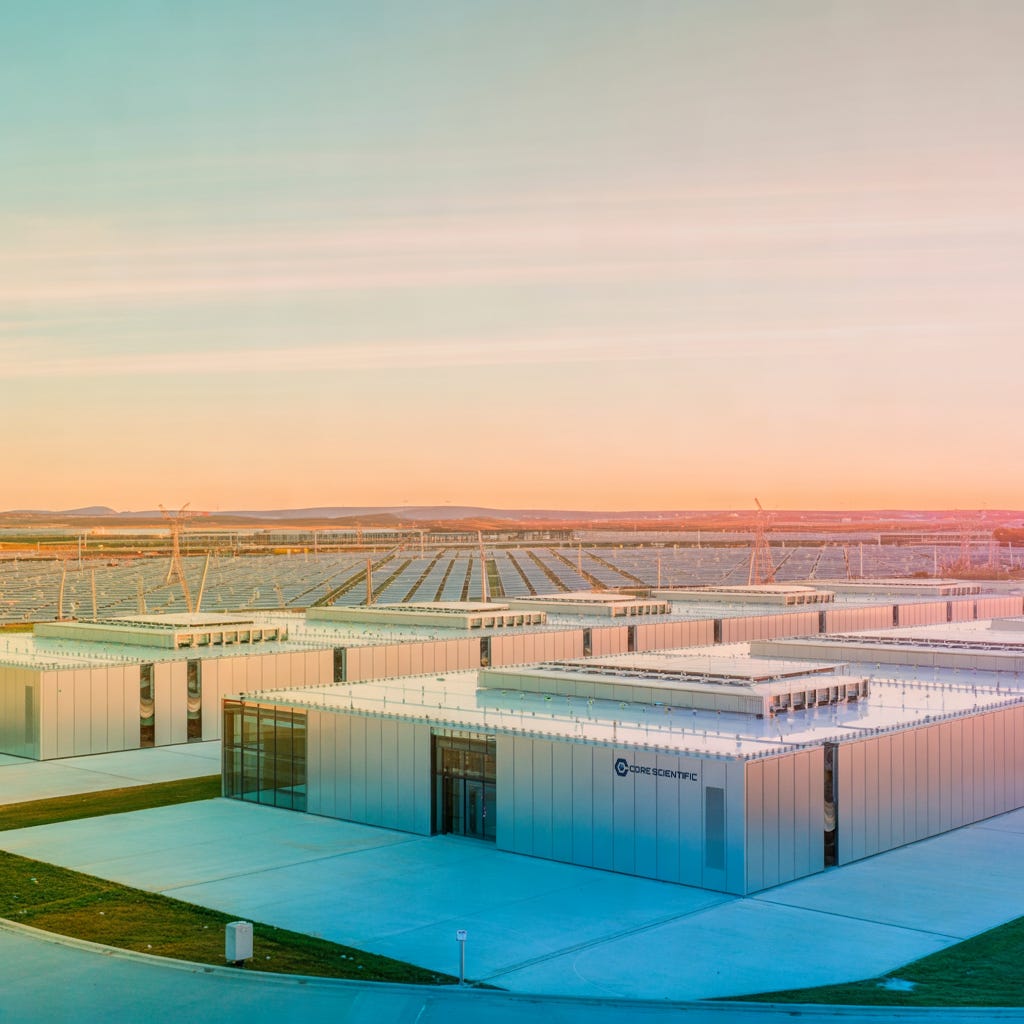
Core Scientific is the cleanest test of that conversion. It rents its revenue-producing capacity to CoreWeave, has signed AMD as a second anchor, and is winding down mining.
The third quarter of 2026 showed the building side working.
It also showed that the open question has moved from whether the company can deliver megawatts to whether it can pay for the next ones on terms the rent can carry.
The $1.2 Billion Profit Is a Warrant Mark. The Operating Turn Is Real.
Start with what not to read. Net income of $1,178.1 million included a $1,034.4 million gain from changes in the fair value of warrants and contingent value rights, plus a $106.5 million tax benefit.
The prior quarter showed a $1,155.3 million net loss. Both swings say more about derivative liabilities than about the business. Even diluted EPS of $0.47 strips most of it out, using a numerator of $219.3 million.
The real signal sits higher up the income statement. Colocation revenue reached $215.4 million, 92.5% of total revenue, up from 83.2% in the second quarter and 18.4% a year earlier.
Colocation earned a 59.6% gross margin while self-mining ran a $7.5 million gross loss. Operating income swung to $72.4 million from a $78.5 million loss.
Adjusted EBITDA rose to $133.6 million, a 57.4% margin against 25.0% one quarter earlier. Management expects to finish the mining wind-down in the fourth quarter.
Billing Megawatts Are the Unit That Counts
Billing capacity rose from 120 MW at the end of 2025 to 225 MW, 395 MW and 485 MW over the next three quarter-ends.
Colocation revenue moved with it, from $31.3 million to $215.4 million. This is not a clean price-per-megawatt series, since revenue reflects delivery timing and variable charges, but it is proof of delivery.
About 82% of CoreWeave’s 590 MW commitment is now billing. The roughly 100 MW left, mainly Dalton Phase 2, is expected by early 2027.
The AMD program is the next layer. About 530 MW of leases are signed across five sites: Pecos, Hunt and Muskogee with AMD directly, and Dalton and Auburn for neocloud tenants backed by AMD credit.
Pecos and Auburn deliver first, in the first half of 2027, and the full program targets completion by the end of 2028. None of it produced revenue at quarter-end.
Beyond that sit 1,925 MW of AMD reservations, which are rights, not leases. Here the power constraint shows. About 385 MW has secured grid power. Another 600 MW is under utility load study, and 940 MW depends on behind-the-meter generation.
On that last piece, management said “we have not filed for the air permits.” It also held its build-cost expectation at “$11 million-$12 million a megawatt.”
GAAP Revenue Runs Ahead of Cash Rent
CoreWeave’s leases carry fixed take-or-pay fees, escalators and generally 12-year terms.
But CoreWeave funded up to about $750 million of specified buildout costs, and Core Scientific repays that by crediting up to half of each monthly fee until the balance is cleared.
GAAP spreads rent evenly across the term, so reported revenue runs ahead of cash collected during the credit period. The company’s own illustration shows this.
Two more items widen the gap. Of the $215.4 million in colocation revenue, $58.2 million was variable lease revenue, largely power and fuel passed through and recorded gross.
And the AMD warrant’s $296.4 million issuance-date value sits as a deferred lease incentive that will reduce revenue once the AMD leases start. Adjusted EBITDA is therefore a generous guide to the cash this business produces today.
One Quarter of Building Left a $920 Million Gap
Operating cash flow for the quarter was $65.3 million. Spending on property and equipment was $540.7 million, and land and development-right acquisitions took another $444.4 million, for $985.1 million in total. After that spending, the quarter ran $919.8 million negative.
The balance sheet holds $803.9 millions of unrestricted cash, $837.6 millions of restricted cash and a $100 million undrawn revolver. The company’s $1,744.2 million liquidity figure counts all three plus digital assets, so it overstates what is freely available.
Long-term debt carries at $4,302.2 million, and stockholders’ equity is a $1,092.1 million deficit. Purchase and construction commitments total about $4.4 billion, mostly due within 24 months.
The debt stack defines the risk. The $3.3 billion of senior secured notes pays 7.75% through 2031, about $255.75 million a year in coupon. The notes sit in ring-fenced subsidiaries, but the parent gives an uncapped completion guarantee on specified projects.
Convertibles add $460 million at 3% due 2029 and $625 million at 0% due 2031. The revolver can only be drawn while market capitalization stays above $3 billion, and it carries a $150 million minimum-liquidity covenant.
On funding the first AMD buildout, management said “we do not expect to issue additional equity or equity-linked securities.”
The 10-Q says additional external financing is required and is not assured on acceptable terms. Both can be true, but only one is a filed statement.
Management also expects about $650 million in cash from Tranche 1 warrant exercises around their January 2027 expiry. That cash has not arrived, and pro forma diluted shares already stand near 509 million against about 322 million issued.
The Ring-Fence Leaks Back to the Parent
Core Scientific’s edge is proven delivery. It added 365 MW of billing capacity in nine months and has a second anchor tenant signed.
Management says over half the contracted portfolio’s cash flows are backed by investment-grade credit, and it illustrates about $1.8 billion of average annual GAAP revenue and $1.6 billion of annual net operating income once that portfolio is delivered.
The weakness is that the structure does not fully separate project risk from the parent. Ring-fenced notes protect lenders.
The uncapped completion guarantee sends construction overruns back to the parent, whose shareholders already sit behind a $1.1 billion book deficit.
Customer risk is also undiversified in practice: all reported colocation revenue still came from CoreWeave. AMD diversifies the contract book. It does not yet diversify cash.
What the Converter Model Is Running Into
Three patterns travel beyond this company. First, reserved megawatts and energized megawatts are different assets.
Only about one-fifth of Core Scientific’s reservation pool has secured grid power; the rest depends on utility studies or on-site generation that still needs permits. Power still sets the delivery schedule.
Second, customer-funded construction moves the cash problem rather than solving it.
CoreWeave’s credits lowered Core Scientific’s upfront spend, then pushed cash rent later.
The AMD sites ask the landlord to fund the build at a stated $11 million to $12 million per megawatt.
Third, the distance between reported earnings and cash keeps growing as derivative marks, straight-line rent and pass-throughs pile up.
Pricing a converter on reported EBITDA means pricing an accounting line, not the rent that services the debt.

What Resolves Next
Investors should watch three things. The first is AMD project financing: amount, pricing, leverage, reserves, and whether completion obligations again reach back to the parent.
The second is Dalton Phase 2 moving to billing by early 2027, alongside management’s call for a double-digit sequential revenue increase in the fourth quarter.
The third is whether any of the 1,925 MW of reservations converts into binding leases paired with secured power and filed permits before the rights expire in December 2028.
Operators face a sequencing problem: secure power and permits before committing capital, not after.
Policymakers face the other side of it. When 940 MW of one company’s pipeline depends on on-site generation, permitting pressure moves from grid operators toward air regulators.
The Bottom Line
Core Scientific has proven the hard operating part: it turns powered sites into billing AI capacity at a colocation gross margin near 60%.
The $1.2 billion profit hides the part still open.
Each new megawatt costs $11 million to $12 million, the rent arrives later than the revenue, and the filing says the money is not yet secured.
The site is no longer the scarce asset. Financing the rent can carry is.