
Welcome to Global Data Center Hub. Join investors, operators, and innovators reading to stay ahead of the latest trends in the data center sector in developed and emerging markets globally.
Edition No. 75
THE WEEK’S THESIS: SOMEONE HAS TO STAND BEHIND IT
AI money moved this week to whoever had the stronger balance sheet behind the asset. The deals that closed had a backer. The ones that didn’t are still looking for one.
Broadcom is standing behind the lenders who will buy chips for Anthropic. Nvidia wrote its own check into Meta’s share sale. Washington offered Constellation cheap federal money to get more out of its reactors. A hyperscaler’s lease sits under EdgeCore’s new bonds.
Oman shows what’s missing without that backer. Two Salalah campuses arrived with a government’s welcome and a list of builders. Neither has a signed tenant. Barclays is moving the other way and looking for insurers to share its AI loan risk.
The structure behind Broadcom’s deal is in The Mechanism below.
MARKET SIGNALS
Amazon says 2027 is mostly sold. Amazon CEO Andy Jassy said on Oct. 23 that AWS capacity for 2027 is “largely sold out.” He added that a good chunk of 2028 is gone too, and he doesn’t expect the shortage to end next year. Amazon hasn’t disclosed the backlog behind the claim. When the largest cloud books two years out, new halls get priced by whoever can switch on first.
Charlotte keeps the door shut. Charlotte’s city council voted unanimously on Oct. 26 to extend its data center moratorium by 11 months. The pause now runs to Oct. 18, 2027, at the latest. Council members want rules on water and grid use in place first. Every site in the city now waits on a policy that hasn’t been written.
Goldman calls the top of the curve. Goldman Sachs chief economist Jan Hatzius expects hyperscaler AI investment growth to peak this quarter, Seeking Alpha reported. He puts that spending at about 1.5% of US GDP. Spending still rises after a peak in growth, just more slowly. Slower growth pushes projects with a signed tenant to the front of the funding line.
CAPITAL WATCH
Blackstone’s QTS. QTS is seeking ~$800 million in private placement debt, Bloomberg reported. The notes reportedly run 7 to 15 years, with Mizuho, Natixis, Société Générale and Wells Fargo arranging. Part of the money refinances existing debt. The pricing will show what long-term buyers want for 15-year data center paper.
TPG and Ark. TPG is reportedly in talks to buy UK operator Ark from Elliott at ~$5 billion, the Financial Times reported. No terms are agreed, and a deal isn’t assured. Ark has a hosting joint venture with the UK government, The Tech Capital noted. A government tenant inside the platform could set the price as much as the megawatts do.
Barclays and its insurers. Barclays is sounding out insurers on default cover for more than $10 billion of AI infrastructure loans, Bloomberg reported. The talks are exploratory, and size and timing aren’t set. Moving the risk frees up capital so the bank can lend more to hyperscaler projects. Banks want to keep making these loans without taking on all the risk.
GLOBAL LENS: THIS WEEK BY REGION
North America: land first, power on the deed
Microsoft bought 37 acres on Refugee Road in Pataskala, Ohio, for about $6.65 million. The parcel adds to its land bank in Licking County, DCD reported. Land at that price is cheap next to the power it will need. The open question is when that power arrives on the parcel.
TerraVolt signed option agreements on 1,077 acres in Cassia County, Idaho. It plans 240MW of on-site gas generation that operates independently of the local grid. A firm supply of 55,000 MMBtu a day from the Williams Northwest Pipeline backs it. The company plans to sell shovel-ready sites to operators and charge for power under long-term service agreements. County and state permits now decide whether the power plan becomes something it can sell.
Europe: buying the plot next door
KDDI and Telehouse completed the purchase of the Inventory Estate at East India Dock for more than £220 million (~$294 million). LaSalle Investment Management and Trilogy Real Estate sold it. The site sits next to the Docklands campus and comes with 65MVA of secured power. Telehouse plans a high-density, AI-ready building there but gave no capacity or date. In London, a powered plot beside an existing hub is the asset worth paying up for.
Volta Data Centers bought Reynolds House in Manchester from Lunar Digital in a carve-out. Arcus European Infrastructure Fund 4 owns Volta, and it didn’t disclose the price. It’s Volta’s first site outside London, at about 1.45MW today with plans for 2.5MW, IREI reported. A second city gives the operator room that London’s crowded market can’t. The test is how fast it fills the extra megawatt.
Middle East and Africa: Oman signs builders before tenants
Mubbadrah Investment unveiled a consortium plan for an AI campus in Salalah of up to 400MW, with an initial ~$3 billion. Sustopia Capital, Vela Tech, and O2 Global Energy are partners, and the plan includes 400MW of solar plus storage. Crusoe has expressed interest as an offtaker but hasn’t signed. The consortium expects to put that interest in writing within weeks. That letter would be the first step in turning this plan into a project.
Yamna signed an MOU with Oman’s transport and communications ministry for an AI data center in Salalah, Gulf News reported. The first phase reportedly costs over £1 billion (~$1.3 billion). It was signed during Sultan Haitham’s state visit to the UK. No capacity or power source was given. Two plans in one city will chase the same small pool of AI tenants, and the first to sign one sets the terms.
CONSTRAINT OF THE WEEK: POWER YOU CAN COUNT ON
Power decided which projects moved this week, and the dependable kind came from plants already running. Constellation secured a conditional DOE loan commitment of up to $5 billion for uprates across its fleet in Illinois, Maryland and Pennsylvania. Twenty-year deals with Google and Amazon had already pushed it to invest more than $7 billion to add ~1,080 MW. The commitment still depends on technical, legal, environmental and financial conditions. Cheap federal debt now sits under megawatts that hyperscalers already bought.
BitFuFu said in an Oct. 13 filing that the power supplier to an 80MW Ethiopian site it is buying threatened to seize collateralized equipment. The site’s operator hadn’t paid disputed bills within a 10-day deadline. BitFuFu has paid $4.1 million toward a majority stake. It’s now weighing whether to walk away or go to arbitration. A site is only as bankable as its power contract, and here the buyer never held that contract.
The next bottleneck is the town hall. Hermantown, Minnesota, postponed final votes on a Google campus after two hours of protests. The first phase would cost $650 million and draw about 500MW. Google dropped its pursuit of up to $80 million in tax breaks and pledged wind and batteries to offset its use. State regulators still have to approve its power deal with Minnesota Power, with a vote expected early next year.
THE MECHANISM
The chip maker stands behind the lender
Anthropic builds AI models, including Claude. Broadcom designs custom AI chips, which it calls XPUs, along with networking gear. On Oct. 26, four firms announced $63 billion of committed financing for a new special purpose vehicle. The SPV will buy Broadcom chips and networking gear and lease them to the lab. Deliveries start in calendar 2027 under a compute agreement Broadcom announced earlier.
Bank of America, Citi and Morgan Stanley are arranging the first lien. Blackstone is the sole provider of the committed second lien. Broadcom gives the SPV residual value support equal to the size of the first lien. Two sources told Reuters the first lien is ~$43.5 billion, or 69% of the total. Broadcom hasn’t confirmed that figure.
So the banks lend against Broadcom’s balance sheet as much as against the lab’s lease. If the chips lose value, the supplier covers the senior debt up to its size. Blackstone sits behind that, exposed to the lease and to whatever the hardware is worth after the guarantee. The SPV owns the chips. The lab gets the compute without putting the hardware on its own books.
The release names no site and no power source. It also leaves out the lease term and the rate. Moody’s warned that Broadcom’s risk rises if it backs several deals like this in a short span, Reuters reported. The weak point is the gap between a chip’s useful life and the lease term.
I’m watching how much of Broadcom’s balance sheet ends up under its customers’ chips. I’d compare the lease term to how long these chips stay useful. The document to watch is Anthropic’s S-1, where the lease payments should show up as commitments.
NOTABLE TRANSACTIONS
Meta: $37.5 billion share sale to fund AI infrastructure
Meta priced two offerings this week to fund its AI buildout. It sold $25 billion of Class A stock at $625 a share, up from $22.5 billion at launch. It also priced 250 million depositary shares at $50 each, tied to mandatory convertible preferred stock. Together they come to about $37.5 billion.
What makes it notable is that a hyperscaler is selling equity to pay for capex, and a chip supplier is buying in. Nvidia said it bought $3 billion of the shares. AMD and Broadcom indicated interest, which the company called nonbinding.
The common stock sits under forward sale agreements. That lets the company take the cash when it settles them. A further program of up to $60 billion waits until a new nonvoting Class C share starts trading. Its terms aren’t final.
Watch the Class C share. Once it trades, the company can sell stock into the market over months. The raise then shifts from a one-time priced event to a standing supply of shares.
EdgeCore: $521 million green ABS on its Santa Clara data center
EdgeCore Digital Infrastructure completed a $521 million asset-backed securitization. SV01, its 36MW operating data center in Santa Clara, backs the notes. Partners Group owns the developer. Proceeds refinance construction loans and fund new green builds.
What makes it notable is that a single leased building now carries its own bond-market debt. SV01 is leased to one investment-grade hyperscaler, DCD reported. The tenant isn’t named.
It’s EdgeCore’s second ABS, after a $235 million deal in 2025. MUFG structured this one, with ING and MUFG as bookrunners. By GDCH’s math, that’s about $14.5 million of debt per megawatt. Construction money gets paid back and recycled into the next site.
Watch the rating agency report. Coverage didn’t publish the rating or the coupon. The report will show how much of the value rests on one tenant’s remaining lease term.
STT GDC: JPY93 billion green loan for its Tokyo campus
STT GDC secured a JPY93 billion (~$590 million) green loan for its two-building campus in Inzai City. The funds support fit-out and operations at TYO1, which is operating, and TYO2, which is under development. Together they carry 70.8MW of IT capacity. Standard Chartered leads, with Société Générale, Mizuho, OCBC and UOB lending.
What makes it notable is that the green label ties to a hard efficiency number. To qualify, the campus needs a green building certification and a design PUE of 1.3 or below.
TYO2 is built for high-density AI, with room for liquid cooling. TYO1 targets an annual PUE below 1.25. Denser AI racks make that kind of number harder to hold.
What to watch is TYO2 once AI tenants move in. The loan’s test is a design figure. The operating figure arrives with the first full racks.
THE FRAMEWORK: WHO STANDS BEHIND EACH DEAL
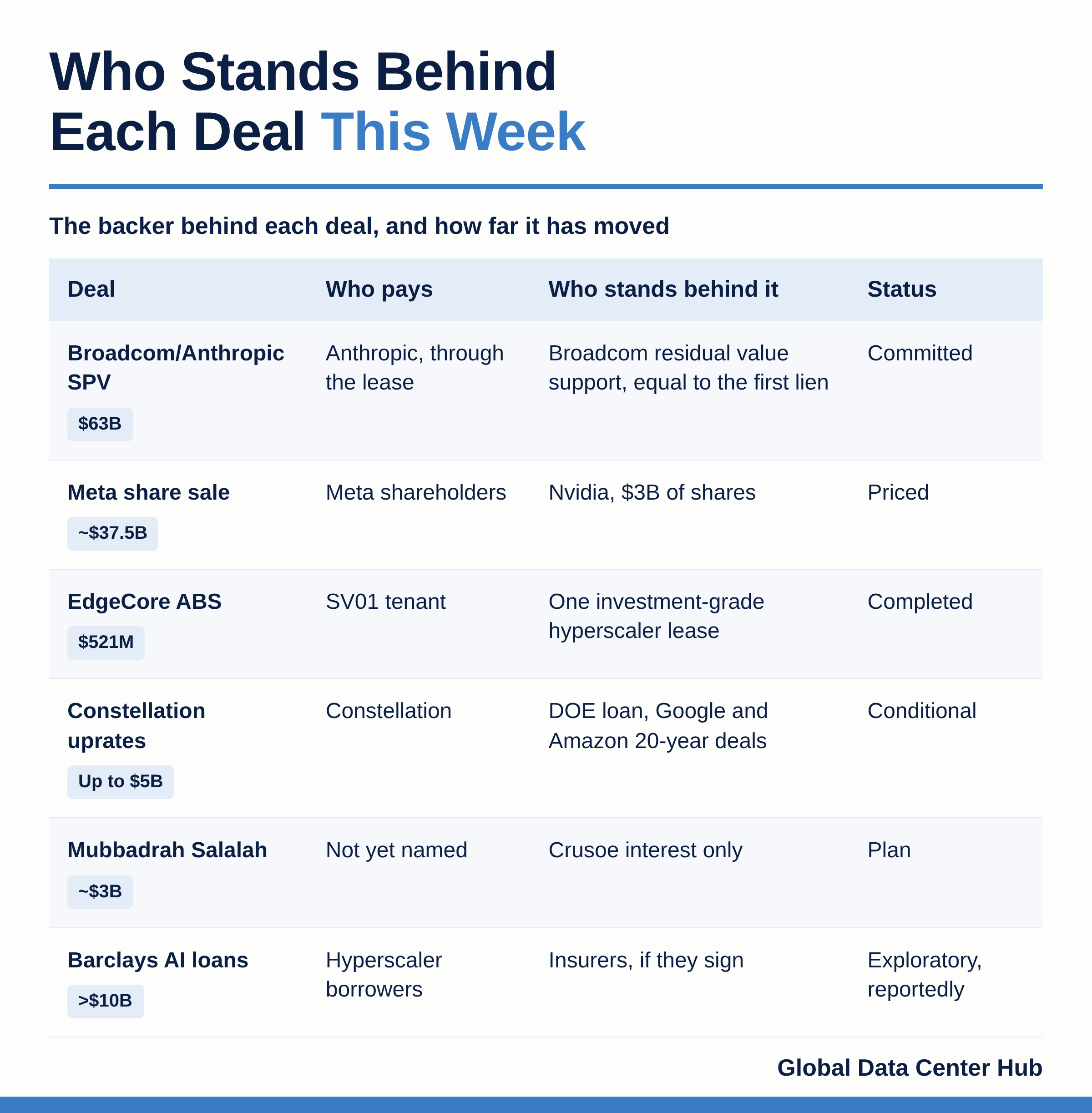
Every deal that moved this week had a stronger backer. The table sets each one against its backer and its status.
THE QUESTION FOR NEXT WEEK
Does Crusoe put its Oman interest in writing? The Mubbadrah consortium expects a signed confirmation within weeks. If it lands, Salalah has its first named AI tenant. If it slips, both Oman plans stay plans.
If you are new to Global Data Center Hub, visit our Start Here page for more information about the newsletter.
If you found this newsletter useful, share it with a colleague.
Have a great week.
- Obinna