
Welcome to Global Data Center Hub. Join investors, operators, and innovators reading to stay ahead of the latest trends in the data center sector in developed and emerging markets globally.
The $63 billion financing for Anthropic’s Broadcom chips is equipment finance, with the supplier standing behind the senior lenders.
That support lets outside capital pay for AI hardware at this scale.
The number is 72.5%. It appears in Broadcom’s SEC filing. The press release leaves it out.
What Was Announced
On October 26, Bank of America, Blackstone, Citi, and Morgan Stanley announced a $63 billion transaction to deploy AI compute capacity for Anthropic using Broadcom technology.
A newly formed special purpose vehicle will buy Broadcom XPU accelerators and networking equipment and lease that equipment to Anthropic. Deliveries are expected to start in calendar 2027.
Bank of America, Citi, and Morgan Stanley are arranging the first lien. Blackstone is the sole provider of the committed portion of the second lien.
Broadcom is providing residual value support to the vehicle for an amount equal to the first lien portion.
The release gives no tranche sizes, pricing, sites, megawatts, or chip counts. Reuters, citing two sources, put the first lien at about $43.5 billion.
How the Backstop Works
Broadcom’s Form 8-K, filed October 27, gives the formula. If the customer defaults on a lease, Broadcom owes the difference between two numbers. One is 72.5% of the outstanding amount owed on that lease.
The other is what the racks sell for at the time. Its maximum potential liability, once the racks are deployed, is about $43 billion on an undiscounted basis.
Three details change how to read that figure.
First, the support moves. It grows as racks are delivered and shrinks as the customer pays rent. So, it builds through 2027 deliveries and then amortizes.
Second, the base is the outstanding lease balance. The $63 billion headline is a different number, and the 72.5% does not apply to it.
Third, Broadcom has remedies before it pays anything. It can take over the lease, sell the racks back to the seller at a fixed price under certain conditions, or arrange a sale.
Broadcom describes the backstop as a contingent liability with a low probability of occurring. It bases that on the customer’s expected profitability and the hardware's lasting value.
That is management’s judgment. It is also the condition the whole structure depends on.
Think of a car dealer who makes the bank a promise. If the car is ever repossessed and sells for less than most of what is still owed, the dealer covers the difference.
The bank can lend more freely, because the party that knows the car best has put its own balance sheet behind the car’s value.
Why the Lenders Want the Chip Maker Behind the Racks
The open variable in any chip loan is how fast the hardware loses value. Fitch affirmed Broadcom at A- with a positive outlook on October 27.
Its model has TPU pod value falling by roughly two-thirds by the end of year two. Fitch uses that as a modeling assumption for collateral value.
That curve is the problem the 72.5% line solves. Lenders take the customer’s rent as the first source of repayment.
Broadcom’s support stands behind the gap between most of the remaining balance and what the racks fetch in a sale.
Fitch kept the rating and the positive outlook with that support built into its analysis.
It also adds part of the backstop to Broadcom’s debt in its forecasts.
The structure has a precedent with the same customer. In June, Apollo led an initial $35 billion capital solution for Broadcom’s AI platform with Blackstone and banks, supporting more than one gigawatt of Anthropic capacity.
Reuters later put Broadcom’s backstop on that earlier deal at up to $29 billion. In GDCH’s reading, the October package scales the same idea up.
The Headline Numbers Measure Different Things
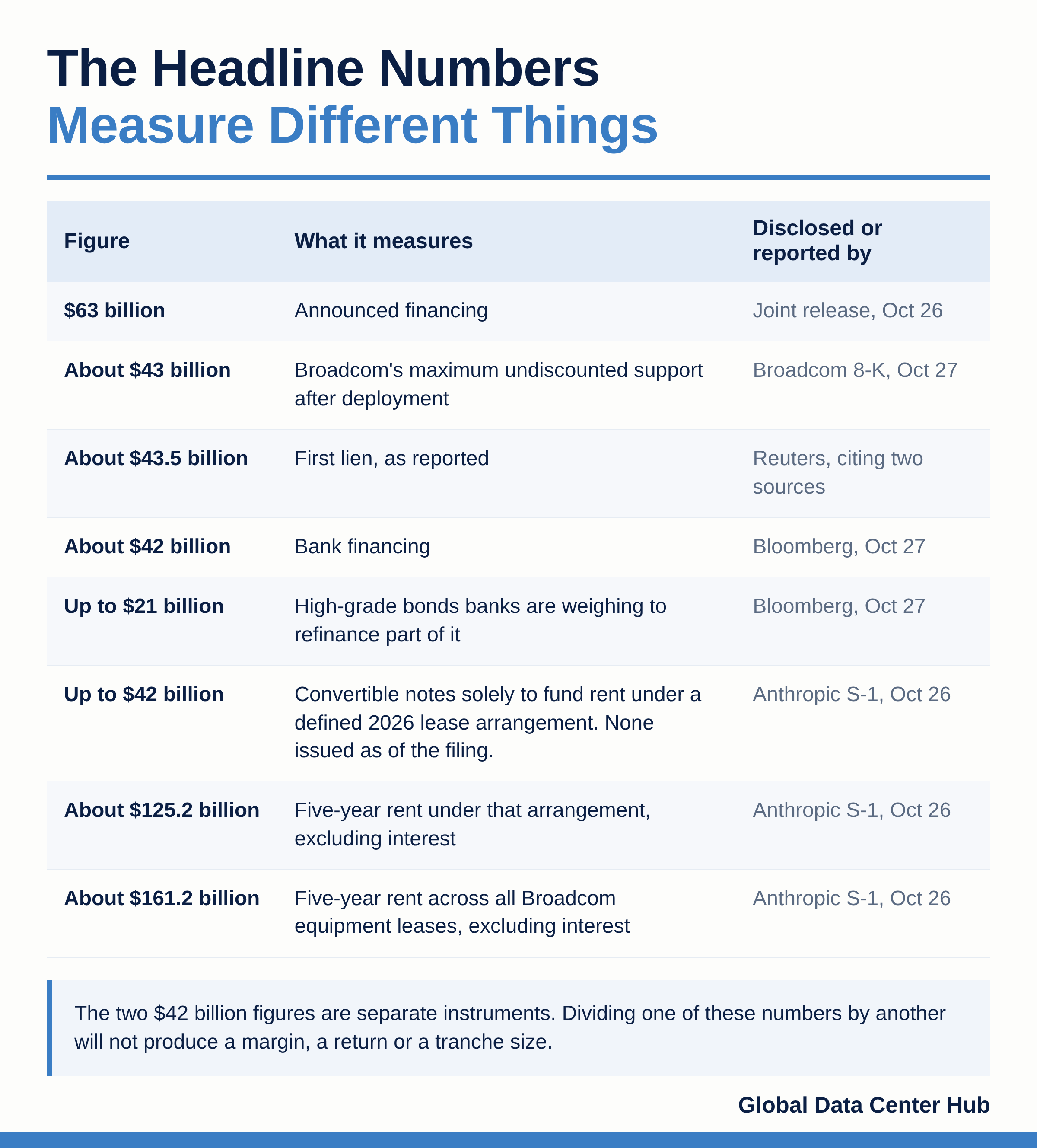
This deal comes with a stack of large figures. They describe different instruments, and they do not add or subtract.
$63 billion is the announced financing. About $43 billion is Broadcom’s maximum undiscounted support after deployment, from the 8-K. Reuters reported about $43.5 billion as the first lien. Bloomberg described the bank financing as about $42 billion.
Bloomberg also reported that banks are weighing up to $21 billion of high-grade bonds to refinance part of it, possibly in the first quarter of 2027.
Anthropic’s S-1, filed October 26, adds three more. Anthropic may issue up to $42 billion of convertible notes, solely to fund rent under a defined 2026 lease arrangement.
No notes had been issued as of the filing. Rent under that arrangement is about $125.2 billion over five years, excluding interest.
Across all its five-year Broadcom equipment leases, rent is about $161.2 billion, excluding interest.
The two $42 billion figures are separate instruments. The public record also does not confirm that the October vehicle finances the same leases the S-1 describes.
Dividing one of these numbers by another will not produce a margin, a return or a tranche size. The filings do not supply that bridge.
What the Money Does Not Reach
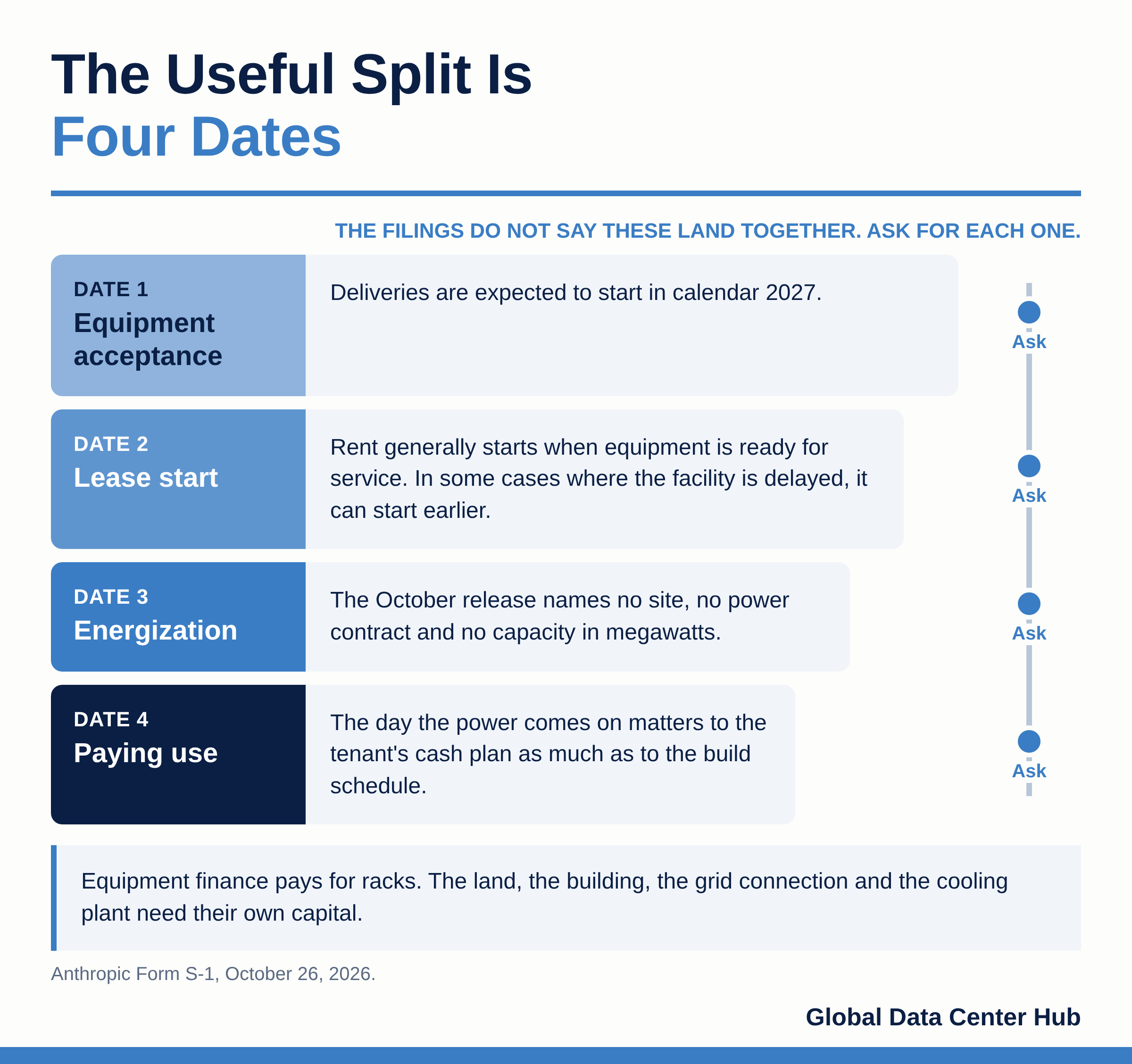
Equipment finance pays for racks. The land, the building, the grid connection and the cooling plant need their own capital.
The October release names no site, no power contract, and no capacity in megawatts.
This is the Bankability Gap at work. It is the distance between announced capacity and capacity that can secure power, financing, permits, equipment, customers, and returns.
This deal closes much of that gap for the equipment. The power and building pieces close on their own schedule, through other contracts.
Anthropic’s S-1 shows why the schedule matters. Rent generally starts when equipment is ready for service at its facility. In some cases, if the facility is delayed, rent can start earlier.
The filing also discloses restricted cash for Broadcom’s benefit and cross-default terms that can accelerate lease obligations. So, the day the power comes on matters to the tenant’s cash plan as much as to the build schedule.
For landlords and infrastructure lenders, the useful split is four dates: equipment acceptance, lease start, energization, and paying use. The filings do not say these are the same. Ask for each one.
Where the Risk Ends Up
The deal moves risk in a clear order. The customer’s rent comes first. The racks come second, as collateral.
Broadcom’s support comes third, for the senior lenders, up to its formula. Blackstone’s second lien sits below the first lien in the security order, and the release does not describe Broadcom support for that tranche.
That order can change hands. Today the senior risk sits with the arranging banks. If the bond refinancing Bloomberg described goes ahead, part of it moves to institutional bond buyers.
The equipment, the customer and the supplier support stay the same. Only the holder changes.
For data center investors, that is the real signal. Chip financing is starting to look like a market with its own buyers, separate from the buyers who fund buildings and power.
Two capital stacks now meet at one rack.
The Investment Lesson
For lenders, the backstop is only as strong as its terms. The public filings give the formula. They do not give the agreement.
That means trigger definitions, notice and cure periods, how the racks are valued, who benefits, and whether later bondholders inherit the support.
If the reported bond refinancing goes ahead, that last point decides what the new holders own.
For operators and landlords, a chip-financing headline tells you the racks are paid for.
It tells you nothing about the shell, the substation or the chillers. Test each contract where your asset meets the hardware: delivery, power-on, and rent start.
For policymakers and cross-border capital, supplier support travels only as far as the rights behind it. Repeating this model in another market would need export eligibility, software access, repossession rights, and permitted resale locations to line up.
The pattern to watch is simple. Lenders will finance AI hardware at scale when someone who knows its value stands behind it. The check to run on the next chip financing is the same: find the filing, find the percentage, find who it protects.
Then ask the question this deal leaves open. When the bank loans become bonds, does the 72.5% travel with them?