
Welcome to Global Data Center Hub. Join investors, operators, and innovators reading to stay ahead of the latest trends in the data center sector in developed and emerging markets globally.
Edition No. 78
THE WEEK’S THESIS: THE TENANT IS THE COLLATERAL
The tenant is now the collateral. Buyers paid up this week for leases signed by names they trust. Lenders pulled back from names they can’t vet. Both moves price the same thing: who sits on the other side of the contract.
Blackstone’s new data center trust bought into finished buildings because the cloud provider inside them signed a long lease. Giga Energy, ChronoScale and TensorWave each got a customer to sign before the build. In Asia, the banks behind Bridge Data Centers’ loan now want proof of who rents the chips.
The deals still waiting lack that signature. Firmus is still chasing prepayments. Oaktree has bidders for Pure DC but no winner. Microsoft has a site in Rockford but no filed plan. Ohio voters showed that even a hyperscaler’s name doesn’t buy a permit.
The structure behind Blackstone’s deal is in The Mechanism below.
MARKET SIGNALS
The biggest AI buyer goes public. Anthropic priced its IPO at $83 a share, above its $70 to $78 range, and began trading on Nasdaq on November 19. The price reportedly values the company at ~$1.5 trillion. Reuters reported that the debut failed to revive wider AI fervor. One of the largest buyers of data center capacity gets a public price every trading day, so its stock becomes a live read on whether that demand holds.
The Senate moves on permits. The US Senate passed a bipartisan bill to speed permits for energy and infrastructure projects. The bill would also require data centers to pay for the grid upgrades they need. The House has yet to vote. Faster permits help the power plants that data centers wait on. The cost clause moves grid upgrades onto the developer’s budget.
Microsoft eyes Rockford. The City of Rockford named Microsoft as the company evaluating a Monarch Energy site in south Rockford, Illinois. The campus could reach 1.4GW in phases. Monarch has put the investment at up to $12 billion. Microsoft hasn’t filed plans, and the site already holds a state incentive that needed no local approval. So the city’s new data center rules won’t fully reach it.
Ohio voters stall Amazon. Local ballot measures passed on November 3 put about $17 billion of Amazon’s planned Ohio spending at risk, the Financial Times reported. One measure, in Sunbury, bans data centers above 25MW. On new US campuses, consent comes before capital. That pushes buyers toward existing buildings.
CAPITAL WATCH
Enlight and Shemen. Nasdaq-listed Enlight Renewable Energy and Shemen Yielding Real Estate signed an agreement to develop a data center of up to 150MW at Hof Shemen in Haifa, Israel. The partners will fund bank guarantees estimated at NIS 334 million, split equally. The project company leases the land from Shemen for 25 years. The guarantees buy a place in the race for ~1,000 MW of grid capacity set aside for data centers, so the campus size depends on what the grid regulator grants.
Starwood, Molloy and Echelon. Echelon founder Niall Molloy told the Business Post he is open to a new majority owner. The Irish developer carries a rumored valuation of ~€4.5 billion. Bloomberg reported in March that Starwood and Molloy had begun a strategic review. A sale near that number would show what buyers pay for Irish power and pipeline that isn’t built yet.
Oaktree and Pure DC. GIC, teamed with Copenhagen Infrastructure Partners, and Saudi Telecom are among the final bidders for a minority stake in UK developer Pure Data Centers, Bloomberg reported. Oaktree could seek a valuation of ~$8 billion, according to one person cited. A Gulf telecom is bidding head-to-head with a Singapore wealth fund for a European developer. Binding bids are due later this month, and the winning price becomes the marker for development platforms.
GLOBAL LENS: THIS WEEK BY REGION
North America: contracts land before buildings
TensorWave signed a six-year agreement to deliver 457MW of dedicated AI infrastructure for OpenAI at US sites it hasn’t named. The capacity runs on AMD Instinct MI455X chips. Neither side disclosed the contract value or the financing. OpenAI keeps spreading its compute across more suppliers and more balance sheets. The open question is whether TensorWave can raise money for 457MW against one customer.
A Core Scientific subsidiary filed a $1.3 billion building with Texas regulators for its Hunt County campus, about 53 miles northeast of Dallas. The core-and-shell building covers 341,325 sq ft, with construction scheduled from November 2026 to September 2028. Core Scientific bought the 265-acre site in March for $232.5 million. The company has said the campus could support up to 285MW of leasable capacity. Energizing can begin in 2027, so the build now races the power ramp.
Europe: consented power changes hands
Goldacre Ventures announced the sale of an East London data center site it co-developed with Legal & General. The site has detailed planning permission, ~90MW of potential IT capacity and about 130 MVA of reserved grid power. Neither the buyer nor the price was disclosed. In London, a consented site with reserved power is the scarce asset, so the developer sold before it was built. Energization is expected within this decade, leaving the new owner with the timing risk.
Nokia, Nscale, Skeleton, Telia and Verda formed AI Gigafactory Northern, a consortium that plans to bid for one of the EU’s AI gigafactories. The plan spreads one facility across several Nordic and Baltic sites. The partners gave no cost, capacity or start date. The bid isn’t won yet and depends on the EU tender. Several sites ease the load on any one grid, but they also need several permits to line up at once.
Asia-Pacific: owners change, funding waits
Next Capital launched Dataspace, a new Australian operator built on five former Fujitsu data centers. The portfolio carries 14.5MW of stated IT capacity across four markets, with 7MW at Greystanes in western Sydney. Next Capital reportedly paid just under ~A$200 million, the Australian Financial Review reported. Growth past enterprise scale now needs new capacity in Sydney and Melbourne.
Firmus plans to raise ~US$3 billion privately through equity, debt and customer prepayments, the Australian Financial Review reported. The plan follows the company’s canceled ASX listing. Firmus reportedly wants upfront payments covering 12.5% of its contracts by year-end, with Nvidia and Meta the most advanced. Customer cash up front would let it build without new public equity. So the pace sits with two buyers’ treasuries.
South America: Brazil builds under new chip rules
Brazil’s ABL Group launched Astella, a data center unit, and opened its first site in Curitiba. The facility began operating on November 11 with 3.5MW, which can reach ~5 MW. The group plans R$300 million more across six new locations by 2028. Brazil sits inside the new US chip license rule described below. That ties Astella’s AI racks to Washington’s approvals as much as to Curitiba’s grid.
Cirion Technologies moved its data center business under a new brand, Datrix. The brand covers 12 data centers in six Latin American markets. Datrix runs as a carrier-neutral platform. A separate brand lets the data center unit be valued apart from Cirion’s network business. Any future raise or sale now has a clean perimeter to price.
CONSTRAINT OF THE WEEK: THE CHIP LICENSE
The chip license is now the bottleneck in Southeast Asia. The Commerce Department’s Bureau of Industry and Security issued a rule on November 16 that took effect on November 19. Advanced chips bound for Indonesia, Malaysia, Singapore, Thailand and Brazil now need US export licenses. Data centers anywhere also need a license to rent large blocks of compute to China-based firms. Shares in Malaysia’s MN Holdings and Critical Holdings fell nearly 20% the next day, Reuters reported.
Malaysia’s trade minister, Johari Abdul Ghani, said data center operators must comply with the US rules. Those unwilling to comply should not operate in Malaysia, he told reporters. The country has drawn nearly $100 billion of data center investment since 2021, Reuters reported. A host government now enforces a foreign chip rule, so every tenant check lands on the operator.
Citigroup and JPMorgan added terms to a potential loan of up to $6.6 billion for Bain Capital’s Bridge Data Centres, Bloomberg reported. The terms make the borrower responsible for US chip-rule compliance and could let the banks call a default on a breach. La Caisse, meanwhile, leads talks for a stake in Bridge, Reuters reported. Some bidders looked at a ~$4 billion valuation against Bain’s ~$5 billion target. The tenant list has become part of the credit file and the price.
The next bottleneck is the license queue itself. Operators have 90 days to license existing remote compute, the South China Morning Post reported. Public comments on the rule run to ~mid-January 2027. Until approvals arrive, lenders will wait for the paperwork before they fund new halls.
THE MECHANISM
The cloud provider sells the building and keeps the use
Blackstone Digital Infrastructure Trust (BXDC) is a Blackstone-managed REIT that listed in May. It buys finished data centers and leases them to cloud providers on long contracts. Its first deal, signed November 16, buys control of two joint ventures with AWS. The ventures own 13 newly built powered shells with 647MW of IT capacity. Nine buildings sit in northern Indiana, in the greater Chicago market, and four in Mississippi.
The portfolio carries a gross value of $5.0 billion at a 7.0% initial cap rate. The trust takes 75.1% under its Form 8-K, which the press release rounds to 75%. The cloud provider keeps 24.9% and leases back every building on a triple-net basis. The initial term is 12 years, extendable to 32. The tenant pays taxes, insurance and maintenance.
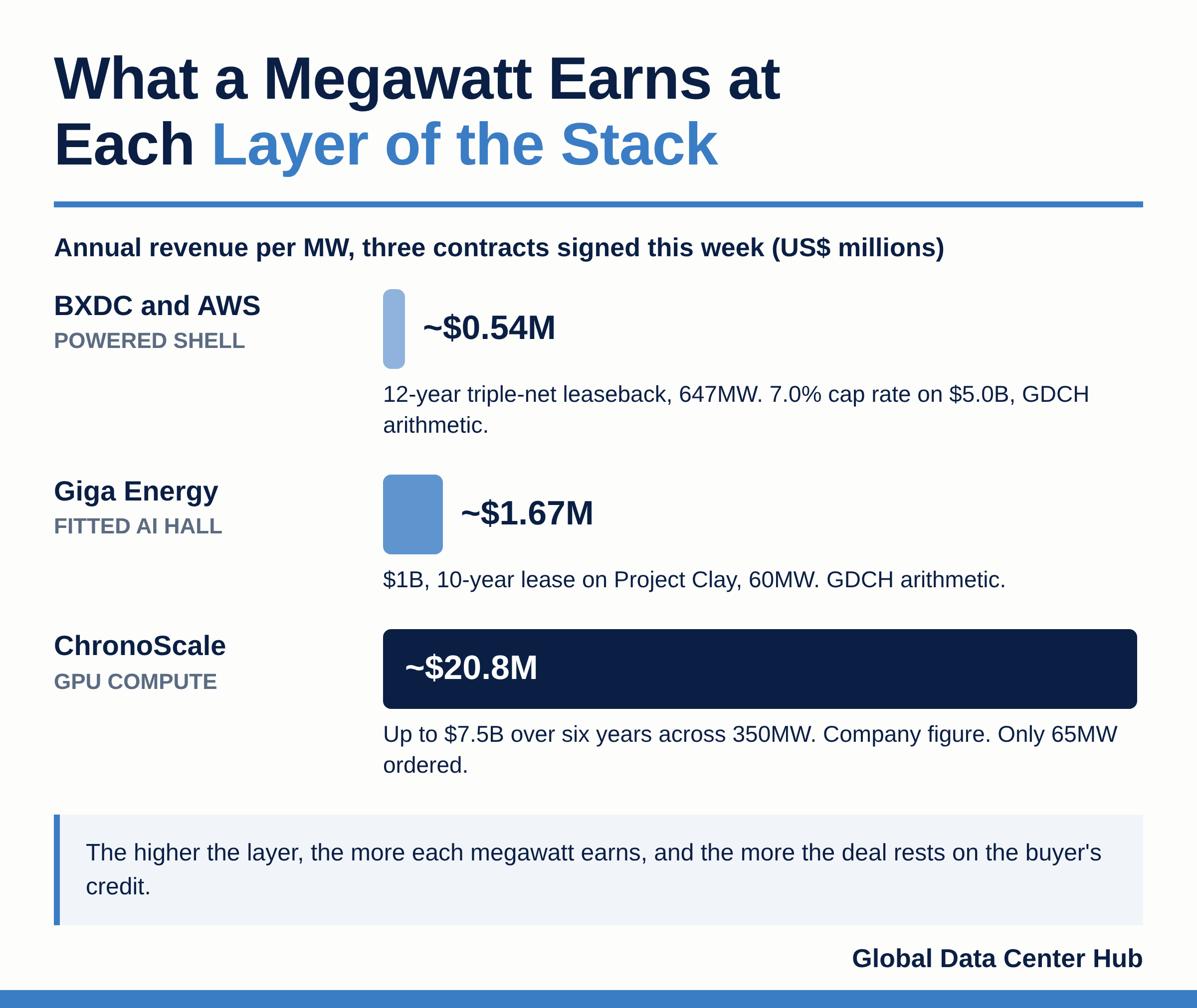
The trust funds its share with ~$1.9 billion of IPO proceeds. The ventures add ~$2.5 billion of non-recourse mortgage debt, about half the gross value. Closing is expected in the fourth quarter, with an outside date of December 31. The cap rate implies ~$350 million of first-year income, or ~$0.54 million per MW. Cash comes back to the seller now, and it keeps the power, the use and a quarter of any upside.
The disclosures don’t show rent escalators or year 12 rent. The equity case rests on one tenant still wanting these shells in 2038.
I read this as a hyperscaler selling the shell and keeping everything that earns. What I’d press on is the renewal, because a 12-year term on 2026 buildings leaves the trust holding the residual. I’m watching for the closing 8-K before December 31 and the mortgage lenders' names.
NOTABLE TRANSACTIONS
ChronoScale: $780 million Odessa partnership and up to $750 million in new financing
ChronoScale Holdings and STN, Inc. formed a 50/50 partnership to develop the company’s Odessa, Texas campus. Each side contributes $390 million, subject to HSR clearance. The company also arranged up to $750 million, split between $250 million of equity and up to $500 million of convertible preferred. Definitive agreements are signed, and closing was expected on November 18.
What makes it notable is the revenue math. The customer, an unnamed frontier AI lab, has ordered a 65MW first phase for the first half of 2027. Total contract value could reach $7.5 billion over six years across 350MW. That works out to ~$20.8 million of annual revenue per MW, blended, per the company.
Phase 1 is backed largely by credit support from an investment-grade technology company. Phases 2 and 3, 285MW in total, have no customer commitment yet. Without them, the company says, contract value would be substantially lower. The frontier lab also invested, alongside Nutanix and Empery Digital.
Watch the Phase 2 order. Until it arrives, the $7.5 billion is a ceiling. The convertible draws set the real funding pace.
Giga Energy: $1 billion, 10-year lease on Project Clay
Giga Energy signed a $1 billion, 10-year lease for Project Clay, a 60MW AI data center in Hunt County, Texas. The tenant is an undisclosed US AI cloud provider. The developer will build, own and operate the ~30-acre campus. Construction began in July, with service due in spring 2027.
What makes it notable is the speed. The company makes its own electrical equipment at factories in Long Beach and Houston. It says the build will finish in under eight months, less than half the usual time.
The lease works out to ~$1.67 million per MW per year. Closed-loop cooling keeps local water use near that of two homes. It says it has delivered over 7GW of electrical infrastructure. The project's financing wasn’t disclosed.
The next document is the debt package. The lease is the collateral, and lenders will want the hidden tenant’s name.
HIIF: 23% stake in Data4 Greece
The Hellenic Innovation & Infrastructure Fund acquired a 23% minority stake in Data4 Greece, under an agreement signed on November 16. HIIF is the investment arm of the Hellenic Growth Fund. The price wasn’t disclosed. The stake supports Data4’s Athens campus in Paiania.
What makes it notable is that HIIF made its first digital infrastructure investment in a building that’s already full. DC01, at 15MW, is fully contracted to a major international technology company under a long-term agreement.
Phase 1 of DC01 went live in July 2026. Phase 2 is due in 2027. The Paiania campus has two data centers and up to 90MW of IT capacity, with more than €300 million of total investment.
The second building is the real test. Public money came in behind a signed tenant, and the rest of the campus needs one too.
THE FRAMEWORK: WHAT A MEGAWATT EARNS
Three contracts this week put a price on a megawatt at three layers of the stack. The higher the layer, the more each megawatt earns and the more the buyer’s credit carries the deal.
THE QUESTION FOR NEXT WEEK
Does La Caisse sign for Bridge Data Centers? Reuters reported a deal could be signed in the coming weeks. A signature with the banks’ chip clause in place would set the first price for a Southeast Asian platform under the new license rule.
If you are new to Global Data Center Hub, visit our Start Here page for more information about the newsletter.
If you found this newsletter useful, share it with a colleague.
Have a great week.
- Obinna