

Wishing our U.S. readers a happy Thanksgiving weekend.
Welcome to Global Data Center Hub. Join investors, operators, and innovators reading to stay ahead of the latest trends in the data center sector in developed and emerging markets globally.
Edition No. 79
THE WEEK’S THESIS: THE CONTRACT SETS THE PRICE
Money went to contracts that can’t walk away this week, and it marked down every contract that can. Length and credit decided the terms. Size didn’t.
Applied Digital signed a long lease with an investment-grade tenant, and three layers of capital lined up behind it before a single megawatt is live. The SpaceX chip notes priced bigger than first planned. Blue Owl’s trust bought a fully leased Virginia building and borrowed most of the price against that lease.
The weak contracts got the opposite treatment. Either side can cancel Anthropic’s reported compute deal with xAI on short notice. HSBC sold part of a loan at a discount after Oracle reserved the right to delay payments. Buyers of Stack’s Asia-Pacific portfolio now want to hold back part of the price until projects deliver.
The structure behind Applied Digital’s deal is in The Mechanism below.
MARKET SIGNALS
Aurora says not now. Aurora’s City Council passed a yearlong temporary moratorium on new data centers on Monday, so Colorado’s third-largest city can write rules. At the same meeting, the mayor said Vantage Data Centers had dropped its planned 500MW Trident campus. One council vote took a hyperscale project off the map. Local consent has become a timing risk that comes before power.
Oracle says the OpenAI build is funded. Oracle said on November 20 that it has all the money it needs to deliver its OpenAI infrastructure contract. It pointed to a final capital raise earlier this month, reportedly ~$20 billion, and to vendor financing it says is already in place. The statement settles who funds the build. It doesn’t settle whether the customer pays on time.
Anthropic rents from xAI, reportedly. The New York Times reported that Anthropic pays xAI ~$3.1 billion a month under a cluster-rental agreement. Either side can cancel either contract on 90 days’ notice, according to the report. None of the companies commented. The largest compute contracts in the market are short-notice rentals, and no lender can finance 90 days the way it finances 18 years.
CAPITAL WATCH
HSBC and Project Jupiter. HSBC sold a ~$300 million slice of the $18 billion construction loan for Project Jupiter in New Mexico at mid-80s prices, Bloomberg reported. The sale followed a force majeure notice from Oracle that would let it defer payments if the campus is delayed. ING is reportedly seeking buyers for $25 million of the same debt. A price near 85 cents puts a public number on what a tenant’s right to delay costs a lender.
BlackRock, IFM and Stack’s Asia-Pacific portfolio. A BlackRock-led consortium with IFM Investors is weighing a lower offer for Stack Infrastructure’s sites in Japan, Australia and Malaysia, Bloomberg reported. Earlier reports put the value of the Blue Owl Capital-held portfolio at about $20 billion to $25 billion. The buyers reportedly want part of the payment tied to project delivery. An earn-out would push delivery risk back to the seller and set the terms for other Asian sales.
GLOBAL LENS: THIS WEEK BY REGION
North America: land and platforms change hands
Since late last year, Switch has bought 610 acres around Las Vegas for about $501.7 million, property records show. Most of it sits in the Apex Industrial Park, at roughly $820,000 an acre. The company has filed plans with North Las Vegas for two data center buildings on part of that land. Switch is paying up for land years before the buildings exist. Nobody has said yet where the power for those two buildings comes from.
KKR’s Helix Digital Infrastructure is in talks to buy a majority stake in Partners Group-backed EdgeCore, Bloomberg reported. One person put EdgeCore’s value as a business at ~$8 billion to ~$10 billion. That range values the whole business, and the parties have agreed no deal. The talks could still end without a transaction. If they close near that range, it sets a fresh mark for what a developer platform is worth before its campuses are full.
Europe: small checks on big grid allocations
Frux Capital, a Spanish private debt manager, is lending nearly €20 million (~US$21.9 million) to Proxity Data Centers through a private bond. The bond runs for two years with a one-year extension option. Proxity will draw it in stages for land, environmental and planning work, and site infrastructure at Loures, north of Lisbon.
The campus’s first phase already has a grid allocation of more than 100MW. This is short, expensive money backing a grid allocation, and it needs a tenant before the term runs out.
Vertical Data sold 95% of its Hamre project company in Sollefteå, Sweden, to a joint venture with affiliates of an unnamed global private equity firm. The project holds 4.7MW and is applying for up to 100MW, subject to grid availability and approvals.
Vertical Data bought the property in September for about $6.2 million, has received about $5.8 million in cash, and keeps 5%. The private equity buyer is paying for a grid application. Whether that pays off rests on the grid operator’s answer on the 100MW.
Asia-Pacific: owners consolidate control
ePLDT, PLDT's technology arm, agreed to buy out its partners in the A-FLOW data center joint venture in Biñan, Laguna. Under a memorandum of agreement, it will take all the shares held by AyalaLand Logistics and Flow Digital Infrastructure in the two A-FLOW companies. The campus can reach up to 48MW. Neither side disclosed the price. PLDT’s arm now owns the campus outright, and the price remains undisclosed.
Heptamax International, a Singapore-listed industrial automation and advisory company, agreed to buy Racks Central for an initial S$500 million (~US$387.6 million) in shares. The deal is a proposed reverse takeover, signed on November 18. Racks Central runs an 8MW data center in Singapore and has potential access to projects in Malaysia. That’s ~S$62.5 million per megawatt, paid in new shares. The shareholder circular has to explain how much of that rests on the Singapore site and how much on Malaysia.
CONSTRAINT OF THE WEEK: THE GRID SENDS THE BILL
The grid has started sending its bill to the data center. The Senate passed the Bipartisan American Affordability and Jobs Act 62–33 on November 19. The bill sets a national policy that data centers pay their full costs. It gives FERC 90 days to issue a policy statement and applies to every data center, with no minimum size. Grid upgrades become a cost line in every new lease.
PJM Interconnection filed a plan with FERC to cut the time it takes to study data center connections to 12 months from 24. The plan would study power plants and transmission upgrades at the same time. Reuters reported that the plan may require data centers to pay a larger share of grid costs. The region faces a ~6.8 GW supply shortfall, according to the same report. Faster hookups are on offer, and data centers pay for the speed.
Chaince Digital and Bit Lake signed a binding framework for a 60/40 joint venture building an AI data center in Big Lake, Texas. AEP Texas still has to confirm in writing that it can serve Phase 1, which is 5MW, with potential to scale to 25MW. Phase 3 depends on the utility approving a pending interconnection application, and either side can walk if definitive documents aren’t signed within 90 days. The next bottleneck is that utility letter. More projects stall there than at the permit.
THE MECHANISM
Eighteen years of rent, funded before the power arrives
Applied Digital builds and leases large data center campuses for AI and cloud tenants. On November 23 it signed a 150MW, 18-year lease with an unnamed tier-one, investment-grade hyperscaler. The base term is worth about $5.4 billion. With every renewal option exercised, the lease runs 33 years and reaches about $12.7 billion.
The money arrives in three layers. Applied Digital has already funded the first equity from its balance sheet. Next comes a $5 billion equity partnership with Macquarie Asset Management. Project debt secured by the lease comes last. Every layer rests on the signed lease.
The cash timing runs the other way. Delivery is expected to start in the first half of 2028, subject to development milestones, utility arrangements, and regulatory approvals. Until then, Applied Digital and its partners carry the build cost with no rent coming in. The company says the lease has higher pricing than its earlier ones. The base term works out to ~$167 per kilowatt per month.
The portfolio behind it has grown large. Contracted base-term lease revenue tops $41 billion across more than 1.6GW of critical IT load. About 75% of that revenue comes from investment-grade tenants. That tenant mix is what lets the company raise capital ahead of revenue.
The weak point is what the filing leaves out. It names neither the tenant nor the campus. The filing asks lenders to price a credit they can’t see, on a site the market can’t check.
I’m watching whether the tenant’s name ever reaches a filing. I’d press hardest on the utility arrangements, because the rent starts only when the power does. Watch the project financing for Delta Forge 1 and Polaris Forge 3. Applied Digital expects it in the first quarter of 2027.
NOTABLE TRANSACTIONS
Blue Owl Digital Infrastructure Trust: $779.5 million Gainesville data center purchase
Blue Owl Digital Infrastructure Trust bought a 54MW data center in Gainesville, Virginia, for about $779.5 million. The deal closed on November 10. The seller was US GCDC Phase 3 Holdings LP. The building is 100% leased to an unnamed hyperscaler.
What makes it notable is how much of the price the lease carried. The trust took a ~$512.6 million floating-rate mortgage. That’s roughly two-thirds of the purchase price. A fully leased building let a non-traded trust borrow like a stabilized landlord on day one.
Citibank and Wells Fargo made the loan. It pays one-month Term SOFR plus 2.00% until November 9, 2027, then 2.25%. The loan matures in December 2028, with one 12-month extension at 2.50%. The trust’s operating partnership gave a non-recourse guaranty.
Citigroup is reportedly arranging a ~$513 million commercial mortgage bond sale backed by the building, Quartz reported. Watch whether that bond prices. If it does, one hyperscale lease becomes tradable paper within weeks of closing.
Apollo and Goldman Sachs: ~$44 billion SpaceX GPU notes
Apollo and Goldman Sachs priced about $44 billion of senior and subordinated notes on November 20. The money buys GPUs and related equipment for SpaceX. The chips are Nvidia Vera Rubin, for the company’s buildout on Earth. The firms called it the largest GPU financing executed to date.
What makes it notable is that the deal grew. The release says investor demand oversubscribed the notes, so the arrangers upsized them. The release doesn’t give the starting size. Demand for chip-backed debt outpaced supply.
The two arrangers' funds committed to the financing. BlackRock, Goldman Sachs Asset Management and accounts advised by KKR provided anchor commitments. Goldman was the sole structuring agent. Yields reportedly run as high as ~8.36%.
The lease schedules begin when the GPUs are delivered, expected in the first half of 2027. The release covers pricing only and reports no closing. The first delivery date tests whether chips can carry debt the way buildings do.
Cogent: $35 million sale of three data centers to Saragon
Cogent agreed to sell three data centers in Omaha, Tacoma, and Cheyenne for $35 million in cash. The buyer is Saragon Infrastructure, owned by I Squared Capital. Closing is expected in the first quarter of 2027.
What makes it notable is the seller’s cost basis. The sites began as switching stations on Sprint’s long-haul fiber network, built in the 1980s and 1990s. After T-Mobile bought Sprint, the company bought the network and sites in 2022 for $1.
Saragon launched earlier this year with ten sites bought from the same seller for $225 million. Those sites hold about 53MW of installed power across nine US markets. The company planned to sell or lease its 24 largest sites wholesale. It keeps a small part of each for its own network.
Watch how many of the remaining large sites go to Saragon. Each sale turns an old telecom building into cash for the seller, and into power-ready capacity for an operator.
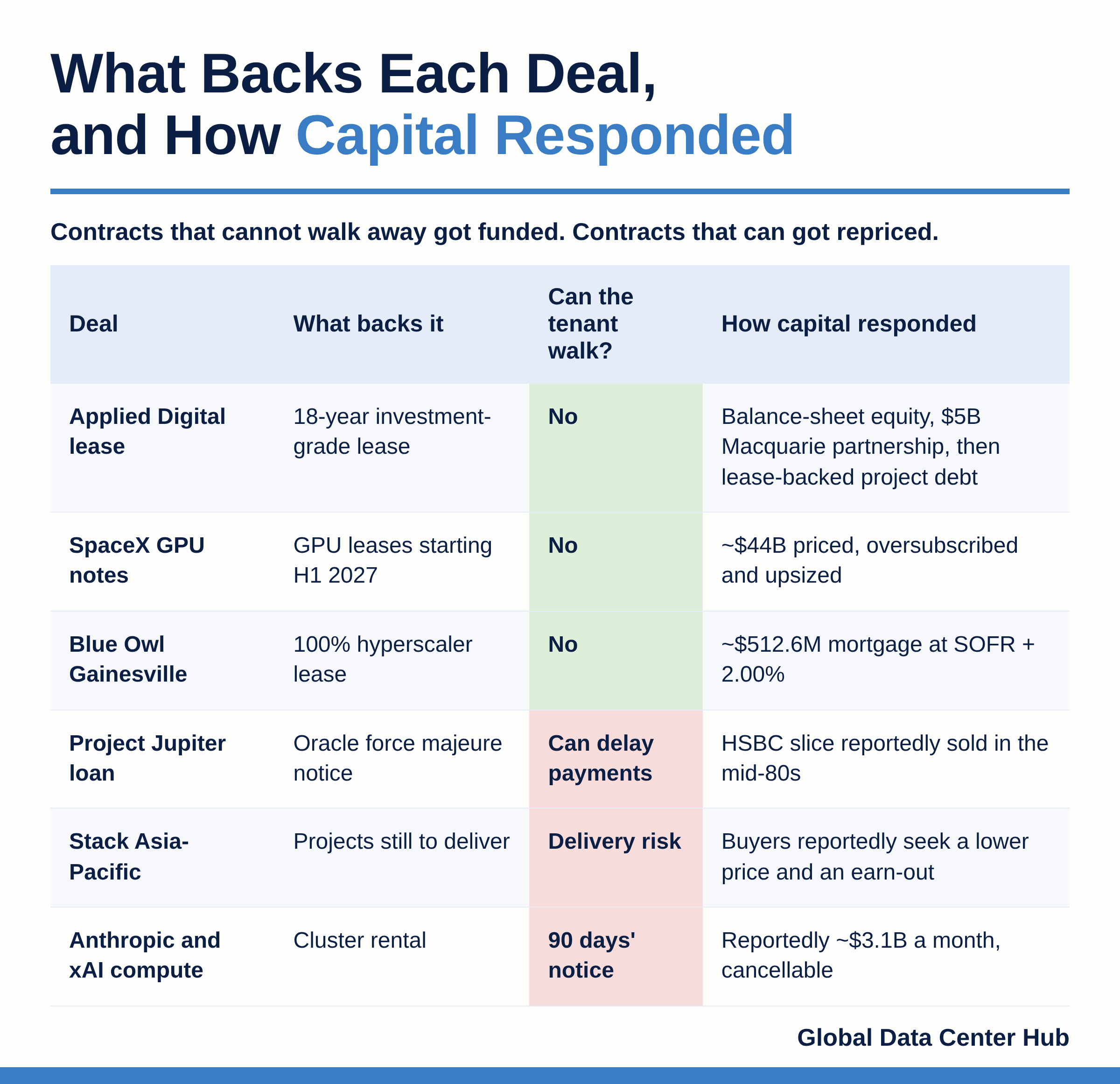
THE FRAMEWORK: WHAT BACKS EACH DEAL
The deals that got funded this week rest on contracts that can’t be canceled early. The ones that got repriced rest on contracts that can.
THE QUESTION FOR NEXT WEEK
Will the House pass the Senate’s permitting bill without changes after the Thanksgiving recess? Speaker Mike Johnson plans to try a suspension vote first, which needs two-thirds and allows no amendments. Any House change sends the bill back to the Senate, and a year-end finish gets much harder.
If you are new to Global Data Center Hub, visit our Start Here page for more information about the newsletter.
If you found this newsletter useful, share it with a colleague.
Have a great week.
- Obinna
The 90-day clause is a grid problem before it is a credit problem. A campus can cancel on a quarter's notice, but the substation and the interconnection sized for it are planned years ahead, and the load forecast behind them does not come down when the contract does. Lenders can mark the paper down; a transmission plan has no equivalent move.