

Welcome to Global Data Center Hub. Join investors, operators, and innovators reading to stay ahead of the latest trends in the data center sector in developed and emerging markets globally.
The Number Is Not The Signal
Amazon did not commit $33 billion to Southeast Asia on May 21.
It aggregated four pledges it had already made over three years into a single regional headline.
The market read the figure as a fresh capital event.
The figure is a packaging decision, and the decision to package now is the actual signal.
When a hyperscaler converts scattered country commitments into one bloc-level number at a policy summit, it is not announcing capital.
It is positioning for a regulatory contest it expects to intensify.
Consolidation Timing Reveals A Defensive Posture
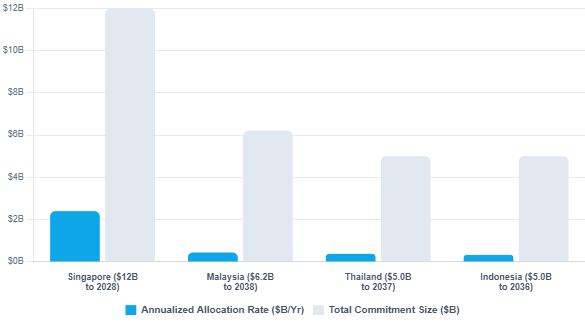
The four pledges underlying the $33 billion were announced separately between 2021 and 2024.
Singapore’s incremental program runs to 2028, Thailand’s to 2037, Malaysia’s to 2038, and Indonesia’s across a 15-year horizon. None of these is new.
What is new is the decision to present them as a unified blueprint at Asia Tech x Singapore, a policy-and-regulation venue rather than a customer or product event.
Amazon chose the regulatory stage to restate old capital as regional scale.
This is the move of an incumbent defending position, not a challenger deploying fresh money.
The next 12 to 24 months will test whether competing hyperscalers respond with their own consolidated bloc numbers, which would confirm that committed-footprint scale has become the competitive currency in ASEAN.
The Sovereign-By-Design Frame Is The Real Product
Zapolsky’s remarks reframed sovereignty as programmatic control rather than provider nationality.
This is the substance beneath the capital headline.
As ASEAN governments tighten data residency rules and pursue sovereign AI strategies, the binding risk for a foreign hyperscaler is regulatory exclusion, not insufficient capital.
Amazon is underwriting against that risk by embedding itself in the ASEAN Digital Economy Framework Agreement process and positioning AWS as a co-architect of cross-border data rules rather than a compliance target.
The $33 billion number is the credential that buys a seat at that table.
Capital scale is being deployed as political access, and the access is the asset.

Investor Action
Private capital should recalibrate how it benchmarks hyperscaler commitments in emerging markets. A consolidated bloc announced at a policy summit is not equivalent to a single site deployment and treating it as fresh demand inflates absorption assumptions that underpin regional data center development models.
Public markets invesotrs should read the consolidation as a signal about competitive defense, not expansion. The structural question for anyone holding hyperscaler equity or evaluating sector exposure is whether committed-footprint scale now functions as a regulatory moat in markets pursuing data localization.
If it does, the hyperscaler with the deepest committed regional footprint compounds an advantage that is political as much as commercial.
Position for the second-order effect: competing providers will be pressured to match the bloc-scale framing, and the capital that follows will be defensive, not growth-driven.
Operators should calibrate against the power constraint the headline obscures. The $33 billion cannot deploy without grid capacity, and Thailand alone implies quadrupling operational capacity within three years against extended lead times for high-voltage transformers and switchgear.
The Verdict
The $33 billion headline marks the moment hyperscaler competition in ASEAN shifted from capital deployment to regulatory positioning.
The bloc that becomes the world’s fourth-largest economy will not be won by whoever spends the most.
It will be won by whoever embeds deepest in the rules that govern where data sits and which models run.
Amazon has declared that committed-footprint scale is now the entry ticket to that contest.
The open question is whether scale of footprint actually converts to regulatory influence, or whether ASEAN governments extract the capital and write the sovereignty rules on their own terms anyway.
That answer decides whether the next decade of hyperscaler capital in the region earns a moat or merely funds someone else’s digital sovereignty.