
Welcome to Global Data Center Hub. Join investors, operators, and innovators reading to stay ahead of the latest trends in the data center sector in developed and emerging markets globally.
Alphabet announced a plan to raise up to $80 billion in new equity during 2026 to fund artificial intelligence and data center expansion.
The capital is being raised across a private placement, underwritten public offerings, and an at-the-market program.
Proceeds are designated for general corporate purposes with explicit emphasis on capital expenditures for AI infrastructure, data centers, and global compute capacity.
The announcement was made on June 1, 2026.
The Three Funding Channels
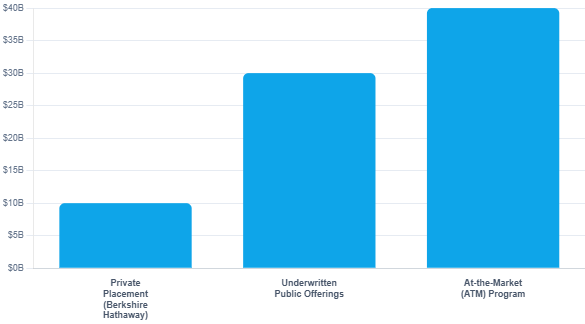
The $80 billion is structured across three distinct issuance programs rather than a single block.
A $10 billion private placement goes to Berkshire Hathaway, split between Class A and Class C shares.
Approximately $30 billion comes through underwritten public offerings, divided between depositary shares tied to mandatory convertible preferred stock and common equity in Class A and Class C form.
The remaining $40 billion runs through an at-the-market program for Class A and Class C shares, expected to begin in the third quarter of 2026.
Goldman Sachs acts as placement agent on the Berkshire leg.
Goldman Sachs, JPMorgan, and Morgan Stanley serve as joint bookrunners on the underwritten public offerings.
Berkshire Hathaway Anchor Terms
Berkshire Hathaway’s $10 billion is structured as two equal tranches.
Five billion dollars is allocated to Class A shares at approximately $351.81 per share.
Five billion dollars is allocated to Class C shares at approximately $348.20 per share.
Both tranches are priced slightly below the prior closing market prices.
The investment is incremental to a stake Berkshire began building in Alphabet in the third quarter of 2025, which had grown to roughly $20 billion in market value before this transaction.
Capex Context And Capital Stack
Alphabet had already lifted its 2026 capital expenditure guidance by approximately $5 billion, to a range of roughly $180 billion to $190 billion, tied to AI infrastructure and custom silicon.
The company is choosing equity over incremental leverage, citing the objective of maintaining a healthy balance sheet while funding the capex program.
Its mix of common equity, mandatory convertible preferred stock, and at-the-market issuance spreads pricing and market-timing risk across multiple instruments rather than concentrating it in a single overnight block.
The at-the-market program gives Alphabet the option to match future issuance against the cadence of its AI infrastructure commitments through the second half of 2026.
𝗔𝗹𝗽𝗵𝗮𝗯𝗲𝘁’s 𝗹𝗮𝗿𝗴𝗲𝘀𝘁 𝗲𝗾𝘂𝗶𝘁𝘆 𝗿𝗮𝗶𝘀𝗲 𝗶𝗻 𝗰𝗼𝗿𝗽𝗼𝗿𝗮𝘁𝗲 𝗵𝗶𝘀𝘁𝗼𝗿𝘆 of $𝟴𝟰.𝟳𝟱 𝗯𝗶𝗹𝗹𝗶𝗼𝗻, 𝘂𝗽𝘀𝗶𝘇𝗲𝗱 𝗳𝗿𝗼𝗺 $𝟴𝟬𝗕 𝘁𝘄𝗼 𝗱𝗮𝘆𝘀 𝗲𝗮𝗿𝗹𝗶𝗲𝗿, at about 2% of Alphabet's $4.34T market cap, funds under six months of the company's $180–190B 2026 capex. The largest equity offering ever assembled covers less than half a year of one company's AI buildout.
Its equity issuance is a testament to the buildout now exceeding what even the best cash flow and the cheapest debt can fund without dilution; for the levered tiers it is the difference between refinancing and not.
Alphabet had already raised over $85B of debt in the past year, including a 100-year bond, pushing total debt past $100B of bonds issued in 2026, with buyers demanding record credit-default protection against it.
If the apex issuer has to reach for dilutive equity, and upsize it into the demand, the tiers beneath it face the same arithmetic with far less cushion.
Neocloud and single-asset structures carry higher coupons, thinner equity, and credit that often rests on a single offtaker contract, and they are benchmarked to a long end that just touched 5.19% on the 30-year Treasury, its highest since 2007.
This is the whole sector. The four largest US hyperscalers are on track to spend close to $725 billion of capex in 2026, up about 36% year over year, with roughly three-quarters tied to AI infrastructure and capital intensity running at an unprecedented 45 to 57% of revenue.
Watch whether Meta and Microsoft follow with equity of their own.
I think Berkshire Hathaway’s rising investment is notable given its being recently famous for just increasing its cash holdings.