
Welcome to Global Data Center Hub. Join investors, operators, and innovators reading to stay ahead of the latest trends in the data center sector in developed and emerging markets globally.
The AI Build Has Outgrown Its Own Cash Flow
For three years the AI infrastructure race was framed as a spending contest.
Each quarter the question was how much the hyperscalers would put into data centers, chips and networking, and each quarter the totals went up.
Underneath sat a quiet assumption: the biggest companies could pay for it themselves.
Their core businesses threw off enough cash to cover the build and still return money to shareholders.
That assumption is now breaking at the company where it looked safest.
Alphabet generated $42.3 billion of operating cash flow in the third quarter and spent $51.4 billion on capex.
The gap was filled from outside, with bonds, common stock and convertible preferred.
Demand is not the limit. Alphabet is renting third-party compute to bridge what management called a “supply-constraint environment.”
Capacity is short, and the cost of adding it has moved onto the balance sheet.
The CFO also named energy, alongside depreciation, as a rising cost line. That makes Q3 2026 a funding story first and an earnings story second.
The Miss Was a SpaceX Mark. The Cash Problem Was Not.
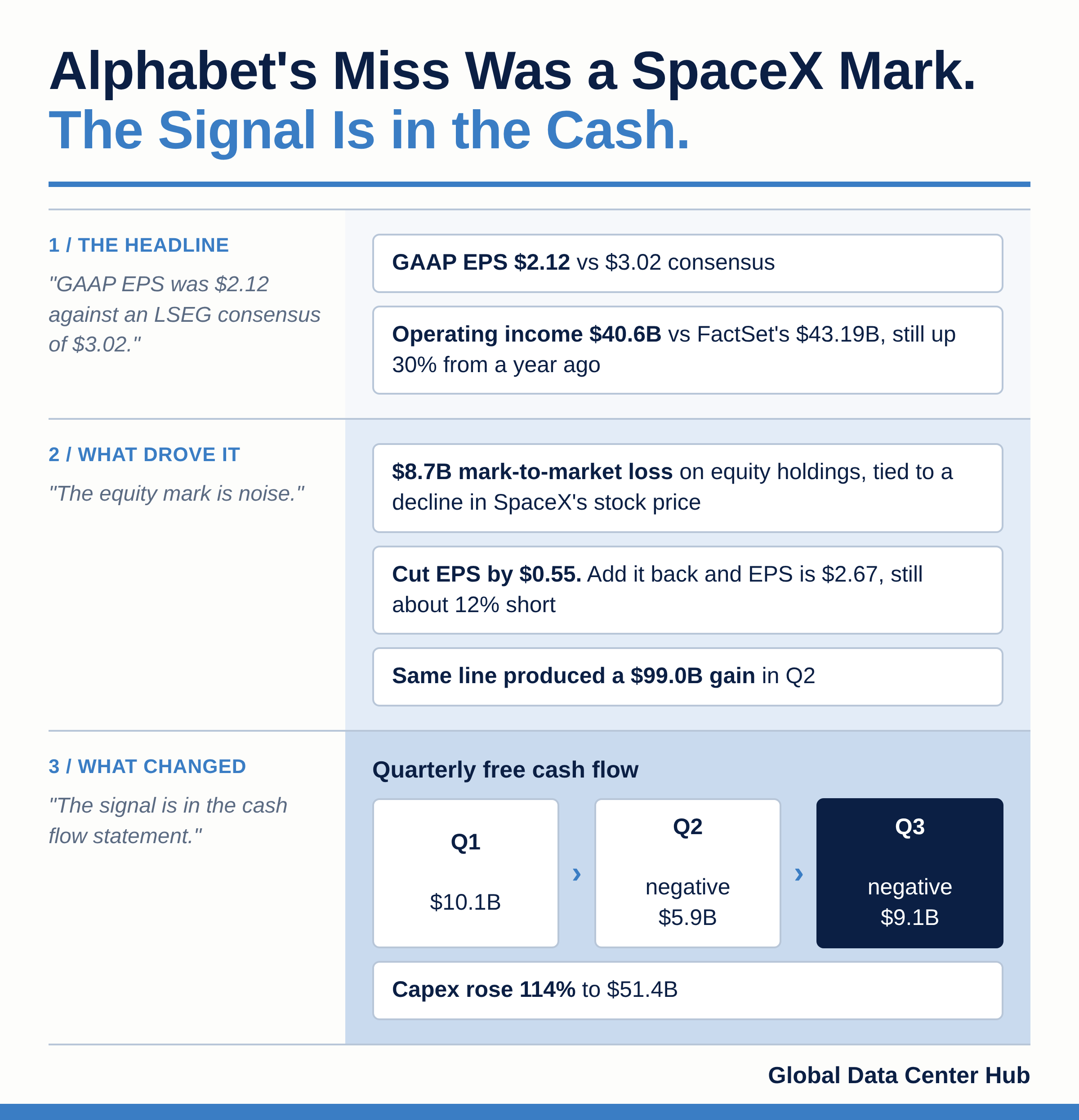
GAAP EPS was $2.12 against a consensus of $3.02. The company’s footnote says an $8.7 billion mark-to-market loss on equity holdings, tied to a decline in SpaceX’s stock price, cut EPS by $0.55. Add that back, and EPS is $2.67, still about 12% short.
Operating income of $40.6 billion also missed FactSet’s $43.19 billion, even though it rose 30% from a year ago.
The equity mark is noise, but it is noise Alphabet now carries every quarter. The same line produced a $99.0 billion gain in Q2.
With $90.4 billion of marketable equity securities on the balance sheet, and SpaceX and Anthropic valuations driving the swings, GAAP earnings will keep moving on events outside the business.
The signal is in the cash flow statement. Quarterly free cash flow went from $10.1 billion in Q1 to negative $5.9 billion in Q2 and negative $9.1 billion in Q3.
Operating cash flow fell 12.6%, pulled down by a TPU inventory build and a $5.2 billion payment of a 2018 EC fine.
Capex rose 114%. Trailing-twelve-month free cash flow is down to $19.7 billion. The stock fell 12.6% the next day.
Cloud Doubled, and Part of the Growth Is Hardware
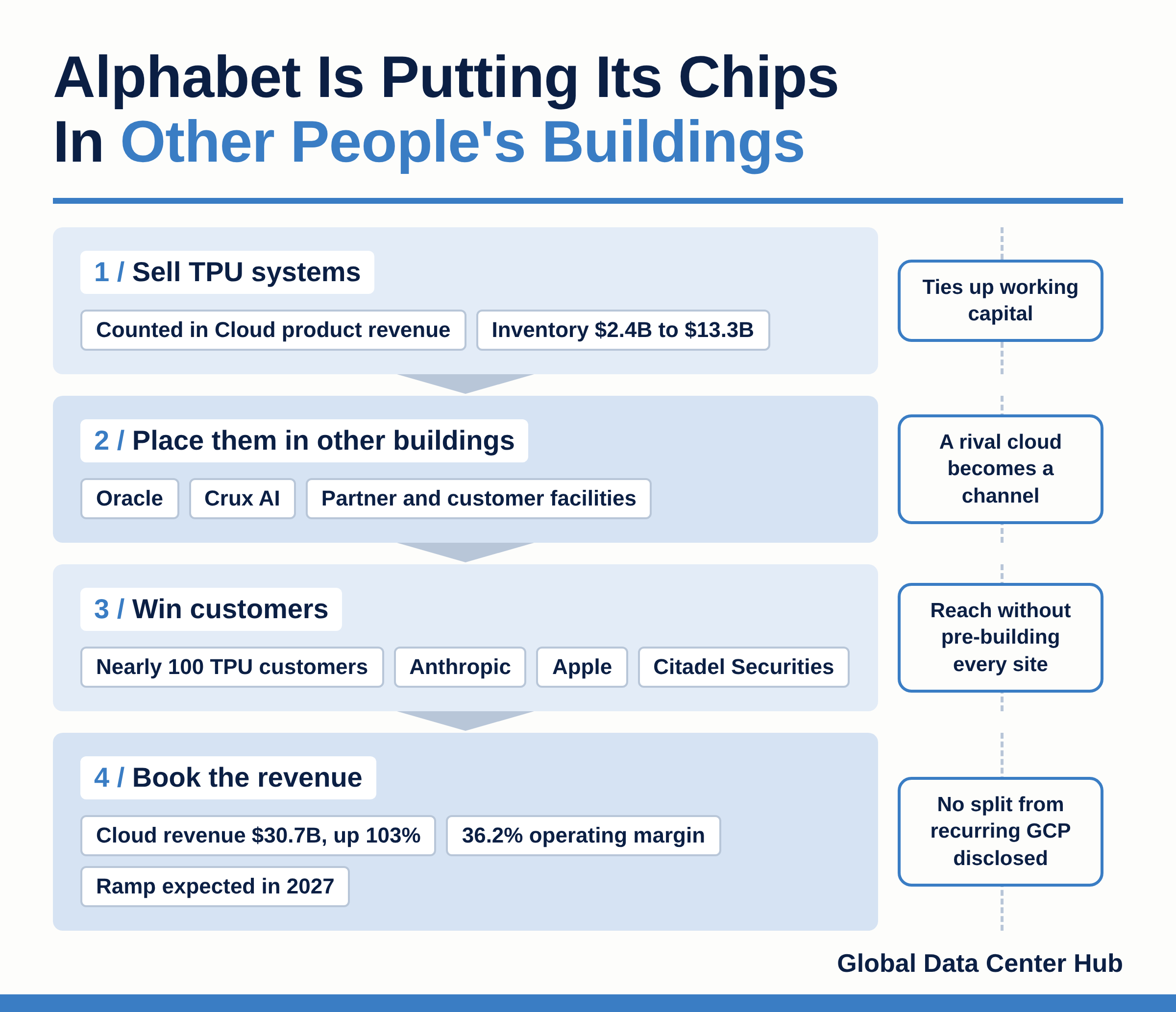
Google Cloud revenue rose 103% to $30.7 billion, ahead of expectations of about $28.7 billion, at a 36.2% operating margin.
Operating income rose from $3.6 billion to $11.1 billion. Cloud now accounts for about 24% of Alphabet’s revenue, up from about 15% a year ago.
The mix matters. TPU hardware sales now sit inside Cloud, and the release describes Cloud product revenue as “primarily from the sale of TPU systems.”
Management said GCP was “the vast majority” of revenue and that growth excluding TPU system sales was “again incredibly strong,” but it did not split the two.
Hardware revenue is lumpier and lower margin than consumption revenue, and it ties up working capital. Inventory rose from $2.4 billion at the end of 2025 to $13.3 billion as of September 30.
The strategic point is distribution. Nearly 100 customers now use TPUs, including Anthropic, Apple and Citadel Securities, and Google announced TPU system partnerships with Oracle and Crux AI.
Alphabet is putting its chips in other people’s buildings. That extends the TPU’s reach without Alphabet having to build every data center itself, and it turns a rival cloud into a channel.
It also ties part of Cloud’s growth to hardware shipments, which management expects to deliver a “meaningful revenue ramp in 2027,” rather than to recurring usage.
Backlog rose to $561 billion from $514 billion, and management expects just over 55% of it to convert within 24 months, up from just over 50%. Alphabet is renting third-party capacity to keep up, which management called margin-dilutive and “bridging.”
That capacity came online at the end of Q3, so its margin effect lands in Q4.
Search is the weaker engine. Search and other revenue grew 12% to $63.35 billion, below the $64.96 billion estimate and down from 17% growth in Q2. FX was the largest drag.
Management also cited lower monetization in AI Mode, even as query growth hit a five-year high. Usage is growing faster than revenue per query. That gap matters more now, because Services cash is what the build used to run on.
From Buying Back Stock to Selling It
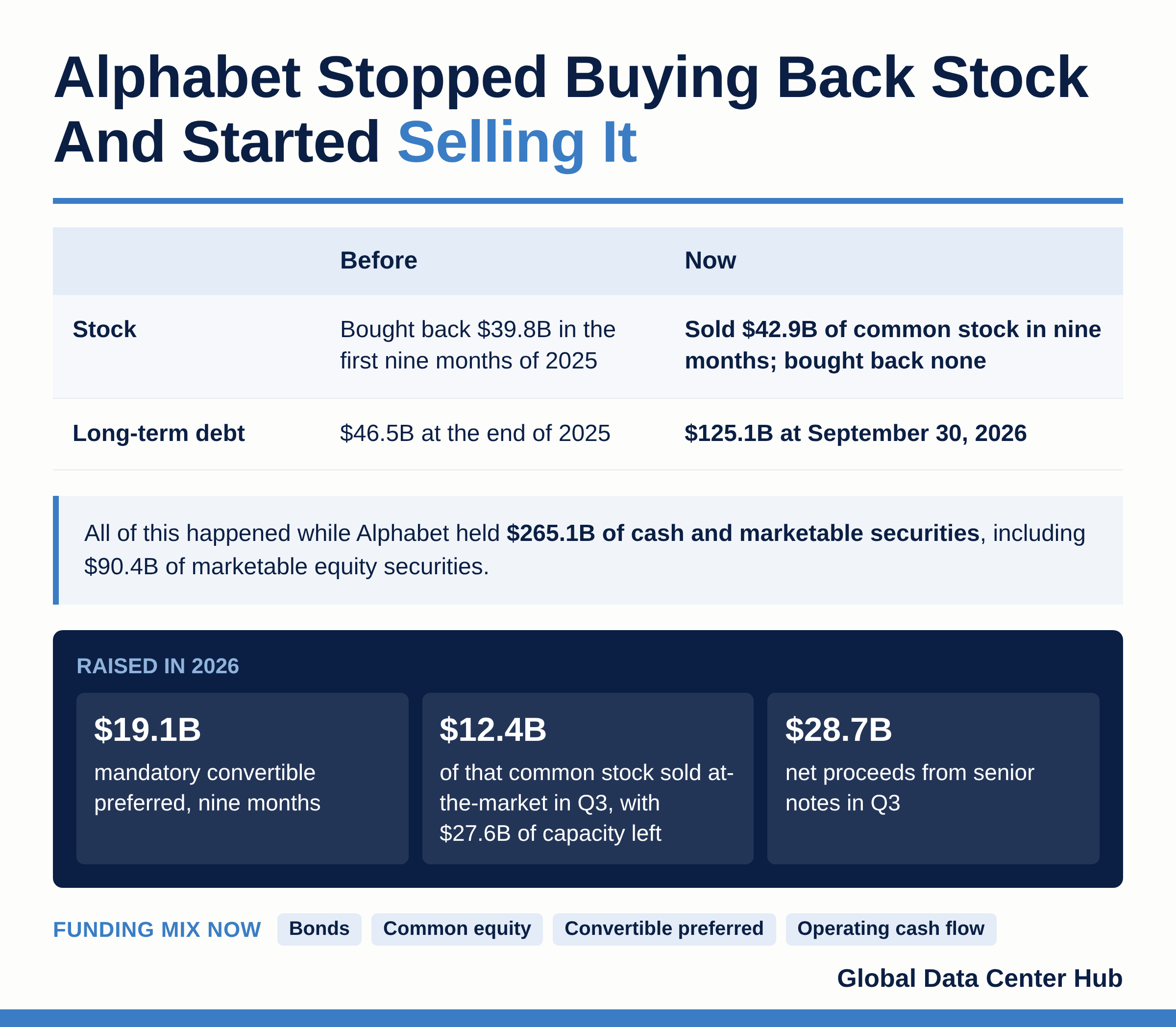
The capital allocation reversal is the quarter’s clearest structural change. In the first nine months of 2025, Alphabet bought back $39.8 billion of stock.
In 2026, it has bought back none. Instead, it sold $42.9 billion of common stock and $19.1 billion of mandatory convertible preferred, about $62 billion of equity in nine months.
Q3 alone included $12.4 billion through an at-the-market program, with $27.6 billion of capacity left.
Debt moved the same way. Long-term debt rose from $46.5 billion at the end of 2025 to $125.1 billion, including senior notes with $28.7 billion of net proceeds in Q3.
This happened while Alphabet held $265.1 billion of cash and marketable securities.
That figure includes $90.4 billion of marketable equity securities, so not all of it is cash available to spend. The disclosures do not explain the choice to raise money rather than draw down what it holds.
What they do show is the new shape of the build’s funding: bonds, common equity, convertible preferred, and operating cash flow together, with buybacks gone.
The asset mix raises the stakes. About 65% of capex goes to servers and networking with six-year lives, and 35% to data centers with lives of seven to 40 years. The short-lived share drives depreciation, which rose 49% to $8.4 billion in the quarter.
Alphabet is paying for six-year assets with permanent equity and multi-year debt, so servers must earn back their cost before they need replacing.
Nine-month capex was $132.0 billion, and the unchanged 2026 guidance of $195 billion to $205 billion implies $63 billion to $73 billion in Q4 alone.
The CFO said returns will remain “meaningfully above our cost of capital” and conceded that TPU inventory and capex “will put pressure on free cash flows.” There is no formal free cash flow target.
$924 Billion Committed, $561 Billion Booked
Alphabet disclosed $924 billion in future purchase commitments covering technical infrastructure, inventory, energy, and leases, plus $152 billion in pre-commencement leases and other obligations.
Against that sits $561 billion of Cloud backlog. Management noted that many contracts carry “variable pricing and volume flexibility,” so actual spend could come in lower.
Even so, the obligations are larger than the booked revenue meant to cover them.
On one side, Alphabet’s position rests on its own accelerator, sold to rival clouds and AI labs, with enterprise reach behind it.
Eighteen Cloud product lines each exceed $1 billion in annual revenue, and nearly 90% of the Fortune 100 use Gemini Enterprise.
Meanwhile, three pressures hit in the same quarters: rising depreciation from short-lived servers, lower margins from rented capacity and hardware sales, and slower Search monetization.
Each is manageable alone. Together they explain how free cash flow went negative while revenue grew 25%.
What the Funding Shift Means for the Wider Build
For data center operators and capacity providers, Alphabet’s numbers point to near-term demand. It is renting third-party compute and placing TPU systems in partner and customer facilities.
Some of the demand that once meant a Google-owned campus now flows to other operators’ halls.
For investors, hyperscaler capex is no longer funded by free cash flow alone.
When one of the most profitable builders issues bonds, common stock and convertible preferred in the same year, the pace of the build depends on credit and equity markets as well as on chips and power.
Energy is the other line to watch: the CFO named data center operating costs “such as energy” as a pressure on the P&L.
What Resolves Next
Three signals matter.
First, the 2027 capex figure and any free cash flow framework on the Q4 call; so far management has said only that spending will “increase significantly.”
Second, the Cloud margin once third-party capacity ramps in Q4, which shows what the bridge costs.
Third, the split between recurring GCP revenue and TPU hardware sales, which decides how much of Cloud’s doubling is durable.
The Bottom Line
Alphabet’s quarter was not a demand problem, and beyond an equity mark, it was not an earnings problem.
It was the quarter a company that bought back $39.8 billion of stock a year earlier started selling stock to keep building.
Capital structure, not the size of the capex number, now decides how far and how fast Alphabet can build.
The next leg of the AI cycle runs through the bond and equity markets.