

Welcome to Global Data Center Hub. Join investors, operators, and innovators reading to stay ahead of the latest trends in the data center sector in developed and emerging markets globally.
Edition No. 73
THE WEEK’S THESIS: BRING YOUR OWN POWER
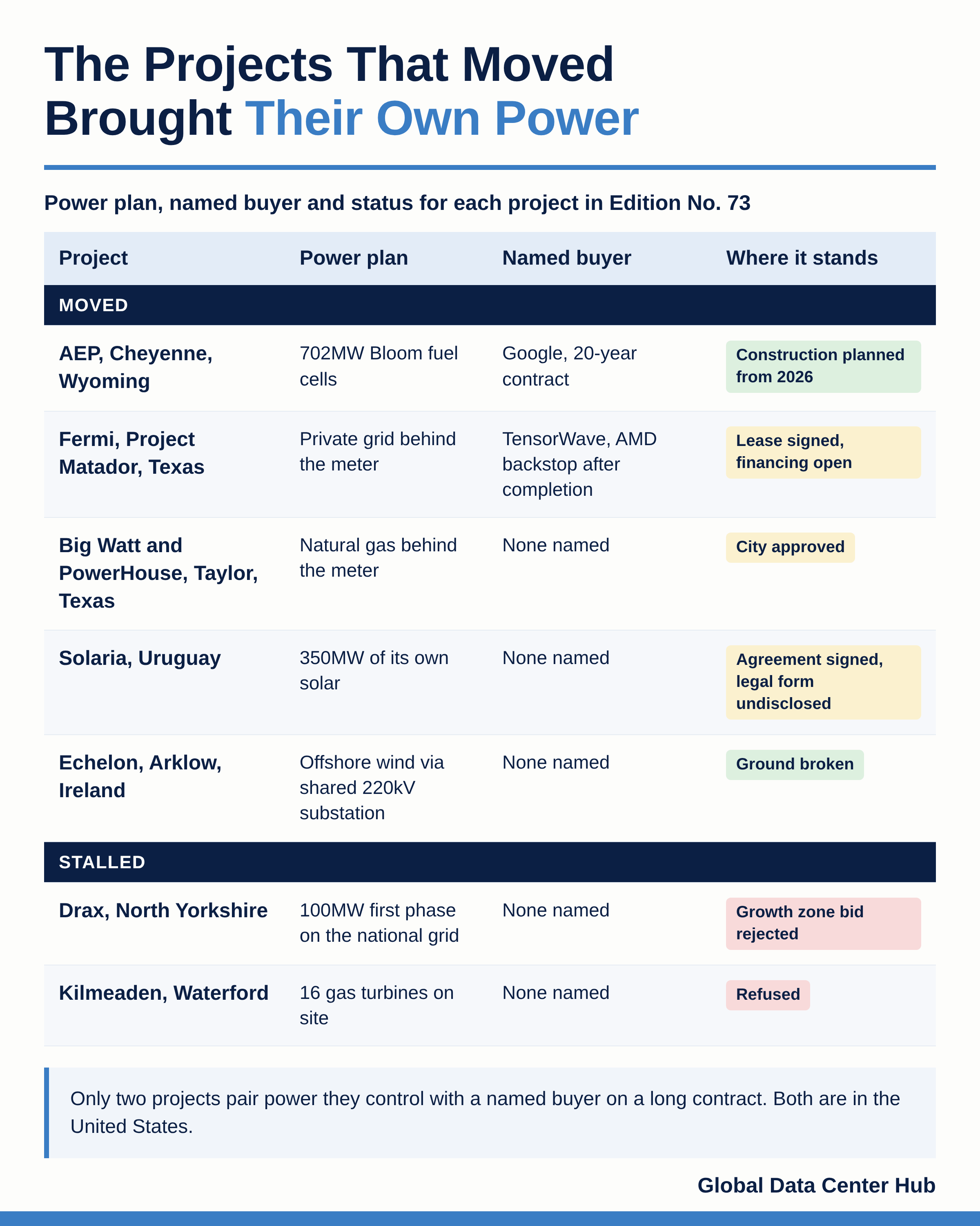
This week, the data centers that moved forward brought their own power plant. The ones that leaned on someone else’s grid, or on a thin energy plan, stalled at the planning vote.
The evidence runs across three countries. AEP is building a power plant for Google in Wyoming. Fermi’s Texas campus runs on its own private grid. The Taylor campus near Austin will burn gas behind the meter. Solaria’s Uruguay park comes with its own solar, and Echelon’s Irish campus taps offshore wind through a substation it shares with the wind farm.
The projects that stalled lacked that answer. The UK turned down a growth zone bid built around a Drax campus and named its energy plan as a gap. In Waterford, gas turbines on site weren’t enough to win consent. Owning the power is now the entry ticket, and the buyer behind it decides who gets financed.
The structure behind AEP’s deal is in The Mechanism below.
MARKET SIGNALS
Fink puts a recession on the table. BlackRock CEO Larry Fink spoke to CNBC on Oct. 14. “If we have a moratorium of some sort in this country, we will be in a recession,” he said. He blamed most of the opposition on misinformation, three weeks before the Nov. 3 midterms. The data center fight has moved from zoning boards to national politics, and the money is now arguing its side in public.
Microsoft prices chips in tokens per megawatt. Microsoft unveiled Maia 300 on Oct. 12 and says it expects 40% more tokens per megawatt than leading GPU-based systems. Production deployments start in 2027. That is the company’s own projection. When power is the scarce input, output per megawatt decides which chip fills the hall.
Digital Realty pays the neighbors. Digital Realty is offering every household in De Soto, Kansas, up to $1,000 a year for 10 years, KSHB reported. The credits cover property taxes or utility bills from a $20 million community fund. The city council holds a hearing on the project’s tax district on Nov. 19. Local consent now has a price per household, and it sits in the developer’s budget.
Malaysia’s approvals pile up. Malaysia approved 27 data center projects worth RM225.97 billion between February 2025 and July 2026, Bernama reported. Johor holds 16 of them and Selangor 10. Each must meet a 30% local content floor. The government is also reviewing how much power the sector actually needs, and that review sets how many more get through.
Humain goes to tender in Riyadh. Humain has issued a construction tender for a 100MW AI data center in Riyadh, MEED reported, with an option to reach 200MW. MEED puts the contract at ~$1 billion. The design calls for direct-to-chip liquid cooling and racks of 240 to 250kW. Bids are due Nov. 8, and they will show what Gulf contractors charge for halls at that density.
CAPITAL WATCH
Solaria and Uruguay. President Yamandú Orsi signed an agreement with Spain’s Solaria on Oct. 14 for a 500MW data center park and 350MW of solar. The government puts the total at US$5.7 billion, with the first 200MW phase due by 2029. Bloomberg reported before the signing that the deal would take the form of a memorandum of understanding, and no tenant is named. So the figure describes the park’s planned size, and no buyer has put cash behind it yet.
Hillhouse and TeraNova. Hillhouse Investment launched TeraNova DC, an India data center platform, the Economic Times reported. It plans to invest ~$12 to $15 billion and build more than 2GW by 2032. No sites or committed capital have been named. The first land deal will show whether the number is a budget or a headline.
Princeton Digital Group and its lenders. PDG is seeking a syndicated loan of up to $1.2 billion for its 198.8MW Johor campus, Bloomberg reported. The three-year facility also refinances existing debt, with HSBC, Maybank, OCBC, Standard Chartered and UOB as lead arrangers. A three-year loan on a long-lived asset means PDG will be back in the loan market once the campus fills.
Nscale and its Norway site. Nscale’s flagship site at Glomfjord, Norway, runs 6.4MW of a planned 30MW and sits about six months behind schedule, Bloomberg reported. Bloomberg cited cooling leaks, local rules, construction delays and a fire. The company is reportedly preparing an IPO at a valuation of up to ~$35 billion. Public buyers will price that listing on megawatts delivered, and Glomfjord is the first number they’ll ask for.
GLOBAL LENS: THIS WEEK BY REGION
North America: the county signs, the state still decides
Mason County, Kentucky, approved development and bond agreements on Oct. 13 for a ~3,000-acre campus, and Meta was named as the company behind it. The first phase is reportedly ~$10 billion, though the county judge-executive has cited $15 billion, WVXU reported. The deal runs through an industrial revenue bond lease-back, so the county holds the deed and Meta makes fixed payments in place of property tax. State incentive approval is still pending, and that vote now decides when the first phase starts.
Big Watt Digital and PowerHouse Data Centers won approval from the Taylor City Council for a campus in Williamson County, Texas. It covers 664 acres and up to 1GW. It will run on natural gas behind the meter, and the developers asked for no tax incentives. First power is targeted for the first half of 2028, and no tenant is named. Gas on site gets the campus around the grid queue, but it still has to find a buyer for the space.
Europe: own the power, then sign the tenant
Echelon Data Centres broke ground on what it calls Ireland’s first green energy park, at its Arklow campus in Wicklow. The €4.2 billion plan covers two data centers and a 220kV substation shared with SSE’s 800MW Arklow Bank Wind Park 2. On-site generation runs on HVO, a renewable diesel. Completion is set for 2028, but the wind farm is still in development. The campus now runs on a wind farm timeline it doesn’t control.
Nebius signed a letter of intent to be the first customer at Volt’s Port of Rotterdam AI campus. Volt plans 600MW across six buildings, and its first phase of two 100MW buildings costs ~€7 billion including compute. Eneco will supply power from offshore wind. The LOI isn’t a lease, and Nebius hasn’t said how many megawatts it will take. A signed lease is what Volt needs to finance phase one.
Asia-Pacific: India builds, but only one has a buyer
Colt DCS and RMZ began construction on a third data center at their Navi Mumbai campus. The 64MW building is fully pre-let to an unnamed hyperscaler. Contracted power and a 220kV substation are already secured. A full pre-let before the building goes up moves the leasing risk off the developers. The next test is whether the substation energizes on the hyperscaler’s schedule.
CapitaLand unveiled a 53MW data center in Chennai, with a planned investment of ~INR 1,940 crore. It offers 34MW of IT capacity across 13 halls and is due by the end of 2026. Its listed India trust and a dedicated data center fund own it jointly. The site was first planned for a 2025 opening, so it’s running about a year late. No tenant has been named, and the first lease will set what Chennai capacity rents for.
CONSTRAINT OF THE WEEK: THE PLANNING VOTE
The planning vote decided more projects this week than the power supply did. The UK government rejected the York and North Yorkshire AI Growth Zone bid, which centered on a Drax campus of at least 1.2GW. It said the bid fell short on credible energy delivery, environmental impact and local benefit. Drax now plans a 100MW first phase on the national grid, with a planning submission due in the coming months. That first phase is a twelfth of what the bid promised.
Waterford City and County Council refused permission for a data center and energy campus at Kilmeaden. The plan carried three data center buildings, 16 gas turbines, solar panels and a battery. The Irish Examiner reported that Echelon is also behind the project. On-site gas didn’t win consent, and any appeal now goes to An Coimisiún Pleanála.
The 150MW Norwich Apex Data Centre drew objections from local MP Ben Goldsborough and broadcaster Jake Humphrey within a week of its application. The Keswick site sits beside the protected Marston Marsh, and the plans include 72 rooftop chiller units. South Norfolk Council will decide. Once an MP objects in week one, the council vote turns political before the first officer report lands.
The next bottleneck is the ballot box. Amazon Web Services held an open house for an 18-building, 600-acre campus outside Trenton, Ohio. It also said it will stop asking local officials to sign NDAs. On Nov. 3, Trenton votes on Issue 17, a data center ban. A town vote can now stop a campus before any planning board sees it.
THE MECHANISM
A utility builds off its map for one buyer
American Electric Power is one of the largest US utilities, with 5.6 million customers in 11 states and about 33,000MW of generation. On Oct. 14 it committed ~$4 billion to a 702MW fuel cell plant near Cheyenne, Wyoming. Google will buy the output under a 20-year power purchase agreement. CEO Bill Fehrman said the plant serves needs “beyond our traditional service territory.”
The seller is Cheyenne Fuel Cell, LLC. AEP owns about 92%, and funds advised by Basalt Infrastructure Partners hold nearly 8%. Bloom Energy supplies fuel cells that make power from natural gas without burning it, and the plan adds carbon capture. Construction is planned to start this year, with full operation by the end of 2028.
That contract is what makes the plant financeable. No ratepayers stand behind this plant, so AEP’s return rests on one customer’s signature. For Google, a dedicated plant puts its power supply on a contract it controls.
The release gives no contract price. It doesn’t say who carries the gas cost for 20 years, or which permits the plant still needs. So, the risk sits with one buyer, one fuel and one fuel cell vendor, and the disclosures leave the fuel side blank.
NOTABLE TRANSACTIONS
Fermi: AMD credit support behind a $6.5 billion TensorWave lease
Fermi said on Oct. 13 that AMD signed a credit support agreement for its Project Matador campus in Carson County, Texas. The support backs TensorWave’s lease of 222MW of power and 156MW of critical IT. The lease carries $6.5 billion of contracted revenue over a 15-year initial term. The campus runs on its own private grid behind the meter.
What makes it notable is that a chipmaker now stands behind its customer’s rent. TensorWave runs a GPU cloud built on AMD chips, so the chipmaker is backing demand for its own product. It is rated A by S&P and A1 by Moody’s.
AMD’s obligations begin only after construction is complete and rent starts on the final phase. The support ends if TensorWave or its guarantor holds an investment-grade rating for 12 straight months. The amount isn’t disclosed. Until rent starts, Fermi and its lenders carry the construction risk.
What to watch is the project financing. Fermi calls the agreement a step toward it and lists financing as a risk. The first construction loan will show what a backstop that starts after completion is worth to lenders.
NeoAI Cloud: KRW600 billion financing for a 40MW Pohang AI data center
NeoAI Cloud closed KRW600 billion (~$445 million) of financing for a 40MW AI data center in Pohang, South Korea. SC Capital Partners joined as a key equity investor. The project loan closed on Oct. 7, and service is targeted for the fourth quarter of 2027.
What makes it notable is how much support sits under one small building. A pre-lease, a contractor’s completion commitment and regional public money all back the first phase.
The money splits into a KRW450 billion project loan and KRW150 billion of equity. Woori Bank and KB Kookmin Bank arranged the loan. North Gyeongsang put in KRW4 billion and helped bring KRW131.5 billion from the Regional Revitalization Investment Fund. NHN Cloud has pre-leased 16MW, half the IT load, and Hyundai E&C committed to complete construction.
What to watch is the 260MW second phase. Phase one leased half its IT load before completion. Phase two will test whether lenders fund a build more than six times larger on the same terms.
EdgeConneX and Stockland: 50-50 Australian venture with 450MW of power secured
EdgeConneX entered Australia through a 50-50 joint venture with Stockland, announced Oct. 14. The venture has secured 450MW of power for hyperscale campuses in Sydney and Melbourne. No capital figure, tenant or timeline was disclosed.
What makes it notable is that a listed property company takes half of an operating platform. Stockland brings land, development and project management. EdgeConneX brings hyperscale delivery.
The power came before the tenant. Further power applications and planning work are in progress. Chris Maher was appointed managing director for Australia.
What to watch is the first planning application and the first signed tenant. Either one will show what a half share in land plus power is worth to Stockland’s shareholders.
THE FRAMEWORK: WHO BRINGS THE POWER
Every project that moved this week had a power plan it controlled. The table sets each one against its buyer and where it stands.
THE QUESTION FOR NEXT WEEK
Does Fermi close the TensorWave lease by Oct. 31? That is the deadline the two companies set in September. A close would put the AMD backstop to work and open the door to project debt. Another extension would tell lenders the guaranty still isn’t settled.
If you are new to Global Data Center Hub, visit our Start Here page for more information about the newsletter.
If you found this newsletter useful, share it with a colleague.
Have a great week.
- Obinna