
Welcome to Global Data Center Hub. Join investors, operators, and innovators reading to stay ahead of the latest trends in the data center sector in developed and emerging markets globally.
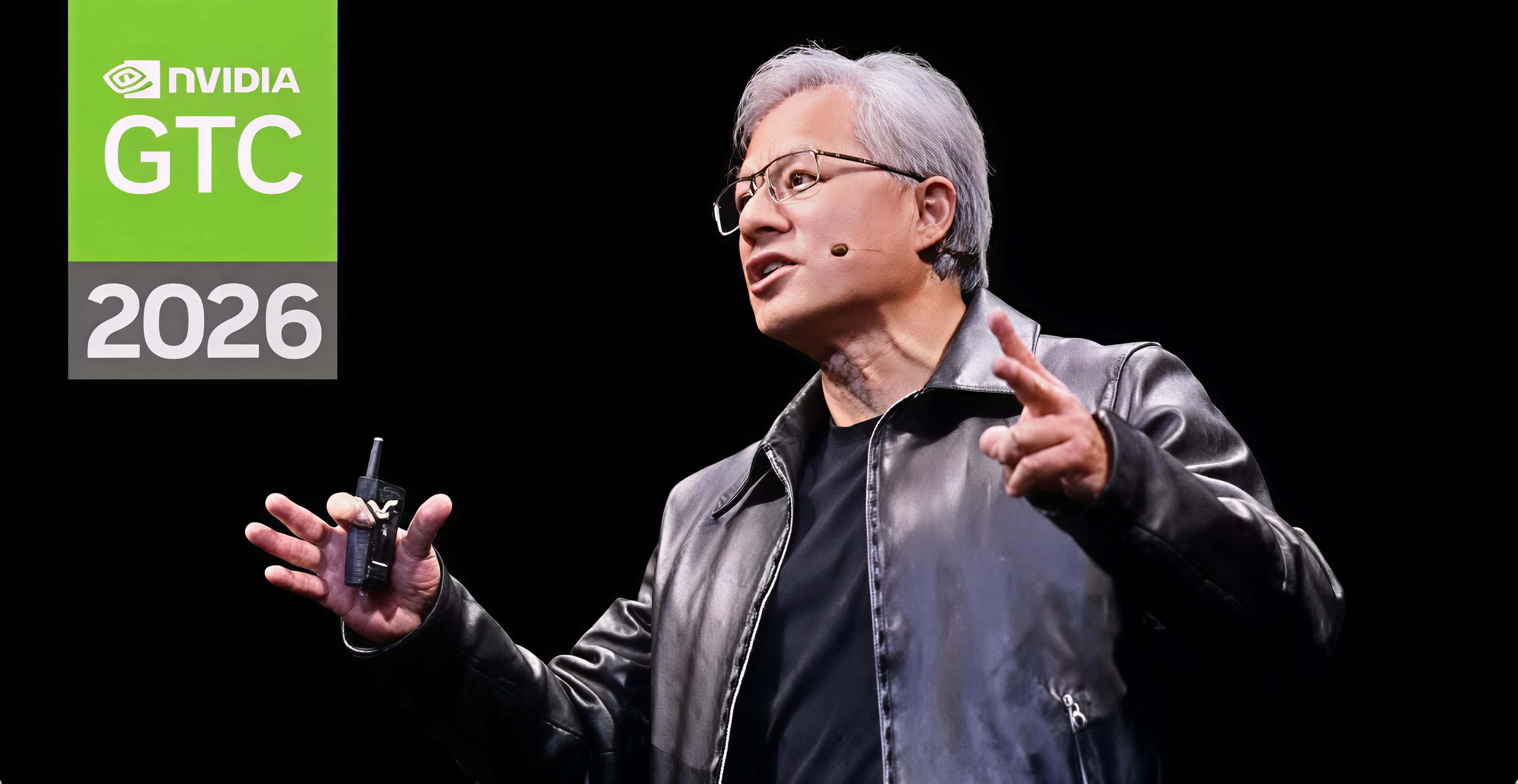
Jensen Huang used NVIDIA GTC 2026 to outline the next phase of compute: AI factories as production systems, inference as the economic engine, agent frameworks as the application layer, and physical AI as the next demand driver.
The keynote shifts the focus of AI infrastructure. It’s no longer about training models. It’s about how efficiently power, memory, and systems convert into tokens at scale, and how AI expands into enterprise, sovereign, and industrial environments.
Below are 19 takeaways from the keynote, outlining the shift from data centers to AI factories and what it means for infrastructure, performance, and scale.
1. The AI factory replaces the traditional view of the data center
Huang repeatedly described AI infrastructure as a factory whose product is tokens. That framing changes how operators, investors, and enterprise buyers evaluate capacity. Data centers are no longer just places to house IT. They are production systems with measurable output, efficiency, and direct revenue implications. Once that framing takes hold, power, throughput, token speed, and system utilization matter more than simple megawatt counts.
2. NVIDIA now frames itself around three platforms, not one
Most of the market still talks about NVIDIA as a chip company anchored by CUDA. Huang broadened that identity, describing three major platforms: CUDA-X, systems, and AI factories. This signals where value is moving. The company is not competing only at the silicon layer. It is defining the operating model for the full AI compute stack.
3. The installed base remains NVIDIA’s deepest moat
Huang emphasized that CUDA has been built over 20 years and now runs on hundreds of millions of GPUs and systems globally. That installed base creates a self-reinforcing cycle: developers build on it, algorithms improve, and new markets emerge. The advantage is not just performance. It is ecosystem gravity that compounds over time.
4. Structured enterprise data is moving into the AI era
A key theme was the role of structured data. Huang pointed to platforms like SQL, Spark, Snowflake, Databricks, BigQuery, and Azure Fabric as part of the next AI workload layer. Future agents will operate directly on enterprise data systems, embedding AI into core business processes rather than isolating it in experimental use cases.
5. Unstructured data is becoming economically usable
Huang argued that most new data is unstructured: documents, speech, images, and video. Historically difficult to query, this data becomes usable once models can interpret and retrieve meaning. That turns dormant information into productive assets and expands inference demand far beyond training and consumer applications.
6. Inference is now the central challenge
A major shift in the keynote was the emphasis on inference. Huang described it as both difficult and critical because it drives revenue. The last phase of AI focused on training and model development. The next phase depends on serving complex inference workloads efficiently, repeatedly, and at scale.
7. Tokens per watt is becoming a core operating metric
Huang framed AI factories as fundamentally power-constrained systems. Capacity does not scale with demand, so efficiency becomes decisive. Tokens per watt, token speed, and cost per token emerge as core metrics. This aligns data center economics more closely with manufacturing, where output per unit of input determines profitability.
8. System-level design now matters more than chip-level storytelling
When introducing next-generation systems, Huang moved away from highlighting individual chips. Instead, he emphasized fully integrated systems spanning compute, memory, interconnect, and software. The unit of competition is no longer the processor. It is the system and how it performs under real workloads.
9. Memory and context are becoming first-order constraints
Huang highlighted that agentic systems require more context, more tokens, and continuous access to memory. Structured and unstructured data, along with KV cache demands, are driving new constraints. Infrastructure is shifting toward larger memory footprints and architectures optimized for retrieval and context-heavy inference.
10. AI factories will be managed through digital twins
The DSX framework presented in the keynote shows how NVIDIA is approaching operations. Huang described a system combining simulation, operational data, and optimization. AI factories become software-defined environments where design, thermal management, power usage, and performance are continuously optimized.
11. Open agentic systems are entering the enterprise stack
Open Claw was introduced as a framework for building agentic systems that integrate tools, models, workflows, and multimodal inputs. Huang positioned it as foundational infrastructure rather than a niche tool. Agent systems are moving from experimentation toward standardized enterprise deployment layers.
12. Security becomes a gating issue for enterprise agents
Huang highlighted a core challenge: agents can access sensitive data, execute code, and interact externally. That creates significant risk. NVIDIA’s approach centers on secure, enterprise-grade architectures. Adoption will depend not only on model capability but on the ability to deploy AI safely within controlled environments.
13. Open models are now part of NVIDIA’s platform strategy
The keynote emphasized a growing ecosystem of open models across multiple domains. Huang noted that millions of models now exist across language, vision, and science. This expands access, drives utilization, and strengthens the platform by increasing the range of workloads that can run on NVIDIA infrastructure.
14. Sovereign AI is becoming a real infrastructure category
Huang connected open models to sovereign AI, arguing that countries and industries require localized models aligned with language, regulation, and strategy. This creates infrastructure demand tied to data localization, security, and domestic capacity. Sovereign AI becomes a structural driver of regional buildout.
15. AI is broadening beyond hyperscalers
Another theme was diversification of demand. Huang pointed to enterprises, regional clouds, sovereign clouds, industrial systems, and edge deployments. AI is no longer concentrated in a few hyperscale platforms. Demand is spreading across multiple customer types, creating a more resilient infrastructure market.
16. Physical AI is now a mainstream part of the roadmap
Huang framed robotics and physical AI as a core part of the next phase. AI systems will increasingly interact with the physical world, from factories to healthcare environments. This expands compute demand beyond traditional data centers into distributed and embedded systems.
17. Synthetic data and simulation are becoming mandatory for robotics
Huang stated that real-world data alone is insufficient to train physical AI due to complexity and edge cases. NVIDIA’s solution is simulation, synthetic data, and world models, expanding the role of compute in development. Robotics requires not just inference at deployment, but large-scale simulation and training upstream.
18. Robotics, automotive, healthcare, and industry are converging into one AI ecosystem
Across sectors, Huang presented AI as a shared infrastructure layer. Whether in finance, healthcare, autonomous vehicles, or industrial systems, the same underlying compute platform applies. This positions AI as a horizontal production layer, increasing both scale and lock-in across industries.
19. The center of AI value is shifting from models to infrastructure productivity
The deepest takeaway is the shift toward infrastructure efficiency. Huang emphasized throughput, token speed, system integration, memory access, and power efficiency as core determinants of value. The competitive advantage is no longer just model quality. It is the ability to convert compute into economically useful output at scale.
The new build equation
At GTC 2026, Huang effectively reduced the next decade of AI infrastructure to a handful of variables: power, throughput, memory, interconnect, orchestration, and security.
The next wave of data center advantage will not belong only to those who can add megawatts. It will belong to those who can turn fixed power into the highest-value token output, support increasingly dense and memory-intensive systems, run those systems securely, and adapt quickly as architectures refresh.
That is the practical meaning of the AI factory era.
Infrastructure is no longer adjacent to AI.
Infrastructure is the operating system of AI scale.